Like the MamaLand Empire!

Have you Liked the AliyahLand adventure?
      ...and sign up for weekly aliyah tips by email (it's free).

Showing posts with label ashkenazim. Show all posts

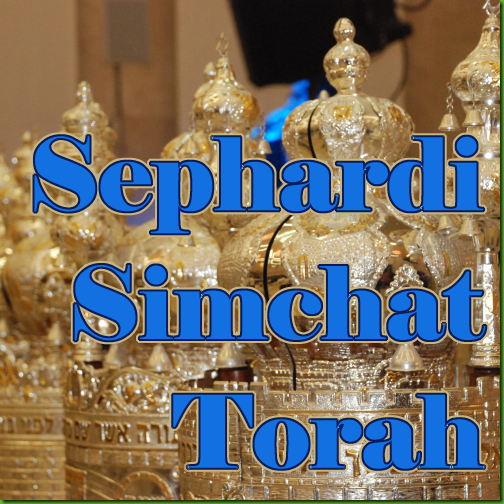
Tin-can dancing – Sefardi Simchat Torah style

image

Some epiphanies come later in life than others, or are only possible in Israel, when you realize that not everybody is Ashkenazi like you are.  One question I heard years ago about Simchas Torah has been echoing in my mind every year, ever since: why is it called “Simchas Torah”? 

(And, yes, in my head it’s still simchas Torah, with a ת/“sav” at the end of the word.  Pronounce it however you like when you read!)

A lot of people lazily refer to the day, when they refer to it in English at all, as “Rejoicing with the Torah,” but you probably suspect this isn’t correct if you know anything about the grammar of possession in HebrewWikipedia translates it as “Rejoicing of/[with the] Torah,” which I like because therein is the answer. 

The name of the holiday is rejoicing not WITH the Torah, but OF the Torah.  Once a year, the Torah rejoices and we, Am Yisrael, are its arms, its legs, its voice in song.

Why have I been thinking about this this year in particular?  Well, if you’re Ashkenazi, like I am, this picture is probably pretty close to what you think of when you think of dancing with a Torah:

image

(Skverer Rebbe photo credit Arit126 via Wikipedia)

This kind of Torah is like a baby, easy to dance with.  Just smoosh it flat against your chest and off you go, bobbling lightly and sedately around the shul.

But it turns out that we Ashkenazim are the only ones

A not simple time: the stolen Yemenite children

image

In Hebrew, instead of saying something in the past was "difficult" or "complicated," the phrase is softened a little.  They say, "it's not simple."

One such not-simple period is the stolen children of Yemen. 

Here's the nutshell:

When Yemenite Jews came to Israel in the 1940s and early 1950s, some children were often taken and given away to Ashkenazi families, some of whom were survivors of the Shoah.  Not all, and perhaps not even many; but some.  The actual number doesn’t matter.  There’s no number that would have been acceptable.

Sometimes, Yemenite parents were told that their children were sick and needed to be in the hospital.  I read the story of one man whose adoptive mother simply showed up at the hospital and was told, "Pick a baby."  His birth mother, like most of the Yemenite parents, was told that her child had died.

Having seen so many Ethiopian families trying to adjust to life in modern Israel in the years we’ve been here, I find it

On Rosh Hashanah, it’s BYOM (bring your own machzor)

image

Rosh Hashanah’s coming, so it’s time for a public service announcement. 

Things here in Israel are NOT the same as they are wherever you come from.  That includes shul on Rosh Hashanah and Yom Kippur.

You probably won’t need tickets, and I don’t know of any shul in Israel that will kick you out if you haven’t signed up ahead of time, but depending on the shul, they might not have a lot of space for you. 

Also, check around your neighbourhood carefully – the davening (prayer services) is very different in different types of shuls.  And I’m not just talking about Ashkenazi and Sefardi (Mizrachi) shuls. 

Yeshivas, for example, may have a longer, more drawn-out davening that’s enjoyable if you like something more spiritual, while “stam” Israeli shuls may have more of a “get in, get out, get home” type of approach.  Most shuls start at 8 am on yom tov, but the ending time really varies, from 10:30ish across the street from me to as late as 1 or 2 in some places.

(So if you’re expected somewhere for either of the lunch meals, it’s extra important to co-ordinate with your hosts so you get there when they want to start.)

If you’re new to your area, ask around to find out which shul is more likely to offer you the best experience.  That depends, of course, on what your criteria are.  Such as whether you like singing or prefer to avoid it at all costs, like at the shul across the street from me, where any necessary musical touches are grudging at best.

Also, if you’re a woman, ask other women – your experience might be very different from what a man would encounter in the same shul.

One thing you won’t get here that you may or may not be used to – calling out page numbers.  Most Orthodox shuls outside of Israel don’t do this either, but our shul in Toronto did because it had a kiruv (outreach) bent. 

5 surprises when you go to shul in Israel (with a helpful vocabulary list!)

image

Considering it’s called the Holy Land, and considering that so many of us move here for religious reasons, I guess it’s strange that I haven’t said anything about going to shul before now.

When my sister was here visiting last year, she also mentioned that she’d been all over the place but hadn’t set foot in a shul.

Life in Israel is like that.

Are you wondering what shul will be like when you make aliyah?  Here are 5 things that may surprise you when you finally get there:

1.  It’s not called shul.

This may be obvious to you, but then, you’re probably smarter than me.  Smart enough to put two and two together and realize that Ashkenazim like me, and our quaint Yiddish expressions, are not in the majority here.  (Us Ashkenazim tend to see the world through Ashkenaz-coloured lenses.)

Shul here is known as בית כנסת / beit knesset.  Everybody calls it that – even Ashkenazim.

Which is another thing, by the way:  in Canada, I grew up thinking of the Jewish world as divided into Ashkenaz and Sefardi.  It turns out we’re the only ones who call them Sefardim.  Here in Israel, these “eastern” / southern Jews are better known as “eidot hamizrach,” or “mizrachi” (which means eastern, go figure).

But within that “Sefardi” realm, there are so many different types of – uh-oh – shuls.  Just within a couple of blocks of here are Moroccan, Tunisian and Yemenite shuls.  Whereas, since we’re a minority, Ashkenazim tend to have the local “Ashkenaz” shul, and not have as much of a choice.  We’re black and white; they’re a whole entire rainbow.

And the truth is, if you accidentally say shul, everybody will know what you’re talking about.  I don’t even think you’ll offend anybody.  But that’s not what they call it.

Things that are cool in Israel #6: Jews of Diversity (where not every Jew looks just like you)

image

Did you grow up Ashkenaz in North America?  I did.

To be raised Ashkenazi in North America is to believe that every single Jew in the world looks pretty much… like you.

image

(this is NOT my Bat Mitzvah picture, but it might as well be.  The colour scheme was similar, but we didn’t make my father wear a tux.)

Coming to Israel has been the most wonderful kind of shock.

It turns out that shiny-white isn’t the only colour Jews come in after all.

It turns out that THESE are Jewish faces…

image

(even the white guy in the background)

And THESE are Jewish faces…

image

And THESE are Jewish faces, too…

image

(even the white guy in the background)

Of course, so are these…

Google