Like the MamaLand Empire!

Have you Liked the AliyahLand adventure?
      ...and sign up for weekly aliyah tips by email (it's free).

Showing posts with label sad. Show all posts

If you're overrun by ants in Israel, is it ANTY-semitism? (with helpful "bugs" vocab chart!)

Sigh. I wish it was a joke.
But alas, it isn't.

How are the ants where you live?
Growing up, I met two kinds of ants: black and red.

Black ants were friendly ants you could gather up and experiment with.  I wasn't the one with the magnifying glass, but these guys were slow and inoffensive enough that you could, if you were so inclined, corral them, then sizzle and pop them by magnifying the rays of the sun.

Red ants, well, you didn't want to mess with them, because there were rumours that they'd bite you.  But they were also shy ants, and if you kept out of their way, they'd mostly keep out of yours.

The creepiest ant incident in my entire childhood was one time, on a family trip, when my toddler sister sat down by the roadside (maybe we were stopping to fix the car in some way?) and then started shrieking because she'd sat on a massive anthill.
She was always doing stuff like that.

So presumably there were some aggressive ants within driving distance of our home.  But they weren't exactly a clear and present danger.

There were also certain facts I learned about ants.  Maybe you learned them too.  Spoiler alert: FACTS THAT TURNED OUT TO BE 100% WRONG HERE IN ISRAEL.
Facts like… Ants love crumbs

It's not Israel, it's YOU (and other ugly lies of aliyah)

"It's not Israel, it's you."

At least, that's what I tell myself sometimes.

"It's all your fault," I tell myself.
Most of these thoughts start with the words, "That's what you get..."

That's what you get for living in an older building, without a vaad bayit.  A building that isn't maintained.  A building where the tenants seriously don't care about anything as long as the thing doesn't fall down around their ears.  A building where the neighbours physically threaten us

Do American Jews get a vote in Israel?

If you hate politics, I get it.  Please move along.  Just skip this post.

When I started this site, I feel like I made a promise to you and to myself that I wouldn't get political.  If you want to know more of my thoughts on getting political, in a book that weirdly doesn't get very political, I urge you to read my book, Getting Political: Scenes from a Life in Israel.  (Hey, even if you don't want to know my thoughts, pick up the book anyway!  Seriously, it doesn't get very political...)

And yet.

And yet.

There are times when I feel like I have to get political.

Because when you move to Israel, you cease, in some important way, to be a "diaspora Jew" and become an “Israeli Jew.”

You live here, you walk the daled amos basically every single day of your life, you breathe the holy and sometimes stinky air.

You live with the noise, or block it out with a nonstop stream of English podcasts and audiobooks.

You vote in the elections.

And I don't even have a post I can link to about the elections, because I haven't talked about politics.

But just for a minute, I want to.  So please cut me some slack.
Because I came across this article about how the Canadian diaspora, and presumably, the rest of the diaspora, can influence Israel.

And it scared me.

Spoiler alert: the way that diaspora Jews can influence Israel, apparently, is to participate in the World Zionist Congress coming up in October.  In fairness, it's held in Jerusalem, so they

Why is Israel so noisy???

The noise in Israel drives me crazy sometimes.  There, I said it.  And I feel better for saying it.  And yes, it is specifically the noise in Israel.  Because Israel truly is an especially noisy place.

I used to just think we lived in a particularly noisy neighbourhood.  Luck of the draw, I figured.  Then I travelled around and realized that I do indeed live in a particularly noisy neighbourhood – and that neighbourhood is called the State of Israel.

You simply can’t get away from noise here.  So don’t even try.

Take our house, for example.  We live within walking distance of four schools, all of which, instead of school bells, play tunes and chimes (instead of school bells, like we had in Canada) so loud you can hear them blocks away.  GZ’s school routinely plays music for the kids’ enjoyment in the yard as they arrive in the morning, and you can hear that two blocks away as well. 

Then there are the happy routines of parades, celebrations, simchas, and special occasions, each of which

The horrifying truth about Lag Baomer bonfires


There's so much I love about the period between Pesach and Shavuos here in Israel.  But there's one thing that absolutely disgusts me.  I'll tell you in a minute and see if you feel the same.

When we lived in Canada, this time of year was pretty dull and featureless.  There's Pesach... Yom HaAtzmaut, if we remembered it... Lag Baomer, if we got our act together to get to a bonfire... and then Shavuos.

It was okay, but nothing special.

Here in Israel, it's a VERY special time of year, especially if you measure by how many days the kids have to wear white shirts to school.  In many religious schools, often kids are supposed to wear white shirts for Rosh Chodesh and any other special occasion... and these seven weeks give us PLENTY of those. 

My son's school also has them wear white shirts on Fridays, bringing the white-shirt days up to an uncountably high number:  two days for Rosh Chodesh Iyar, Yom Hashoah, a couple of Fridays, Yom Hazikaron, and more that I'm probably not remembering.  Some chains actually have sales on white t-shirts with school logos just to help parents stock up.

I love all these special days, especially Yom Haatzmaut, which comes smack-dab in the middle of the solemn sefirah period and means we can celebrate Israel's birth with music, which we don't normally listen to during this period (I'm aware that different people observe this different, halachically -- consult your rav for details if you're not sure).

But here's what I don't love. 

What I hate, if you'll allow me to use a strong word.  What disgusts me.

Lag Baomer

Nefesh b'Nefesh: How helpful are they AFTER you make aliyah?

One of my children will sometimes say, "You hate Nefesh b'Nefesh."  But nothing could be further from the truth.  Really.

So let's just say it straight out before I start here -- I love Nefesh b'Nefesh.  Adore them.

We have met and been helped by so many great people through Nefesh b'Nefesh (NbN).  I don't know what the aliyah process would have been like without them, but I'm sure it would have been quite a bit harder.

So that's the first thing.

The second thing, though, is that olim sometimes arrive with unrealistic expectations about what NbN is going to do for them.

At this point, I’ve met quite a few of these olim, and some, I’ll admit, actually do hate NbN. 

Feeling under the WEATHER...? Two things making me happy in the rain!

image

Feeling under the weather…?

And I do mean that literally, by the way.  I wouldn't blame you if you were.  We've had a LOT of weather to be under this winter so far.  The great news is that water levels in the Kinneret (Sea of Galilee) are on their way back up to where they're supposed to be, which is one measure of how relatively water-secure this country is.

[QUICK ASIDE FOR ISRAEL WATER LESSON!]

The Kinneret was once Israel’s main source of fresh water.  Today, thanks to desalination, it is apparently only responsible for 10%.  Still a considerable chunk.  Water level in the Kinneret is measured against 3 lines: 

  • UPPER RED = Full.  The level hasn’t reached this point since about 2002.
  • LOWER RED = Lowest “normal” level.  Below this point will have environmental consequences.
  • BLACK = Serious drought / environmental crisis.  The line dipped down below this round about October following 5 years of drought and insufficient winter rain.

image

(check a live version of this graph)

Oh, yeah, and because the whole lake is below sea level, the numbers run down – a “bigger,” i.e., more negative, number is WORSE, not better.

As you can see from this graph, we’re back above the black line thanks to this winter’s prodigious rain, but not all the way back up to that slightly more comfy lower red line. 

[END OF LESSON]

But while we're feeling flush (ahem) when it comes to water, we're also being deluged in a desert country that's ill-prepared to deal with an excess of water.  When it’s raining, the streets flood, programs and trips get cancelled, and it can be very dangerous to be out on the roads.

All of which means, it’s a lot better to stay home if you possibly can.  (Even though, without central heating, surrounded by dank concrete walls, it can get pretty miserable inside the house as well…)

So I wanted to share two things that I really

What’s the best age to make aliyah? (Spoiler: There isn’t one.)

image

What's the best age to make aliyah?  What's the worst age?  The truth is, there is no perfect age.  It’s always hard.

You read that right: making aliyah can be tough at any age, but I also believe it can be great at any age.  So much depends on you, and where you are in your life, and how flexible you are and ready for change and challenge (and growth, and we all know growth is painful!).

Yes, aliyah is tough.  HOWEVER.  Since there are no clouds without a silver lining, there’s always a flipside... so I thought it would be fun to put together three reasons it's tougher to make aliyah when you're older, along with three reasons it’s easier... and then the flipside: three reasons it’s tougher when you're younger and three reasons it’s easier. 

Whew!  It sounds complicated to explain, but I think it’ll be clear

My vacation in Mecca, or why I’m saying bye bye to Airbnb

image

I’ve always loved Airbnb, a site that made it super-easy for anyone and everyone to rent out their place and make a little money on the side (or a lot – I know for lots of people it’s an actual business at this point). 

But I abruptly quite loving them today, following the announcement that they’ll be blocking listings from Jews in disputed areas of the West Bank.

Why?  According to NGO Human Rights Watch, who undoubtedly has advised Airbnb every step of the way, it’s mainly because “Palestinian ID holders are effectively barred from entering” these areas (just as they can’t enter many parts of Israel).  Because the Palestinian Authority have utterly failed, since the initial hope of Oslo, to reach any kind of peace agreement – not tried and failed, but simply failed due to power hunger on the part of their leadership.

When I read about all of this this morning, frankly, I was astonished that I had an opinion at all.

I didn’t used to.

You have to understand that I was a very bad prospective olah, in that I didn't really know anything about Israel before we came here.

I probably couldn't have found Haifa on a map.  Let alone Beer Sheva, Netanya, Ramat Gan and a whole bunch of other towns that I now know as well as the suburbs where I grew up.

Which also meant I couldn't tell the difference, politically, between Chevron and Rechovot, between Efrat and Eilat, between Kochav Yaakov and Kochav Yair (okay, to be fair, even born Israelis get those two mixed up!).

I always figured that if I lived in Israel, the "situation" here would make a lot more sense.  I would know what "settlements" people were talking about and understand whether they were right or wrong and which were the good bits of the country and which weren't.

I’m a lot less naive now. 

But even so, I certainly couldn't claim to know more about how to fix the situation than anyone else.  So the fact that Airbnb, like the EU, is announcing that they have the answer, and that the answer is to label different parts of the country in different ways to call attention to the political situation… well, that’s astonishing. 

  • It’s astonishing that they

Our bad neighbour–a Yom Kippur story without a happy ending

image

There are a few things that make me sad here in Israel, believe it or not.  I’m about to tell you about THE thing that has made me the most miserable over the last 2-3 years.

EDITED TO ADD:  Before you read on, be aware – I was attacked on Facebook about some of the strongly negative thoughts I’ve expressed in this post.  I know it’s unlike me.  I’ll get back to the happy stuff soon, I promise – I am still in love with this country, don’t worry.  And I’ll share a couple of those negative comments below – just for fun.

I believe it’s important to share not just the good stuff.  Everyone who works in aliyah, whether professionally or just for fun, like I do, has a responsibility to present both the good and bad side of what goes on here, and I hope you know I always try to do that.  I love Israel, love aliyah, love our lives here -- but I'm also realistic and try to present the reality on the ground, not the rose-coloured glasses version some people claim is all they get before they arrive.

I’m saying this because I’ve gotten in trouble for posting negative stuff before.  Even though this site is about 90% gung-ho and positive, there are some people who simply won’t let you share your thoughts if they’re at all down.  If you’re one of those people, I suggest you st0p reading right now even though there’s an exciting bit with firetrucks a little further along.

So.  Still with me?

Good.

What's making me miserable these days is our neighbour.
We live in an almost completely religious neighbourhood, and he wears a kippah and you know, I wouldn't have been surprised if you told me before we moved here that there were evil, horrible people who wear kippahs.  I would have said, "Of course there are."  But meeting one in person is just making me sad, sad, sad.  It's bringing down my whole experience.

He plays music.  Super, super loud music.
We're on the ground floor.  In an apartment which is nearly perfect in terms of almost all

Canadian doctor Tarek Loubani shot near Gaza: A Canadian in Israel responds

image

You know what this blog post was going to be about?  Volunteers.  And about how Israel doesn't appreciate volunteers who come here from places like United States and Canada. 

It’s an important topic, right?  Too bad that’s not what I ended up writing about.

Volunteers are people of all faiths and all ages who don't have to come here, and who work for organizations like Sar-El (which places volunteers on military bases), on farms, in schools, all over the country.  They must contribute millions of dollars to the Israeli economy, which is absolutely fabulous.

I was talking someone a couple of weeks ago who had been here volunteering on farms for two months, and she started telling me about how she and the others were forced to work half a day on Yom HaAtzmaut, while the farm's owner slept in, then lounged around the house with friends and family (later, the volunteers were invited to join the BBQ -- once they were done work).  She noted that the paid migrant workers weren't in the fields... probably because it's illegal to make them work on a national holiday.

Volunteers can work whenever they want, I guess.

That made me mad, and I also, somewhat guiltily, realized that my daughter has had a volunteer from the U.S. teaching English in her school this entire year and I hadn't even met her, let alone thanked her (she's been working one-on-one with some of the native English speakers), until someone invited her to our Lag Ba'omer BBQ.  So I felt bad that she's been in the country so long and probably barely acknowledged by the community, and finally, belatedly, invited her over.

Like I said, that's what this blog post was going to be about. 

Because seriously, with the feeling towards Israel in North America these days, it's not at all obvious that someone would come here to volunteer, paying their own airfare and often also paying to volunteer, just so they can show up and be ignored at best and their goodwill abused at worst.  Israelis probably see volunteers as "freyers," suckers who are easily conned and therefore aren't worth very much.

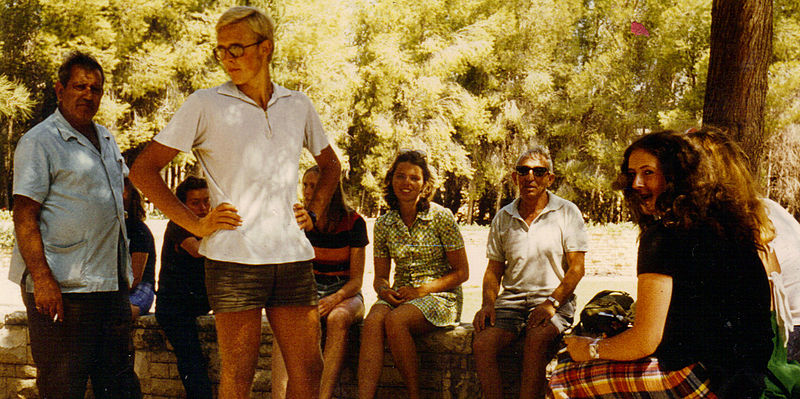
File:Flickr - Israel Defense Forces - Sar-El Volunteers at Lebanon Border (4).jpgFile:Austrian Volunteers in Ein Hashofet July 19731.JPGimageimage

(All freyers????  L-R: Sar-El volunteers 2012 photo © IDF via Wikimedia; Austrian Kibbutz volunteers 1978 photo © Robert Schediwy via Wikimedia; American volunteers at Masada meeting George W. Bush 2008 © White House via U.S. National Archives; Farm volunteer © WWOOF Israel)

I wanted to write about that because I was mad.  But then…

Then I saw something that made me even madder, and also -- I found out about people who abuse their volunteers even more than Israel does:  Gaza.  Or rather, Hamas, its quasi-elected dictatorship.

Gaza has had a humanitarian crisis over the last few years due to its leadership's terrorist policies.  Hamas is a government that's in power on a one-plank platform: eliminate Israel.  Once elected in 2006, they dismantled electoral operations so nobody could un-elect them and proceeded to take money out of children's and families' pockets and dedicate it to building terror tunnels and rockets with which to bombard nearby Israelis.

Hamas may be many things, but they're not stupid.  So in addition to these operations, they have poured a ton of work into the PR battle for the hearts and minds of the world.  It's a humanitarian crisis, they weep to the world, which is absolutely, 100% true.  And then, they point to Israel.  That's the whole PR thing: point to the crisis, point to Israel.  Repeat until hearts bleed and journalists cry.  It doesn't take much to make journalists cry, especially if there are pictures of children.

But courting NGOs and liberal media outlets is easy, hardly a challenge anymore.  Like I said, they cry easily.

So if I was in charge of the Hamas PR machine, then the thing that I would want most of all, more than anything else in the world, is a Canadian. 

The world loves nobody more than a Canadian.

To the world, Canadians are innocent, naive, the ultimate freyers, really.

Yup, that’s what would head up my wish list: A nice Canadian frayer, a volunteer who could

Nine (9) things I wouldn't have to tell a Canadian neighbour

image

I get alarmed sometimes, living in Israel.  There truly are moments when I just look around and realize we’re living somewhere utterly foreign, and I ask myself what we think we’re doing here, when it is so, so painfully clear that we don’t belong… such as when we have less-than-pleasant encounters with various neighbours in our building.  Sheesh.

This is a neighbourhood full of “characters,” and sometimes it’s fun and you can laugh it off.  But sometimes, you just want to cry and wish everybody could be Canadian, so you wouldn’t have to fill them in on the basics, such as…

1. Turn off your music -- it's 2 a.m. and I'm trying to sleep.

Israelis are sometimes strange about noise.  I have a personal theory that because it's such a small country, and you really can't get away from other people, they don't even bother trying.  There are no boundaries.  "If I feel like listening to music, then you feel like listening to music," is pretty much how many Israelis feel about their tunes. 

Also, this particular neighbour is a weird, too-thin skittish little guy who you just figure has got to be on a pile of something addictive, though obviously, we have no proof.  His behaviour has been pathological in the past. 

The fun part is him trying to convince us that this is what Israel is like, and if we don't like it, we should go back to Canada, where people are quiet and polite.  Which brings back memories of calling the police on inconsiderate neighbours in a few different situations... and, yes, of having them called on a party I held at one point.

But I think one difference is that this guy doesn't care, he'll just turn it right back on after the cops leave, just to show me he can.

2. That's not music, it's cats yowling.

I may not be the best candidate to move to the Middle East.  Some people really enjoy "Mizrachi" music, the swirling, wailing sound of notes that go up and down seemingly at random.  Then again, some people like chummus, which tastes like dirt paste.  Okay, to be honest, everybody here likes chummus—with a passion.  Except me.

I want to show up outside this neighbour’s door at 7 a.m. with

Do you know how to protect yourself on Jerusalem’s sidewalks?

image

This is actually more of a public service announcement than a blog post.  Know what the biggest threat is to pedestrians in Jerusalem?  From what I’ve learned this week it definitely isn’t terrorism… it’s slippery sidewalks.

Yup, those fabulous shining stone walkways that make Jerusalem look so lovely for so much of the year… are apparently (almost literally) deadly.

If you’ve ever walked through the Old City at night in the rain, you probably figured that already.  But maybe, like me, you thought you were the only one.  Nope, nope, nope.  If you’ve ever stopped yourself from running for a bus in our nation’s capital because you were scared you’d slip and fall and break your neck… it turns out you’re not alone.

Except some people aren’t just afraid of falling.  They’ve actually fallen, and maybe not suffered

Are you ever too old to make aliyah?

image

I'm no spring chicken.  Are you???

I've always been amused by the fact that we happily admit that someone's "no spring chicken," but at no point in their life does anyone admit to actually being a spring chicken.  We only use it to define what we and others are not.

But if you, like me, are no spring chicken, then aliyah is going to present you with some special challenges.

Last week, I asked readers to share their biggest aliyah questions with me.  I was surprised, amazed, touched - you choose the right word - at how many did.  And at how many different questions there are.  So much for my big idea of offering advice.  It's humbling sometimes how little I know.

A few questions that keep coming up again and again, sometimes in slightly different form, are:

How can I make aliyah at my age?  Will it be too hard?  Can I do it?  Will I be okay?

I'm not going to lie to you.  When you are no spring chicken (like me!),

What is Yom Yerushalayim, and why do we need it?

image

What are you up to this week???  Here in Israel, we’re still celebrating.  It’s like one non-stop party at this time of year, which was so bland back when we lived in Canada.  And this time, it’s one of the strangest holidays of all: Yom Yerushalayim (Jerusalem Day). 

This is it – the Big 5-0, and the city is all geared up with so many different kinds of celebration.  Every school in the country, pretty much, is organizing tiyulim to the Holy City, and the place is mobbed with the usual tourists plus some.

I was there, with my son’s school.  We had a great time, but it was a heartbreaking time as well, and here is why:  Jerusalem is so far from being perfect it’s not funny.  Jerusalem is so far from being perfect that I could cry.

imageimage

At the seder each year, we sing, לשנה הבאה בירושלים / leshana haba’ah bi’Yerushalayim – “Next Year in Jerusalem.”  We sing this even if we are lucky enough to be in Jerusalem, because the last word is הבנויה / habnuya – Rebuilt. 

The Jerusalem that we have is a miracle.  It is a beautiful, busy, living, crazy balagan of a city and I love it.   I love the fact that the country just turned 69 years old, and its capital is only 50 – this shows that you can’t take even a capital city for granted here, since we had to do without it for 19 years.

Yes, a miracle indeed. 

image

(photo credit: IDF via Wikimedia)

The Jerusalem we have today is truly many things… but it is not yet rebuilt.

This year, we’re celebrating 50 years since the liberation of Jerusalem from Jordanian hands, putting it in Jewish control for the first time in thousands of years.  But walking the streets of Jerusalem, the city does not yet feel free.

Driving past the Damascus Gate (Shaar Shechem), the Palestinian Bus Station, the police standing guard across from Givat Hatachmoshet, the Dome of the Rock and Al-Aqsa, the scars, mostly invisible, that have been inflicted on this city and its people since it was liberated… well, these things are more than heartbreaking.  They are like a slap in the face when everybody’s coming to celebrate.

But this is the reality.

British media: Covering up murder, as usual

image

It’s tragic when anyone dies in a terror attack.  But last week’s murder by a Palestinian attacker of a British student in Jerusalem provides an opportunity to view the “local angle” – the British take on what exactly happened.

We all know the truth isn’t pretty – at least, until the British start telling it.  These three media reports are typical in that they sidestep the truth, leaving huge gaps when talking about who exactly committed the murder.

First, we have The Guardian:

Headline:  “Jerusalem stabbing: British student, 20, killed close to Old City”

Paragraph 1:  “British victim of a fatal stabbing”  (who did it?)

Paragraph 2:  “killed on Friday” (by whom?)

Paragraph 3:  “The attack, which police said involved a Palestinian assailant with a history of mental health issues” (involved?  was there anyone ELSE involved?  who exactly did it???)

Later in the article:  “A wave of unrest that erupted in October 2015 has claimed the lives of 260 Palestinians, 41 Israelis, two Americans, one Jordanian, an Eritrean and a Sudanese...”  (erupted?)

Blah.

Next up is Sky News:

Headline:  “British student Hannah Bladon's family 'devastated' by her killing in Jerusalem”

Things that are weird in Israel #17: Bread, bread, everywhere.

image

This picture is sadly pretty typical for our neighbourhood.   There is bread on the ground, on sewer covers, almost literally everywhere.

image

Luckily, I knew about this before I came to Israel.  According to halacha, you’re not supposed to throw away useable bread – which is defined as anything bigger than a kezayis (olive-sized piece) worth.  (This may apply to other food as well.)

What this means, in practice, is that all over Israel, instead of throwing away bread, people leave it out (as seen here), or leave it in plastic bags, hanging from recycle bins, dumpsters, and other public spots while the contents get moldy, slimy, and disgusting.

Ostensibly, if it’s laid out like this, then people are feeding animals (presumably birds?) with it, rather than wasting it.  But the birds here are kind of picky, and judging from the mold on these rolls, not all that interested in everybody’s cast-off crusts.

I believe it’s a very good thing to think of bread as something special, as something holy, even.  We should put in time and effort to make it.  We should make it as healthy and delicious as possible, and savour it while we’re eating it.  Bread is absolutely one of the holy things.  Mahatma Gandhi said “There are people in the world so hungry that God cannot appear to them except in the form of bread.”

But you know what’s holier than bread?  Israel.

Duh.

Explaining Israel: What the heck is going on here???

image

Do you know how to explain “the situation” in Israel if you had to?

If so, good for you.  I mean it.  I couldn’t – up until very recently.

Maybe you’re a keen Israel advocate, but I never have been.  I mean, I liked Israel, I thought in some vague and Biblically-informed way that we had a right and indeed a halachic obligation to be here.  But if you’d asked me about specifics, I would have been mighty short on details.

Which was why I was surprised when a friend sent me a link the other day to a typical article, at the BBC website, with the headline, “Israel postpones vote on new Jerusalem settlement homes.”  And she asked for my “take” on the situation.

The surprising part – to me, at least – is that I actually DO have a “take” now.  That’s strange because I’m not a “politics” person.  Never have been.  I avoid news if I can help it at all, and perhaps articles like this, shallow and lazy, are one reason why.  But when I sat down to share my views, I realized I needed to share a whole lot more by way of background. 

So I started to type, and this is what I got…

The Truth About Israel and the Middle East

I actually thought the situation in the Middle East would all become a whole lot clearer “on the ground,” you know; once we lived in Israel it would all make sense. I laugh now at how naïve that belief was.

Still, at least I do know some things, and I do have a “take,” for what it’s worth.


First of all…

Nobody wants to build where anyone lives, but it's a small country and we're all very close together. As Harper said when he was here, it is surprising (and probably feels very wrong) that Ramallah, capital of the Palestinian Authority (PA) region, is less than half an hour from Jerusalem. So things get a little squishy sometimes.


Second of all…

None of this has anything to do with Arabs who live in the non-disputed borders of Israel, squishy as it is. They are full Israeli citizens and enjoy – on paper and in many cases in reality, though I will admit that the reality isn’t 100% where our dreams are – full rights and privileges of citizenship, including health care and the right to celebrate the end of Ramadan in front of me in line at McDonald’s in our local mall so we have to wander around looking for seats and muttering, “what kind of Jewish country is this…” only because we are so obviously in the minority here in the North.

That’s not what the media mean when they say “Palestinians.” What they mean are the cousins of those Arab Israelis who live under the authority of the PA, formerly known as the Palestinian Liberation Organization (PLO), the terrorist organization.

For a while, they were considered “peace partners”

Does terror in Europe mean the world has gone mad?

image

Does terror in Europe mean the world has gone mad?

Not unless you’re blaming the victims.  And you’re not doing that… or are you?

OK, sorry; probably you are.

Others have said this more eloquently than I, but I can’t sit silently snoozing through what I’m seeing. Here is just one of many memes going around Facebook last week.

image

Source: Twitter

The commentary seems to be of the opinion – and yes, people have actually said this – “The world has gone mad.”

Here’s just a random sampling – these all came up when I searched Google for “Aleppo, Zurich, Berlin,” and I don’t know any of these people personally.

imageimageimageimageimageimageimageimageimageimage

That’s a whole lot of solidarity.  So why does everybody seem to think the world has gone mad?

Because terror has left its nice cozy boundaries.

Where are those boundaries?  Well, you know, the dangerous places, where presumably, it belongs.

I think we all do this to some extent.

Since 9/11 the world has experienced the same thing, to varying degrees, in just about every country I can think of. The Hype cachere incident in France was just one of a number of attacks around the world that stood out. For me and those I know, the 2014 incident in the parliament buildings in Ottawa struck home since the person who did it was a convert to Islam and could have been anybody’s neighbour. Then there was the attack in Nice earlier this year.

(Okay, I have to share the following tasteless meme…)

Weird, wacky, wonderful (Hebrew) words: שַׁלֶּכֶת/ shalechet

image

It’s way too early to be thinking about fall, but there you go – that’s what I’m thinking about.  I accidentally put on my “Elul Hebrew Songs” playlist before Shabbos and ended up listening to a whole bunch of pre-Rosh Hashanah songs and getting into THAT kind of mood.

And with all these songs comes a word that comes up all the time in the fall in Israel that I had never really even thought about before… שַׁלֶּכֶת/ shalechet.

Morfix translates the word as “fall (of autumn leaves) ; (botany) exfoliation.”  Google, as “autumn, fall, or effoliation.”  But you’ll have to take my word for it – nobody says this in English the way Israelis do here, with its many heaped-on layers of meaning.

This is a lovely word that is a haiku unto itself.  It means, vaguely, “fallen leaves on sidewalks.”  But it also refers to the crunchiness of the leaves and the mood of the leaves and the ending-and-transitioning that is fall and even, kind of, winter in Israel, which isn’t really a season but more a dampness that descends for a while and then lifts.

It’s certainly not just “falling leaves” – because when people want to talk about falling leaves, they say עלי שלכת/alei shalechet, which would be redundant if shalechet was all about leaves.

Google