Like the MamaLand Empire!

Have you Liked the AliyahLand adventure?
      ...and sign up for weekly aliyah tips by email (it's free).

Showing posts with label yerushalayim. Show all posts

My vacation in Mecca, or why I’m saying bye bye to Airbnb

image

I’ve always loved Airbnb, a site that made it super-easy for anyone and everyone to rent out their place and make a little money on the side (or a lot – I know for lots of people it’s an actual business at this point). 

But I abruptly quite loving them today, following the announcement that they’ll be blocking listings from Jews in disputed areas of the West Bank.

Why?  According to NGO Human Rights Watch, who undoubtedly has advised Airbnb every step of the way, it’s mainly because “Palestinian ID holders are effectively barred from entering” these areas (just as they can’t enter many parts of Israel).  Because the Palestinian Authority have utterly failed, since the initial hope of Oslo, to reach any kind of peace agreement – not tried and failed, but simply failed due to power hunger on the part of their leadership.

When I read about all of this this morning, frankly, I was astonished that I had an opinion at all.

I didn’t used to.

You have to understand that I was a very bad prospective olah, in that I didn't really know anything about Israel before we came here.

I probably couldn't have found Haifa on a map.  Let alone Beer Sheva, Netanya, Ramat Gan and a whole bunch of other towns that I now know as well as the suburbs where I grew up.

Which also meant I couldn't tell the difference, politically, between Chevron and Rechovot, between Efrat and Eilat, between Kochav Yaakov and Kochav Yair (okay, to be fair, even born Israelis get those two mixed up!).

I always figured that if I lived in Israel, the "situation" here would make a lot more sense.  I would know what "settlements" people were talking about and understand whether they were right or wrong and which were the good bits of the country and which weren't.

I’m a lot less naive now. 

But even so, I certainly couldn't claim to know more about how to fix the situation than anyone else.  So the fact that Airbnb, like the EU, is announcing that they have the answer, and that the answer is to label different parts of the country in different ways to call attention to the political situation… well, that’s astonishing. 

  • It’s astonishing that they

What is Yom Yerushalayim, and why do we need it?

image

What are you up to this week???  Here in Israel, we’re still celebrating.  It’s like one non-stop party at this time of year, which was so bland back when we lived in Canada.  And this time, it’s one of the strangest holidays of all: Yom Yerushalayim (Jerusalem Day). 

This is it – the Big 5-0, and the city is all geared up with so many different kinds of celebration.  Every school in the country, pretty much, is organizing tiyulim to the Holy City, and the place is mobbed with the usual tourists plus some.

I was there, with my son’s school.  We had a great time, but it was a heartbreaking time as well, and here is why:  Jerusalem is so far from being perfect it’s not funny.  Jerusalem is so far from being perfect that I could cry.

imageimage

At the seder each year, we sing, לשנה הבאה בירושלים / leshana haba’ah bi’Yerushalayim – “Next Year in Jerusalem.”  We sing this even if we are lucky enough to be in Jerusalem, because the last word is הבנויה / habnuya – Rebuilt. 

The Jerusalem that we have is a miracle.  It is a beautiful, busy, living, crazy balagan of a city and I love it.   I love the fact that the country just turned 69 years old, and its capital is only 50 – this shows that you can’t take even a capital city for granted here, since we had to do without it for 19 years.

Yes, a miracle indeed. 

image

(photo credit: IDF via Wikimedia)

The Jerusalem we have today is truly many things… but it is not yet rebuilt.

This year, we’re celebrating 50 years since the liberation of Jerusalem from Jordanian hands, putting it in Jewish control for the first time in thousands of years.  But walking the streets of Jerusalem, the city does not yet feel free.

Driving past the Damascus Gate (Shaar Shechem), the Palestinian Bus Station, the police standing guard across from Givat Hatachmoshet, the Dome of the Rock and Al-Aqsa, the scars, mostly invisible, that have been inflicted on this city and its people since it was liberated… well, these things are more than heartbreaking.  They are like a slap in the face when everybody’s coming to celebrate.

But this is the reality.

Did you forget to call us on our special day? (Please call!)

image

It’s not too late, in case you were thinking of picking up the phone.  You’ve still got a few more days.

What?  You weren’t??  Why not???

If you’d normally call someone on their birthday or anniversary, why not call all your Israeli friends and family on Yom HaAtzmaut and/or Yom Yerushalayim?

Go on, pick up the phone.  It’s easy, cheaper than ever; it only takes a few minutes, and means so, so much.

Usually when I speak to family back home in Canada around these special events, which always fall between Pesach and Shavuos, and I mention a holiday, they usually say something like, “Oh, yeah… it’s, um, is it Lag Baomer?”  (Which, to be fair, it sometimes is and sometimes isn’t.)

And they’re absolutely right to be ignorant about what’s going on here.  You really don’t feel Yom HaAtzmaut or Yom Yerushalayim outside of Israel unless you’re immersed in a tremendously Zionist context where people are going to extremes to deck the halls.  That “Oh, yeah,” reaction – well, I don’t blame them.  If you’re just going about your life, it’s a little much to expect you to remember a minor, modern holiday in a country far away.

And yet… every year, I wake up on March 1st knowing it’s my sister’s birthday.  There’s no sign of it in the weather, in the air, posters on the walls, sales in the malls, or fireworks anywhere I go.  (I picked this sister deliberately, and not my mother, who was born on Bastille Day, the French national holiday, or my other sister, who was born on Valentine’s Day…)

And because it’s my sister’s birthday, I think about her, plan a gift (okay, I don’t always get around to sending one – I’m not the BEST sister!), send her some kind of e-greeting, make a phone call.  I sort of think about her all day, and the amazing things she does that I never could.  It’s her special day.

image

(See?  Very special!)

Now, you’ll probably admit that we’re not limited to ONE special day per year per person.  People also phone loved ones on their anniversaries, Mother’s Day, graduations, and other special occasions, so this isn’t limited to birthdays at all.

So why not extend the love to include, oh, an Independence Day (or two)?

Who Israel has instead of rock stars and supermodels (and why I’m glad)

image

Sure, supermodel Bar Refaeli captures her share of headlines here.  But you know who's a real celebrity in this country?

I'll tell you.

I was sitting down this afternoon in a little cafe in the mall, revving up my voice recorder, buffing up my pen & notepad, or whatever I do before an interview… when I noticed a woman standing outside the cafe, staring intently. 

After a second, she started waving - at the guy I had come to interview.  She waved timidly at first, shyly, and then a little more crazily when she saw that he'd spotted her there.  "Todah," she mouthed at him.  "Todah."  Thanks.

"He's like a rock star here," said the translator.

I nodded, numb, amazed.

Who was this instantly-recognizable mega-star that I had come to interview?

It was this guy:

image

What’s that you say?

Exactly!  Yeah, this guy.  (The one in the vest.  No idea who the guy in the white kippah could be.)

image

Yup, him.  Desmond Tutu’s buddy.

How to choose YOUR OWN best destination in Israel

image

How up are you on your Israeli geography?

One of the things I found most maddening before we moved to Israel was place names.  Beyond Jerusalem, Tel Aviv and Haifa, I had barely heard of other places here.  Maybe Beersheva, because it’s in the Torah.  Some places were in the news (Chevron), so they were somewhere in my consciousness.  Others, not so much.

That quickly became a problem when we started planning to move here.

Maybe this is something you’ve experienced? 

Anyone who has been anywhere in Israel, even if they’ve never lived there, has anywhere between three and a dozen places to recommend.  They’ll come up to you anywhere, anytime, and spout this list like it’s gospel (or, you know, the Jewish equivalent).

Telling Kiryat Arba from Kiryat Shmona

These places are not all cities.  Some are cities, some are neighbourhoods within cities, some are kibbutzim or moshavim, some are, I don’t know, hilltops somewhere with a few idealists in trailers parked on top.

Essential phrases you must know in Israel: Chafetz Chashud / חֵפֶץ חָשׁוּד

image

Stop!  Before you put that backpack down for a second… don’t.

Israelis are, shall we say, just a little bit touchy about unattended luggage, purses, backpacks, of any kind. 

Leave it alone for more than a few seconds and it’s automatically reclassified.  It’s no longer your stuff… it becomes a חֵפֶץ חָשׁוּד / chafetz chashud = suspicious object.  And that is something everyone here takes very, very seriously.

Here is the entire Kotel / Western Wall complex shut down because of a chafetz chashud:

image

Can you spot it in this picture?

image

Some moron put down a backpack and walked away… and the entire place had to be evacuated.

When you do leave something behind by accident, Israelis are very vigilant.  It starts so quietly you might not notice, but the reaction is almost immediate:  “Whose bag is this?”

If it’s your bag, you’d better claim it, and fast, because soon enough, everybody will be chiming in trying to figure out which dummy has left a potentially suspicious object lying around.

Ultimately, the chain of inquiry can lead to your bag being exploded for you

Sanctity vs Cynicism: Highlights of GZ’s siddur party in Jerusalem

image

My older kids had siddur parties.  Maybe yours did, too?

It’s very cute. 

Once first graders are reading well enough, they have a big ceremony and make a huge deal about handing over their Very First Siddur.  For my big kids, that took about an hour, with refreshments following.

IMG_00005950

Here in Kiryat Shmuel, in the boys’ school, at least, things get a little more involved.  Like, “involved” as in a 12-hour shlep to Yerushalayim. 

And while you’re shlepping, you’d better not just hand over the siddur.  At least not without a ceremony.  And pizza.  And a Chief Rabbi.  And a visit to the Kotel (Western Wall).

Yup, 12 hours.  Fun, fun, fun.

We just got home, and I decided to write down the highlights of the day while they’re still fresh in my memory.

The main celebration (see blurry photo above) was in the Kehillat Bnei Torah synagogue in Har Nof, where last November, two Arabs walked in and started stabbing Jews. 

Why was that a good highlight?  Because we shook the floorboards with laughter, singing and pizza.  Because Jews support Jews and Israelis support Israelis.  Kiryat Shmuel is the same as Har Nof as far as the bad guys are concerned.  And yet our vibrant Jewish lives here go on and children grow up and receive siddurs.

Two other stops on the action-packed agenda were the Machon HaMikdash (the Temple Institute), where we learned all about the Bais (Beit!) HaMikdash, including grinding our own incense, and then on to the Kotel (Western Wall).

IMG_00005978

So… what were some of the outstanding moments from today’s long, long journey?

  • Discovery.  Like the kid behind me on the bus shouting out "Abba, abba, hinei!" (look!) whenever he saw anything.  It doesn't matter what.  Police, hills, trees; this kid has clearly lived in a box his whole life.

Hebrew: the shame of olim (and 6 easy ways to conquer it).

image from The Monster at the End of This Book, by Jon Stone

Are you ashamed of your Hebrew?

If you live in Israel, you know exactly how good your Hebrew is.  If you’re not sure, Israelis will be quick to set you straight… but they won’t do it directly.

The slippery-slope compliment

Here’s what happens to me these days:

Israeli:  “How long have you been in Israel?” / “When did you make aliyah?”

Me:  “A year and a half.”

Israeli:  “Oh, your Hebrew is good.”

Sound like a compliment???

It isn’t.  At least, not exactly.  In fact, I’ve been demoted. 

Review: SANDEMAN’S New Jerusalem Free Old City Walking Tour

image

I can’t get over how wonderful it is living in Israel and NOT being a tourist here.    I still rant about it sometimes, in my head, how utterly amazing it is that we get to wake up here Every Single Day.

But… sometimes, a tourist is exactly what you want to be.

When you live somewhere, usually nobody tells you what’s what.  You’re on your own to figure stuff out.

Of course, that was true back in Toronto as well.  I would have been annoyed if someone had pointed out famous landmarks like Casa Loma or the CN Tower every time we went past them.  Plus, back there, there are plenty of “personal landmarks,” places that mean a lot to me but not necessarily other people – like the hospital where my brother & sisters were born, which I wave to every time I drive past.

Here, the opposite is sometimes true.  We have almost no history here, and people assume I know stuff because I’m Israeli (now) when, in some cases, I totally do not. 

The truth is that when you live here, you sometimes have no time to do the fun tourist stuff that can help you get oriented for the long term.

So last Wednesday, I grabbed Naomi Rivka (age 9) for a day of being girl tourists in the nation’s capital.  We did the twice-daily free* walking tour of the Old City of Jerusalem with a company called Sandeman’s New Europe

You can see us here in the mandatory group shot before the tour – we’re the only ones shading our eyes from the really bright afternoon sun.

Coming true

image

Quick, fill in the blanks!

A bird ___.

A ____ surfs.

The travellers ___.

We eat ____.

The players play the ____.

In English, nouns and verbs have their own separate lives.  Sometimes they intersect (“a surfer surfs” “a traveller travels” “the players play” “a guard guards”), and sometimes, they don’t (“a bird flies” “we eat food” “the players play the game”).

In Hebrew, the two are closer together and far more flexible than in English.   Where in English, they’re always conjugated slightly differently, in Hebrew, nouns and verbs are often completely interchangeable.  For example:

  • השומר שומר / hashomer shomer = the guard guards
  • הגולש גולש על הגולש / hagolesh golesh al ha golesh = the surfer surfs (on the surfboard)
  • הנוסעים נוסעים / hanosim nosim = the travellers travel
  • הוא אוכל אוכל / hoo o-CHEL O-chel (same spelling, slightly different emphasis) = he eats food
  • המשחקים משחקים במשחקים / hamesachakim mesachakim ba-mischakim (same spelling, slightly different pronunciation) = the players play the games

But today I realized there’s one example where English is more flexible.  There is no verb in Hebrew (that I know of, which isn’t saying much!) for “to rain.”

The mystery of English place names in Israel - SOLVED.

image

Tomorrow, we’re going to visit our friends who live in… Tzfat?  Tsfat?  Maybe its ultra-weird English name, Safed? 

No problem, though, we’ll just catch a bus from where we live in Kiryat… no, make that, Qiryat… hmm, or Qeeriyat… Shemuel.  Shmuel?

Argh.

image

English place names here can make you crazy.

If you’re lucky, the English version bears some resemblance to the actual place name, ie what the people who live there call it.  Sometimes, it doesn’t.  

A minor example:  Haifa.  Before I lived here, I had no idea, really, if it was a “H” or a “Ch” at the front.  Is it “Hi” as in, “Hi, howya doin’?”  Or “Chhhhhai” as in “Le’chhhhhayim!”  (turns out it’s a Ch)

Some places are impossible to guess.  For various historical linguistic reasons, even one of the most currently newsworthy areas, the Gaza Strip (let’s think of it as part of Israel for a moment) is actually called Aza in Hebrew. 

Blame it on the Crusaders

But the city spelled “Acre”?  Let’s pronounce it Akko.  I think that one is the Crusaders’ fault.

Safed?  Hmm… better pronounce that one Tzefat.  If you’re Ashkenazi and not going anywhere other than shuls and graves of holy people, you may be able to get away with calling it Tzefas, but don’t try it in the rest of the country.

Some of this is the fault of Christianity, which has popularized these ridiculous names.  It’s hard to unlearn 2000 years worth of Bible study.  Here are some of the good place names Christians have ruined permanently.

Joppa?  Say it Yaffo

Tiberias?  Teveria.

One of my favourites, for the way it fails to trip of the tongue, is the now no-longer-a-town, Capernaum… or, in Hebrew, kfar Nachum.

Halfway through her school year, our older daughter started referring to the city where she lived, most pretentiously, as Jer-oo-zalem.  Another Crusader / Christian legacy, I’m sure.  The rest of us stuck with Yerushalayim.

Sometimes, Israelis are so confident in the rightness of their pronunciation that they act like they don’t care a bit how it’s written in English.  After all, it’s right there in Hebrew character, and Hebrew (unlike English) is a totally phonetic language. 

So who needs English?

English speakers, that’s who.

Somebody has already (in Hebrew) beaten me to the punch with this article (here’s the Google English version) to complain about street signs here in the Krayot, with a pretty funny collection of signs spotted in Kiryat Bialik, considered one of the “nicer” Krayot… but not, I guess, in terms of its English literacy.

image

Yes, they have spelled the name of one of the world’s best-known Israeli military leaders and statesmen “Mina Aham Begin.” 

Remember, these signs were all collected from the SAME very small city.  Somebody in City Hall could probably just keep a list of all the street names and consult it when they need to order a new sign.

The secret – revealed!

But they probably do more like what they were doing in the passport office where we happened to be waiting for another reason a few weeks ago. 

Here is the secret of English place names in Israel and how they come to be so very, very wonky.

When the clerk had to transcribe a person’s name into English for his passport, she called out to the office in general, “How do you spell ‘Danny’ in English?” 

When one of her clerk friends started guessing (wrong; she left off the extra “n”) I called out the answer from where I was sitting in the waiting area.

The guy was doing about thirty passports, I think, for every living member of his family, and eventually – literally after 40 minutes - we left in disgust.  But not before helping out with the spelling of 5 names in English that would have been transcribed disastrously wrong had we not been sitting right there at the time.

THAT, my friends, is how street signs are made in Israel. 

I have solved the mystery, and here is how it happens:  the clerks call out to their friends, “How do you spell ‘Menachem’ in English?” … and whoever answers first calls it.

More signs of madness

One that really drove me crazy when I saw it in person was a street in the Old Port of Jaffa (Yaffo?) named after famous French guy Louis Pasteur. 

image image

(“How do you spell PASTER?” the clerk called to her friend.)

(I took this picture myself while my sister was begging me to come see the sites; I knew it would come in handy someday!)

It’s not like this is hard.  He himself personally wrote his name every day in English (well, French) characters.  So on the sign, you spell it… like he spelled it.  Apparently, that type of standardization and reliance on others goes against the Israeli spirit.

One of the wonkiest signs I turned up is nearby in Haifa, though I haven’t seen it in person:  Captain Steve Street / Rechov Keptin Steve.

You can see the main illuminated sign above, but what I love is that sometimes in and around Israel, we’ve seen these smaller signs that don’t light up but do tell you a little bit about the person for whom they’re named.  Usually they’re a general or politician, but occasionally, you come across something interesting.  Perhaps someday soon I’ll go there in person to figure out what this sign is telling me.

image image

In the meantime, I have the Internet, which tells me – in this article from December, 1966, that he was a Spanish captain who brought “illegal immigrants” during the British mandate (those are the article’s quotes quotes, not mine; to me, they were actually illegal at the time; it was just a bad law):

The street… was named “Captain Steve Gate” for Captain Esteban Hernandorene, who was known to the “illegal immigration workers” as “Steve.” Born in Spain in 1905, he died in Haifa last year after serving the Zim lines where his son is now an officer.

Attending the ceremony were Jewish seamen, veterans of the second wave of prestate immigrants, naval officers and Catholic clergymen. The latter took part because Captain Hernandorene had been a Catholic. Poet Nathan Alterman said of the Spanish hero that “we shall yet read songs and poems of this fleet small and grey, and of you, too, Captain.”

Now there’s a story (to read more, here’s Captain Steve’s story in his own words).  I guess there is one, behind every one of those wonky street signs and place names.

Want to know something else weird?  Did you catch the name of that poet?

Here’s where I got off the bus this morning to walk in to work.

image

Natan Alterman Street.

Until I sat down to write this, I had no idea who he was either.

Not only is there a story behind every place name… but it seems they’re all connected in this tiny, besieged land of ours.  Pray for the peace (piece?  peece?) of Jerusalem and the country that surrounds her.

To the stories, to the connections, to the wonky street signs… to life.

Tzivia / צִיבְיָה


We <3 (love) United Hatzalah!

IMG_00003911This may be the most important post on my blog.  I hope you read it carefully.

Today was “We <3 [love] United Hatzalah Day” for our family!  We learned so much, but this shouldn’t end with us.  I believe that every oleh, tourist, heck, Jew, must know about this organization, which saves countless lives each year not just in Yerushalayim, but throughout the country.

We took the bus down to Yerushalayim for a dedication ceremony on behalf of a Canadian friend who donated an “ambucycle” – a motorcycle ambulance – and who couldn’t travel to be there for the dedication in person.

I thought we’d go, see the motorcycle, shake a few hands (Akiva) and, as we say in Israel, zehu – finished.  But oh, no.  The five of us (big daughter Elisheva skipped classes to join us, for which I’m very grateful) were given the total red carpet treatment.

Saving a single life?

Later on, after we got home, I did some Googling and discovered that the big news for United Hatzalah this month (though nobody mentioned this while we were there) is that a New York millionaire has donated FIFTY ambucycles, at a cost of about $1.3 million. 

Which is fabulous and all, I mean it, but my heart beat proudly, seeing that, to realize that “our” donation of a single ambucycle (it wasn’t really even ours!) was not treated as any less significant… as if they really do give credence to the Talmudic dictum, “he who saves a single life, it is as if he has saved the entire world.” 

Just one ambucycle can save thousands of lives, and they know it.

And oy, what a setup they have there!  I’ve walked past their building maybe dozens of times while in Yerushalayim, and never, ever had a clue as to everything going on behind those doors.

Our tour began with the ambucycle itself, dedicated by our friend in Toronto.  It was clearly brand-new – it still had the plastic wrap on the seat and its supply box was empty.

IMG_00003909

We then went into the supply depot to see what goes into the kit that all the United Hatzalah volunteers (currently over 2000) take with them everywhere they go.

A lot of stuff to carry around.

So what’s inside the big box in the back of the ambucycle?  A little bit of everything, it turns out.  “It’s got everything an ambulance has, except the bed,” says founder Eli Beer.

There’s a portable bag containing everything from a drug box to bandages to a childbirth kit, all in big, padded red compartments.  There were a few items that our host decided not to pull out, concerned that they might alarm the children.  Good call, I think, especially since GZ is creeped out by all things medical.

Here’s the childbirth kit:

IMG_00003916

(Of course, to my homebirthed kiddoes, the first question was, why do you need supplies to have a baby?  When I looked at the contents list and explained that there was a blanket inside, they remained unconvinced.)

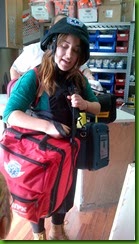
To show us exactly how much equipment is involved, he started loading Elisheva up, starting out by kitting her up with a bulletproof vest and helmet – I suppose for heading into still-active trouble areas.  These aren’t worn every day, but they’re a fun part of the demonstration.  After that, he added a backpack, supplies bag, defibrillator… as she staggered under the weight. 
IMG_00003928 

It’s a lot of stuff to carry around, but the mobility and portability are the secret to United Hatzalah’s success.  In years of driving an ambulance, Beer says, he never successfully rescued a patient until he responded on foot to a call he’d overheard on a police scanner in his own neighbourhood… and actually saved a life for the first time.

Motorcycles, scooters and medics on foot are nimble in a city, a country, where being nimble can mean the difference between a response time of ten minutes (dead on arrival) or ninety seconds (good chance of resuscitation).

Command and control:  hand in hand

From the supplies room, we headed into Command Central – the hard-core control room from which United Hatzalah responds to nearly 200,000 calls a year. 

*** YOU CAN REACH UNITED HATZALAH WITH A CALL TO 1221 (no star) FROM ANY PHONE IN ISRAEL.

*** FOR MAGEN DAVID ADOM (regular ambulance), DIAL 101.

“Jews and Arabs don’t always get along,” says Beer.  But today, “hand in hand… Jews and Arabs are getting together for the purpose of saving lives.”  When Beer’s own father collapsed a few years ago, the first responder at his side was an Arab medic from East Jerusalem.

In addition to complex mapping software which can plot the arrival times of the five nearest United Hatzalah responders (which is calculated intelligently based on whether they’re coming on foot, by car or on a motorcycle!), our host pointed out the central computer which is hard-wired to Home Front Command, the central Israeli agency which sends out missile alerts.  If there is anything going on, anywhere in the country, these guys will know about it first.

IMG_00003931

The other cool thing is that if you have donated an ambucycle (and really, you must if you can!), they can find it for you anywhere, anytime.  Just punch in the number and their computers can tell you instantly where it is.

Because the rescue workers with United Hatzalah are all volunteers, the ambucycle essentially becomes their best friend – they take it with them everywhere they go.  The volunteers are essentially on duty 24/7 – yes, that’s 7 as in “seven days a week,” unlike a lot of other things in Israel, which are 24/6. 

Anytime, anywhere, they could get a call.  And no matter what they’re doing – our host told us about a time he was in shul on Simchas Torah and had to leave right before the big aliyah he’d paid a lot for – they drop everything and run.  (He said he also had a newborn baby at the time – but that doesn’t matter when you’re a United Hatzalah volunteer.)

When I mentioned that you’d have to have a pretty understanding employer, he told us about a United Hatzalah volunteer who worked as a delivery guy for a meat store.  The boss apparently started getting sick of not knowing when his employee would have to leave, abandoning his chicken deliveries (“He delivered chickens… he delivered babies.”).  But, since they were both religious people, the meat store owner consulted a rabbi who said that he may be losing a reliable delivery guy but he was gaining a half share in the zechut, the merit, of the lives that the delivery guy was saving.  The delivery guy kept his job.

Ambucycles save lives:  the too-scary-for-kids video

After our visit to Command Central, we went inside to watch a video about United Hatzalah and its activities. 

I’ll warn you now:  this video is too scary for children.  And maybe too creepy for adults. 

A father basically dies during his young daughter’s birthday party because the conventional ambulance can’t get to him on time.  Then, the scene is replayed, except he is saved by an ambucycle that arrives within 90 seconds of the call (based on an actual call to United Hatzalah).

Our host realized after the video started that the kids probably shouldn’t watch the guy (actor, but hey, they’re young kids) die, so he fast-forwarded to the triumphant ambucycle scene.  Nevertheless, they were both quite troubled afterwards. 

As with seemingly every event of this type, there were tasty pastries and soft drinks, and we were even presented with “swag” in the form of magnets, brochures and some nifty-cool United Hatzalah hats.

A country run on donations.

On our way out, we waved to “our” ambucycle, while I silently resolved never to drop in on the Command Centre to find out where it is at any given time.  The work these guys are doing is just too important to interrupt.

But that idea, of pandering to demanding American donors, got me thinking hard about the donor-recipient relationship between Israel and chutz la’aretz, which has gone on since even before the state itself was founded. 

A few weeks ago in my Hebrew film discussion class (what?  you didn’t know I was taking a film discussion class?), we explored this issue as part of the classic 1965 film Sallah Shabati (סאלח שבתי) (excerpt here, captions in French only), in which early pioneers are planting a forest.  When wealthy American donors drive up, their fancy-looking Israeli host hammers in a sign dedicating the forest as the “Birnbaum” forest.    But later, after they’re out of sight, he comes with a new sign proclaiming it to be the “Mrs. Pearl Sonnenschein” forest. 

image

“What can I do?” he asks.  “It’s tourist season.  They all want their own sign.”

Of Yissachar and Zevulun.

Modern Israel is littered with signs, acknowledging all the Birnbaums and Sonnenscheins, generous donors all, over the last century.  Before I came, I admit, I was more cynical about this phenomenon.  If they care so much about Israel, why don’t they move there?  I wondered. 

I still don’t have an answer to this question, but I don’t ask it so much anymore.

Now that I’m here, I’m grateful every time I see an ambulance going past with its dedication, whether from the Canadian Friends of Magen David Adom or from Australia, the U.S., or the United Kingdom.  I’m grateful for every hospital, clinic, and ambucycle bearing the name of somebody outside of Israel who cared deeply about the wellbeing of the people here.

Yeah, it would be incredible if everybody could come live here.  But as in the case of the chicken seller and his ambulance/delivery driver, the Torah speaks of the “Yissachar / Zevulun” relationship, in which one of these tribes (Yissachar / Issachar) worked hard to learn Torah, while the other (Zevulun / Zebulon) became sailors and traders to support them.

I am so, so grateful to our friend in Toronto, and everybody like her who – although they cannot live here – have taken on the role of Zevulun to those of us who are working hard, like Yissachar, to make this a liveable homeland.

Thanks to them, it is a safer home, where lives are saved in a way that respects the land’s holiness, the honour of all its inhabitants… and cashes in on the enterprising high-tech spirit that has made this the “Start-up Nation” we all know it can be at its best.

For more about the spirit behind United Hatzalah, I really recommend watching United Hatzalah founder Eli Beer’s TED Talks video, The Fastest Ambulance?  A Motorcycle.

Did I mention that United Hatzalah emergency responders, thousands of them, are all volunteers?  That they’re on duty 24/7?  That, Muslim or Christian or Jew or whatever, they will save your life for FREE if you ever need them?  Even if you can’t afford a whole ambucycle, do something today to help them out!!!

*** YOU CAN REACH UNITED HATZALAH WITH A CALL TO 1221 (no star) FROM ANY PHONE IN ISRAEL.

*** FOR MAGEN DAVID ADOM (regular ambulance), DIAL 101.

Google