Like the MamaLand Empire!

Have you Liked the AliyahLand adventure?
      ...and sign up for weekly aliyah tips by email (it's free).

Showing posts with label video. Show all posts

Video interview for ELI on Air: Aliyah with Children

Wondering just how twitchy I can be?

How many times I can scratch my nose, drink water, grab my ears, or just roll my head around in random directions in the course of a half-hour discussion?

Wonder no more!

Our live chat is over, so now you can tune in (not-so-live) to watch my Q&A with Miriam Brosseau of ELI on Air (part of ELI Talks), available for all embarrassing eternity on YouTube.

Check it out here!


Questions you wish you could have asked? 

Leave them here in the comments section!

Tzivia / צִיבְיָה


How can we sleep (when our beds are burning)?

How can I blog when my nation is mourning? 

Sometimes, the things that are great about Israel are not the easy, fun things. 

Sometimes, the things that are great about Israel are the ugly, painful things. 

Like hundreds of thousands of people uniting in demonstrations around the country… and the same hundreds of thousands flocking to one of the largest funerals in the country's history. 

Not for a great rabbi, a famous statesman or singer.

Just some kids, ordinary kids with pimples and fantasties, and who probably got on their parents’ nerves from time to time… at least until the day they weren’t around anymore.

And now, earth turning, we move on.

Except, as after every tragedy that has happened here since we first decided to make Israel our home, moving on can be very difficult.

I found these lyrics going through my head the other day (scroll down to watch the video if you like – I can’t, because I’m still in shloshim), to an 80s song by an Australian band called Midnight Oil:

How can we dance
When our earth is turning?
How do we sleep
While our beds are burning?

How can we lay our heads down each night knowing children can just vanish?

I wanted to make sure the song was okay to share, so I took a minute to read about its lyrics.

You may be amazed; I was.

It’s a song about giving native Australian lands back to the the Pintupi people, forced out during the 1950s and 1960s, while the Australian government tried furiously to assimilate indigenous peoples.  In 1981, they established their own “country,” the Kintore community, where – despite attempts to wipe them out – a remnant of 400 continue to live today.

Let’s see…

  • Forced out of our native land (albeit a couple thousand years ago) – check.
  • Resisted the world’s attempts to exterminate us – check.
  • Succeeded in re-establishing a claim to our homeland – check.
  • Proudly live here to this day (thank God, more than a small remnant) – check.

This song is about us.

And as it goes on to say,

The time has come
A fact's a fact
It belongs to them
Let's give it back

I don’t get political on this site, mainly out of humility; I don’t understand enough to get involved in one side or the other.

But in this, there can be no sides.

The world already acknowledges that we were here and forcibly removed 2000 years ago.  After the Shoah, they seemed pretty sure they knew what to do with that information – in the words of the song:  “let’s give it back.”

Yet today, those words, that certainty, has been lost behind a smokescreen of fabrications and confusion (“maybe they’re not the original Jews” “maybe they made up that stuff about the Shoah” “the Jews are actually the oppressors and don’t deserve the land”).

The story the world hears is so very different from the truth that it’s hard to grasp what’s going on here.  As a result, most people today believe there are sides to this issue.

And then, children die, and for a moment we have clarity.

There are no sides.

It’s not that this is STILL the right place for Jews to be – despite the tragedy.

It’s not that we should make aliyah – even THOUGH bad things happen here.

Aliyah is the right choice for the same reason it has been all along; because this land belongs to us.  There are plenty of people out there who’d like to take it away from us if we’re not interested.

It’s not ours unless we take it back.

At times like these, we turn to our leaders to help us understand what’s going on in the world around us.  A couple of links that may be helpful:

And, for a few more days, at least, until 17 Tammuz and our national mourning period, we turn to music for inspiration as well.  (Not me, because I’m still in my personal 30-day mourning period for another few days.  I’ll listen to it on Wednesday.)


We <3 (love) United Hatzalah!

IMG_00003911This may be the most important post on my blog.  I hope you read it carefully.

Today was “We <3 [love] United Hatzalah Day” for our family!  We learned so much, but this shouldn’t end with us.  I believe that every oleh, tourist, heck, Jew, must know about this organization, which saves countless lives each year not just in Yerushalayim, but throughout the country.

We took the bus down to Yerushalayim for a dedication ceremony on behalf of a Canadian friend who donated an “ambucycle” – a motorcycle ambulance – and who couldn’t travel to be there for the dedication in person.

I thought we’d go, see the motorcycle, shake a few hands (Akiva) and, as we say in Israel, zehu – finished.  But oh, no.  The five of us (big daughter Elisheva skipped classes to join us, for which I’m very grateful) were given the total red carpet treatment.

Saving a single life?

Later on, after we got home, I did some Googling and discovered that the big news for United Hatzalah this month (though nobody mentioned this while we were there) is that a New York millionaire has donated FIFTY ambucycles, at a cost of about $1.3 million. 

Which is fabulous and all, I mean it, but my heart beat proudly, seeing that, to realize that “our” donation of a single ambucycle (it wasn’t really even ours!) was not treated as any less significant… as if they really do give credence to the Talmudic dictum, “he who saves a single life, it is as if he has saved the entire world.” 

Just one ambucycle can save thousands of lives, and they know it.

And oy, what a setup they have there!  I’ve walked past their building maybe dozens of times while in Yerushalayim, and never, ever had a clue as to everything going on behind those doors.

Our tour began with the ambucycle itself, dedicated by our friend in Toronto.  It was clearly brand-new – it still had the plastic wrap on the seat and its supply box was empty.

IMG_00003909

We then went into the supply depot to see what goes into the kit that all the United Hatzalah volunteers (currently over 2000) take with them everywhere they go.

A lot of stuff to carry around.

So what’s inside the big box in the back of the ambucycle?  A little bit of everything, it turns out.  “It’s got everything an ambulance has, except the bed,” says founder Eli Beer.

There’s a portable bag containing everything from a drug box to bandages to a childbirth kit, all in big, padded red compartments.  There were a few items that our host decided not to pull out, concerned that they might alarm the children.  Good call, I think, especially since GZ is creeped out by all things medical.

Here’s the childbirth kit:

IMG_00003916

(Of course, to my homebirthed kiddoes, the first question was, why do you need supplies to have a baby?  When I looked at the contents list and explained that there was a blanket inside, they remained unconvinced.)

To show us exactly how much equipment is involved, he started loading Elisheva up, starting out by kitting her up with a bulletproof vest and helmet – I suppose for heading into still-active trouble areas.  These aren’t worn every day, but they’re a fun part of the demonstration.  After that, he added a backpack, supplies bag, defibrillator… as she staggered under the weight. 
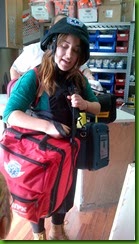
IMG_00003928 

It’s a lot of stuff to carry around, but the mobility and portability are the secret to United Hatzalah’s success.  In years of driving an ambulance, Beer says, he never successfully rescued a patient until he responded on foot to a call he’d overheard on a police scanner in his own neighbourhood… and actually saved a life for the first time.

Motorcycles, scooters and medics on foot are nimble in a city, a country, where being nimble can mean the difference between a response time of ten minutes (dead on arrival) or ninety seconds (good chance of resuscitation).

Command and control:  hand in hand

From the supplies room, we headed into Command Central – the hard-core control room from which United Hatzalah responds to nearly 200,000 calls a year. 

*** YOU CAN REACH UNITED HATZALAH WITH A CALL TO 1221 (no star) FROM ANY PHONE IN ISRAEL.

*** FOR MAGEN DAVID ADOM (regular ambulance), DIAL 101.

“Jews and Arabs don’t always get along,” says Beer.  But today, “hand in hand… Jews and Arabs are getting together for the purpose of saving lives.”  When Beer’s own father collapsed a few years ago, the first responder at his side was an Arab medic from East Jerusalem.

In addition to complex mapping software which can plot the arrival times of the five nearest United Hatzalah responders (which is calculated intelligently based on whether they’re coming on foot, by car or on a motorcycle!), our host pointed out the central computer which is hard-wired to Home Front Command, the central Israeli agency which sends out missile alerts.  If there is anything going on, anywhere in the country, these guys will know about it first.

IMG_00003931

The other cool thing is that if you have donated an ambucycle (and really, you must if you can!), they can find it for you anywhere, anytime.  Just punch in the number and their computers can tell you instantly where it is.

Because the rescue workers with United Hatzalah are all volunteers, the ambucycle essentially becomes their best friend – they take it with them everywhere they go.  The volunteers are essentially on duty 24/7 – yes, that’s 7 as in “seven days a week,” unlike a lot of other things in Israel, which are 24/6. 

Anytime, anywhere, they could get a call.  And no matter what they’re doing – our host told us about a time he was in shul on Simchas Torah and had to leave right before the big aliyah he’d paid a lot for – they drop everything and run.  (He said he also had a newborn baby at the time – but that doesn’t matter when you’re a United Hatzalah volunteer.)

When I mentioned that you’d have to have a pretty understanding employer, he told us about a United Hatzalah volunteer who worked as a delivery guy for a meat store.  The boss apparently started getting sick of not knowing when his employee would have to leave, abandoning his chicken deliveries (“He delivered chickens… he delivered babies.”).  But, since they were both religious people, the meat store owner consulted a rabbi who said that he may be losing a reliable delivery guy but he was gaining a half share in the zechut, the merit, of the lives that the delivery guy was saving.  The delivery guy kept his job.

Ambucycles save lives:  the too-scary-for-kids video

After our visit to Command Central, we went inside to watch a video about United Hatzalah and its activities. 

I’ll warn you now:  this video is too scary for children.  And maybe too creepy for adults. 

A father basically dies during his young daughter’s birthday party because the conventional ambulance can’t get to him on time.  Then, the scene is replayed, except he is saved by an ambucycle that arrives within 90 seconds of the call (based on an actual call to United Hatzalah).

Our host realized after the video started that the kids probably shouldn’t watch the guy (actor, but hey, they’re young kids) die, so he fast-forwarded to the triumphant ambucycle scene.  Nevertheless, they were both quite troubled afterwards. 

As with seemingly every event of this type, there were tasty pastries and soft drinks, and we were even presented with “swag” in the form of magnets, brochures and some nifty-cool United Hatzalah hats.

A country run on donations.

On our way out, we waved to “our” ambucycle, while I silently resolved never to drop in on the Command Centre to find out where it is at any given time.  The work these guys are doing is just too important to interrupt.

But that idea, of pandering to demanding American donors, got me thinking hard about the donor-recipient relationship between Israel and chutz la’aretz, which has gone on since even before the state itself was founded. 

A few weeks ago in my Hebrew film discussion class (what?  you didn’t know I was taking a film discussion class?), we explored this issue as part of the classic 1965 film Sallah Shabati (סאלח שבתי) (excerpt here, captions in French only), in which early pioneers are planting a forest.  When wealthy American donors drive up, their fancy-looking Israeli host hammers in a sign dedicating the forest as the “Birnbaum” forest.    But later, after they’re out of sight, he comes with a new sign proclaiming it to be the “Mrs. Pearl Sonnenschein” forest. 

image

“What can I do?” he asks.  “It’s tourist season.  They all want their own sign.”

Of Yissachar and Zevulun.

Modern Israel is littered with signs, acknowledging all the Birnbaums and Sonnenscheins, generous donors all, over the last century.  Before I came, I admit, I was more cynical about this phenomenon.  If they care so much about Israel, why don’t they move there?  I wondered. 

I still don’t have an answer to this question, but I don’t ask it so much anymore.

Now that I’m here, I’m grateful every time I see an ambulance going past with its dedication, whether from the Canadian Friends of Magen David Adom or from Australia, the U.S., or the United Kingdom.  I’m grateful for every hospital, clinic, and ambucycle bearing the name of somebody outside of Israel who cared deeply about the wellbeing of the people here.

Yeah, it would be incredible if everybody could come live here.  But as in the case of the chicken seller and his ambulance/delivery driver, the Torah speaks of the “Yissachar / Zevulun” relationship, in which one of these tribes (Yissachar / Issachar) worked hard to learn Torah, while the other (Zevulun / Zebulon) became sailors and traders to support them.

I am so, so grateful to our friend in Toronto, and everybody like her who – although they cannot live here – have taken on the role of Zevulun to those of us who are working hard, like Yissachar, to make this a liveable homeland.

Thanks to them, it is a safer home, where lives are saved in a way that respects the land’s holiness, the honour of all its inhabitants… and cashes in on the enterprising high-tech spirit that has made this the “Start-up Nation” we all know it can be at its best.

For more about the spirit behind United Hatzalah, I really recommend watching United Hatzalah founder Eli Beer’s TED Talks video, The Fastest Ambulance?  A Motorcycle.

Did I mention that United Hatzalah emergency responders, thousands of them, are all volunteers?  That they’re on duty 24/7?  That, Muslim or Christian or Jew or whatever, they will save your life for FREE if you ever need them?  Even if you can’t afford a whole ambucycle, do something today to help them out!!!

*** YOU CAN REACH UNITED HATZALAH WITH A CALL TO 1221 (no star) FROM ANY PHONE IN ISRAEL.

*** FOR MAGEN DAVID ADOM (regular ambulance), DIAL 101.

Why, why, why –?

image

Say it just like in the headline:  WHY, WHY, WHY???  Wring your hands; shake your head.  Sounds almost like English, right?

It’s not:  it’s Hebrew, the quintessential Hebrew of the streets, the inner dialogue of Israelis as they shuffle along down the street.  “Why, why, why?”

This expression baffled me for months after we got here.  What the heck did it mean?

I realized almost right away, just from the context, that it doesn’t mean “why.”  That would have been too easy.  For one thing, it always comes in threes.  I don’t think I’ve ever heard any Israeli say just, “why?”  But you might mistake it for a single word if they say it quickly enough.

Google hasn’t been helpful – it translates it as “Wai” (which doesn’t add much), and Morfix says the word isn’t found.

Currently, I think it’s somewhere between a “whoa!” of mild disbelief and an “alas!” of slight disappointment or disgruntlement.

If you walk outdoors and it’s startlingly cold, you mutter “why, why, why?” to yourself.  If the bus takes too long to come, or your transfer rips, you can mutter “why, why, why?” under your breath.  But if the magnitude of the tragedy is great enough to make you say “why?” in English – as in, “why would a benevolent God do this to me?!?” – then you are already WELL beyond the scope of the Hebrew “why, why, why?”

Whatever the heck it means (feel free to jump in and rescue me by explaining!) here’s a kinda-catchy song you may or may not enjoy by the same name.

The words say:

וואי וואי וואי שמש זורחת מעליי ליי ליי
כמו דג במים אני חי חי חי
לפי הקצב של המטקות אני זז
ולא חושב יותר מידי

Wai Wai Wai Sun shining over me Lei Lei
Like a fish in water I Living Living Living
To the beat of the paddles could I move
And not think too much

וואי וואי וואי שמש זורחת מעליי ליי ליי
כמו דג במים אני חי חי חי
לפי הקצב של המטקות אני זז

Wai Wai Wai Sun shining over me Lei Lei
Like a fish in water I Living Living Living
To the beat of the paddles could I move

Just the kind of intelligent song I love!

Anyone care to help me out here???

New Apartment – Video Tour

From an email to my family / friends back in Toronto, mainly unedited…

So tonight is our last night in the Merkaz Klitah (absorption centre).  Here we are at the 6 month mark (nearly) and the next step of our adventure is beginning.

Yes, the apartment is tiny, but it is clean, if not spacious.  Still, I made these videos after dark and it all looks a bit grimy because of the bare-bulb lighting and cardboard boxes everywhere.

This video tour is presented by our 3 wonderful tour guides, each (kind of) more gracious than the next.  As always, the screaming and squabbling you have come to enjoy from our videos has not been edited out here.

Video 1

Video 2

Video 3

Remember, if you're ever bored or sleepless or thinking you'd like to
follow our adventures, I'm STILL blogging at...
http://aliyahland.blogspot.com

Plus, my newest (ad)venture, for fun and super-slight profit...
http://WriteKidsBooks.org

We are thinking of you and miss you all.

IMG_00003872

(saying goodbye to friends at the Merkaz Klitah… mischievous inquisitive little friends who asked 1000 times if we were coming back and where we were going, but still don’t quite seem to understand the concept…)

Sometimes Blue

Sunny skies, birds chirping… an unseasonal heatwave… and here I am weeping in the stupid ulpan party.  Luckily, Ted was there.  And luckily also, it’s impossible to cry through “gangnam style.”  So I didn’t miss too much.

It’s not that we made a mistake coming here.  Let me rephrase that:  we didn’t make a mistake, coming here.  But we are very, very far away from the place we’ve always called home.  Sometimes, it’s impossible to get away from the feeling that you are way, way away from where you’re supposed to be.

Of course, I do believe that here is where we’re supposed to be.  Most of the time, that helps.

But when the list starts listing itself in my head of the people we’ve left behind… I’m sad.  I miss my mother, my sisters Sara and Abigail, even (a little) my brother, my Aunt Dorothy, Uncle Michael, Marilyn, beloved neighbour Judy, cherished friends (I could pretend I have too many to name, but ha ha ha – I don’t) Shira, Chana Beila, Sara, okay, there are some others, but I don’t connect with people well and I know that.  Friendly neighbours, shul acquaintances, and just all the people you smile at going up and down the street. 

Most particularly, most especially, most painfully, the little person I gave birth to 19 years ago, who hates to dance and sing with me at the best of times, but who nevertheless has been there for every Chanukah anyway, my entire adult life.

Listing them helps.  Quantifying the pain, touching the idea of each person in my mind, actually helps.  Maybe because when it first hits, the sadness of being apart from them feels INFINITE.  Like there are a million, a billion, a googol of them that I’ve left behind.  But still.  Of course, each person left behind is an infinity of ouch, but thinking of them, sending them little eGifts (which I know, usually mean “I don’t give a darn,” but from Israel mean, “I saved postage so I could send you a more valuable gift”), reminds me that even though the pain is real, I can bear it, get through it, and even still feel happier when I think of them and talk to them.

image The party itself was totally goofy:  exactly the kind of thing you do for a couple of years in kindergarten, and then never again.

We rehearsed a song (“Ner Li”), then stood up and sang it to the assembled crowd of all the ulpan students.  Ted was all nervous because he had two lines to say during his class’s performance, but my only solo task was translating the song into English (Also goofy:  “My candle, my candle, my thin candle.  On Chanukah, I will light my candle.  On Chanukah, my candle will glow.  On Chanukah, I will sing songs.”)

ulpanclassAnd then we sat down and enjoyed the rest of the show, which consisted of fully-grown people waving giant candles, dreidels (sevivonim) and generally having a rollicking good time.

Now we have a vacation for a week and a half, and after that, just over a week to prepare for the upcoming EXAM that concludes our Ulpan Alef (Hebrew Boot Camp) study.

And now, I’m feeling a little bit better – heading into the kitchen in a minute to wash dishes so I can make latkes and something chicken-y for our first night’s supper.  On Friday, when Elisheva comes up, I will make my regular chocolate sourdough sufganiyot, using the culture I brought with me from Canada…  a little taste of home, right here in our “pina ketana” (פינה קטנה / little corner) of the Holy Land.

One thing I’m trying not to do.  All my life, I’ve heard immigrants talking about life “back home.”  I don’t refer to Canada as “home,” even though it has been my home my whole life.  This is a conscious choice and a HARD choice.  It’s nice, easy shorthand… but I’m trying not to do it.  We are home.

Just in case you’re feeling blue, too – for wherever it is you came from, or whoever it is you miss – here’s a little taste of the Gangnam groove (caution – may contain inappropriate images, in which case, just flip the video into the background and just listen to the audio).  (Try it; it really is impossible to be sad while listening to it!)

And just to cancel out the secular bizarrity of that video, let me also throw one in with an Israeli tune that is wildly popular and yet also wildly spiritual, that odd Israeli mindset that even if you’re not religious, Hashem is looking out for you if only you believe He’s there.

Happy Chanukah to all my fellow Israelis who may be feeling at once at home and far from home, and to my fellow Canadians who are missing us this Chanukah.  You are missed like crazy.

And meanwhile… (silliness)

Who says an aliyah blog has to be all serious, all the time?  Enjoy this so-cheesy-it’s-great retro music video, detailing the unfortunate life of a child whose parents love to travel around Israel, leaving her running to catch up.

However cheesy it may be, I almost tear up at the refrain:

אבא, אמא קצת יותר לאט
אבא, אמא תחכו מעט
אין לאן לרוץ ואין לאן למהר
ארץ ישראל פה לעולם תשאר.

Father, mother a little more slowly
Father, mother wait a little
There's nowhere to run and nowhere to hurry
Eretz Israel will remain here forever.

(thanks to Google translate)

Another favourite, that almost makes me wish I’d had an Israeli childhood, is this even sillier song, which really has nothing to do with Israel; it’s a Hebrew variation on the “one in the bed and the little one said – move over!”  I love this funky-retro combo of hairy, fully-clad TV-host adults co-sleeping with puppets…

Here, Google somewhat fails at its translating task:

Hebrew:

במיטה אחת לא כל כך גדולה
ארבעה שובבים טרללללה.

My (real) translation:
In one bed, not so very big, [were] four sillies, tra-la-la-la-la…
Google Translate:

One bed is not so great;
Four playful Trllllh.

Oh-kay… Enjoy!

Google