Like the MamaLand Empire!

Have you Liked the AliyahLand adventure?
      ...and sign up for weekly aliyah tips by email (it's free).

Showing posts with label tiyulim. Show all posts

Cranky Complaints-Lady Visits -- a bathroom in Jerusalem!


I'm curious... what do YOU think?  Is this issue as outrageous as it feels to me? Or am I overreacting / overthinking?
(This wouldn't be the first time...)
Backing up for a second:

On my other blog, Adventures in MamaLand, I used to have a recurring "Cranky Complaints-Lady" feature where I wrote complain-y letters to a whole bunch of places which were deserving of my scorn.  

Most are a little weird looking back, and way too wordy.  A good complaint letter should get right to the point.  And it should probably be in a language that the recipient understands and can read.  But this issue at the brand-new train station in Jerusalem has been bugging me for a while... so I decided to write a letter.  

Just venting makes me feel a little better.  But yeah -- like I said, be gentle, but am I off base here in thinking the women's bathrooms should be women's bathrooms, i.e., a private safe space where I can adjust my tichel behind closed doors?

Let me know (gently!) in the comments!

p.s. I apologize for not being around more often -- one huge reason is that as of March, the program I used to post to Blogger (Open Live Writer) is no longer supported by Google/Blogger.  I've been looking around for another home for these blogs... but it's had to take a back seat to parnassah and other concerns.  But I'm still around, and if you ever need to get a hold of me, please email -- Tzivia @ aliyahland.com

-----

Dear Israel Railways,

I've been through the train station at Jerusalem Navon several times so far and the station is always clean and efficient.  It's a pleasure to arrive by train rather than by bus after the long journey from north of Haifa.

However, I have noticed one particularly troubling problem -- there seem to always be men in the women's bathroom, specifically cleaning staff.  On one occasion a man walked right in to clean one of the women's bathrooms without first knocking and asking women to leave.  On our most recent visit, during Pesach, I noticed that there is a staff "break room" right inside the women's bathroom on the main floor.  Two or three men were in there taking a break while we were using the bathroom.

Israel: It’s for the birds (and for you)

image

When I met my first husband, I told him about our family's annual camping trips to provincial parks where we'd drive in, park on the site, pitch the tent, and head to the beach or river or forest or whatever to enjoy nature.  Sometimes, those campsites would have running water, other times, you had to walk somewhere else to get water.  My father's strategy was sending the kids to wash dishes in the bathroom -- strictly forbidden according to all provincial campground rules, but you know.  Someone has to be an exception to the rules.

So that was camping.

But my first husband quickly declared, "It doesn't count if you can get to it with a car."

He would have had a hard time with Israel.

Here, camping sometimes means that your tent is just a few feet away from the next person's…

image

(© Tiberias municipality via Wikimedia)

… and hiking usually means taking one of quite a few well-used routes, like the Israel Trail, a 1025 km. (look it up!) route – nothing to sneeze at, really, given that National Geographic has called one of the world's 20 most "epic trails."  But there certainly isn’t the variety, and from what I’ve heard, you’re very likely, in most stretches and hiking-friendly seasons, to bump into a number of fellow travellers.

image

(It’s also perhaps the only one that apparently features a lending library so you can pick up reading material along the way -- People of the Book, indeed.)

image

(photo credit © royisoko via Wikimedia)

Finding a nature getaway definitely isn't hard in Israel.  But as with so many things when you make aliyah, you may have to (slightly) redefine what you mean by the term. 

Since almost every spot is within half an hour's drive of a big city, and there are factories and processing plants of all kinds everywhere from north to south, you're probably not going to get total solitude and silence to commune with nature unless you take to the deep south.

But that has its upside, too, like the fact that you can hop in a bus in Nahariya and within not very long, be standing in the middle of one of the world's most extraordinary bird sanctuaries -- the Hula Valley.  A crucial migration spot between Europe and Africa (and back), the Hula Valley hosts about 500 million migrating birds every single year, and an incredible range of birds as well.

And it happens to be crane season RIGHT NOW.  Well, okay, as our guide explained, these days, it's crane season all winter long, at least until March.

That's because of the Strange History of the Hula Valley, which I'll sum up here very briefly.
Maybe in Hebrew school you learned how

Things that are cool in Israel #9: Tripping over history

image

Are you a dummy about history?

Don’t know your Maccabees from your Hasmoneans?  Can’t tell Greeks, Romans and Babylonians apart?  Well, relax – there’s no way you could be dumber about Israeli history than I am.

And the great thing about living in Israel is you just kind of ABSORB history by living here.  It’s all over – so much so that at certain times and places, you’re actually tripping over it.  Like today, when we went and visited a whole bunch of graves.

Even if you find graves kind of creepy (who doesn’t?), even the gravest sites in Israel have been thoroughly sanitized by time and by the nice archaeology people who are in charge of removing the bones to Elsewhere for a proper burial before they swing the doors wide to tourists.

Sure, Israel has some big-name graves (Rabbi Shimon bar Yochai and Maimonides being two of the biggies), but we decided to head a little off the beaten path today to celebrate one of Northern Israel’s cultural treasures – the grave of Rabbi Yehudah Ha-Nassi (Judah the Prince), otherwise known throughout the Talmud as “Rabbi.”  Why does this guy merit the one-name appellation, out of all the rabbis who have ever lived, throughout Jewish history?

Rabbi Yehudah Ha-Nassi is better known as the REDACTOR of the Mishna.  He was the editor, the guy who pulled together all the oral traditions floating around and single-handedly, perhaps, saved Judaism as we were poised on the brink of a very long exile.

After Rabbi Yehuda Ha-Nassi requested to be buried there around the year 217, the village of Beit She'arim in the Jezreel Valley became THE trendy burial site for Northern Israel.  Lots of famous and wealthy people hurried to follow his example.  So there are lots and lots and lots of long-ago relatives to visit, in a lovely park-like setting on a deliciously breezy hillside.

Sanctity vs Cynicism: Highlights of GZ’s siddur party in Jerusalem

image

My older kids had siddur parties.  Maybe yours did, too?

It’s very cute. 

Once first graders are reading well enough, they have a big ceremony and make a huge deal about handing over their Very First Siddur.  For my big kids, that took about an hour, with refreshments following.

IMG_00005950

Here in Kiryat Shmuel, in the boys’ school, at least, things get a little more involved.  Like, “involved” as in a 12-hour shlep to Yerushalayim. 

And while you’re shlepping, you’d better not just hand over the siddur.  At least not without a ceremony.  And pizza.  And a Chief Rabbi.  And a visit to the Kotel (Western Wall).

Yup, 12 hours.  Fun, fun, fun.

We just got home, and I decided to write down the highlights of the day while they’re still fresh in my memory.

The main celebration (see blurry photo above) was in the Kehillat Bnei Torah synagogue in Har Nof, where last November, two Arabs walked in and started stabbing Jews. 

Why was that a good highlight?  Because we shook the floorboards with laughter, singing and pizza.  Because Jews support Jews and Israelis support Israelis.  Kiryat Shmuel is the same as Har Nof as far as the bad guys are concerned.  And yet our vibrant Jewish lives here go on and children grow up and receive siddurs.

Two other stops on the action-packed agenda were the Machon HaMikdash (the Temple Institute), where we learned all about the Bais (Beit!) HaMikdash, including grinding our own incense, and then on to the Kotel (Western Wall).

IMG_00005978

So… what were some of the outstanding moments from today’s long, long journey?

  • Discovery.  Like the kid behind me on the bus shouting out "Abba, abba, hinei!" (look!) whenever he saw anything.  It doesn't matter what.  Police, hills, trees; this kid has clearly lived in a box his whole life.

Ten favourite selfies in Israel! (#4 blew me away!)

According to Definition #7 at Urban Dictionary, a selfie is “An over used word meaning taking a picture of your self. This is mainly used by people who are too lazy to say "take a picture of myself."”

So that’s what these are – my ten favourite selfies since we arrived here in Israel.  If you’re interested in seeing the egg-shaped top of my head, you, my friend, are in for a treat!

Here they are in order… starting with #10:

#10:  Family bus trip to Nahariya (full story here)

 IMG_00003312

Kind of a lousy picture, actually (I look like I’m kind of squashed back into my seat and / or about to leap up and eat the camera) but I had to get the obligatory “Egged bus” shot in this list somewhere.

#9:  Entering the Carmelit with Elisheva (full story here)

abigail haifa (3)

The world’s wonkiest subway, captured perfectly in this shot of two homemade crocheted hats.  Hard to think way back now and remember this cold December weather… and it’s only March now.  Sheesh.

#8:  The Bay at Old Yaffo (full story of my sister’s visit here)

abelish (6)

I like how I pretended I was taking a picture of her but managed to sneak in my own big, egg-shaped head.  Urban Dictionary says this is called photo bombing, “Intentionally posing in other people's photos, for a later surprise.”  She’s known me for a long time, though, so I don’t think she was really surprised.

#7:  Harem in Old Akko

IMG_00003430

This was our Nefesh b’Nefesh Chanukah tiyul… Akko was kind of boring, though there were some highlights, like this nice dappled treed area.

#6:  Food Court in the Yerushalayim Merkazit with Abigail & Elisheva

abitrip - Copy (3)

This was nice.  My sister, my daughter.  Fleeting moment captured perfectly over a delicious fast-food lunch.  Well, fast food for me.  Salads for them… they’re both always eating salads.

#5:  Kotel with Abigail (once again, read the full story of her visit here)

abitrip (27)

Me n’ my sister n’ the holiest place n’ the world.

#4:  Waiting for Yerachmiel in the Airport

 IMG_00003115

It was a Friday, very rushed, very crazy.  But since he would only be in Israel for 8 days, we figured it was worth it to drive down and meet his plane.  Crazy how excited you can get about seeing your own kid.

(If you came straight from the headline, sorry.  This picture is not actually likely to blow anyone away, but apparently, when creating a “viral-type” list headline, the Thing to Do Nowadays is choose one to get your readers hooked and scrolling.  Since you’re here anyway, keep on scrolling!  You’re nearly at the bottom… and #1 is worth it, I promise!)

#3:  New Ikea Store with Elisheva (full story here)

IMG_00004232

Fun, fun, fun, ‘till the cows come home (or in this case, two really cute stuffed toy mice for about 6 shekels each).

#2:  The Knesset (full story here)

IMG_00003774

Playing at Cub Reporter – having fun, getting paid.  This is the real reason I’m here!

And finally…

#1:  My most-favourite selfie since we came to Israel.

DSCN0601

Well, I didn’t say they had to be of ME, right???

Like food photography (the amateur kind), selfies are a quintessentially modern preoccupation.  In the old days, film used to be way too expensive to waste on potentially-lousy pictures of oneself. 

Still – I think it’s a great way of getting a shot of yourself at times and places when nobody else is there to do it for you.  You just remember stuff better when you’re in the picture yourself!

Do you take selfies?   Do you usually share them, or keep them hidden in some metaphorical “drawer” on your hard drive?

We <3 (love) United Hatzalah!

IMG_00003911This may be the most important post on my blog.  I hope you read it carefully.

Today was “We <3 [love] United Hatzalah Day” for our family!  We learned so much, but this shouldn’t end with us.  I believe that every oleh, tourist, heck, Jew, must know about this organization, which saves countless lives each year not just in Yerushalayim, but throughout the country.

We took the bus down to Yerushalayim for a dedication ceremony on behalf of a Canadian friend who donated an “ambucycle” – a motorcycle ambulance – and who couldn’t travel to be there for the dedication in person.

I thought we’d go, see the motorcycle, shake a few hands (Akiva) and, as we say in Israel, zehu – finished.  But oh, no.  The five of us (big daughter Elisheva skipped classes to join us, for which I’m very grateful) were given the total red carpet treatment.

Saving a single life?

Later on, after we got home, I did some Googling and discovered that the big news for United Hatzalah this month (though nobody mentioned this while we were there) is that a New York millionaire has donated FIFTY ambucycles, at a cost of about $1.3 million. 

Which is fabulous and all, I mean it, but my heart beat proudly, seeing that, to realize that “our” donation of a single ambucycle (it wasn’t really even ours!) was not treated as any less significant… as if they really do give credence to the Talmudic dictum, “he who saves a single life, it is as if he has saved the entire world.” 

Just one ambucycle can save thousands of lives, and they know it.

And oy, what a setup they have there!  I’ve walked past their building maybe dozens of times while in Yerushalayim, and never, ever had a clue as to everything going on behind those doors.

Our tour began with the ambucycle itself, dedicated by our friend in Toronto.  It was clearly brand-new – it still had the plastic wrap on the seat and its supply box was empty.

IMG_00003909

We then went into the supply depot to see what goes into the kit that all the United Hatzalah volunteers (currently over 2000) take with them everywhere they go.

A lot of stuff to carry around.

So what’s inside the big box in the back of the ambucycle?  A little bit of everything, it turns out.  “It’s got everything an ambulance has, except the bed,” says founder Eli Beer.

There’s a portable bag containing everything from a drug box to bandages to a childbirth kit, all in big, padded red compartments.  There were a few items that our host decided not to pull out, concerned that they might alarm the children.  Good call, I think, especially since GZ is creeped out by all things medical.

Here’s the childbirth kit:

IMG_00003916

(Of course, to my homebirthed kiddoes, the first question was, why do you need supplies to have a baby?  When I looked at the contents list and explained that there was a blanket inside, they remained unconvinced.)

To show us exactly how much equipment is involved, he started loading Elisheva up, starting out by kitting her up with a bulletproof vest and helmet – I suppose for heading into still-active trouble areas.  These aren’t worn every day, but they’re a fun part of the demonstration.  After that, he added a backpack, supplies bag, defibrillator… as she staggered under the weight. 

IMG_00003928 

It’s a lot of stuff to carry around, but the mobility and portability are the secret to United Hatzalah’s success.  In years of driving an ambulance, Beer says, he never successfully rescued a patient until he responded on foot to a call he’d overheard on a police scanner in his own neighbourhood… and actually saved a life for the first time.

Motorcycles, scooters and medics on foot are nimble in a city, a country, where being nimble can mean the difference between a response time of ten minutes (dead on arrival) or ninety seconds (good chance of resuscitation).

Command and control:  hand in hand

From the supplies room, we headed into Command Central – the hard-core control room from which United Hatzalah responds to nearly 200,000 calls a year. 

*** YOU CAN REACH UNITED HATZALAH WITH A CALL TO 1221 (no star) FROM ANY PHONE IN ISRAEL.

*** FOR MAGEN DAVID ADOM (regular ambulance), DIAL 101.

“Jews and Arabs don’t always get along,” says Beer.  But today, “hand in hand… Jews and Arabs are getting together for the purpose of saving lives.”  When Beer’s own father collapsed a few years ago, the first responder at his side was an Arab medic from East Jerusalem.

In addition to complex mapping software which can plot the arrival times of the five nearest United Hatzalah responders (which is calculated intelligently based on whether they’re coming on foot, by car or on a motorcycle!), our host pointed out the central computer which is hard-wired to Home Front Command, the central Israeli agency which sends out missile alerts.  If there is anything going on, anywhere in the country, these guys will know about it first.

IMG_00003931

The other cool thing is that if you have donated an ambucycle (and really, you must if you can!), they can find it for you anywhere, anytime.  Just punch in the number and their computers can tell you instantly where it is.

Because the rescue workers with United Hatzalah are all volunteers, the ambucycle essentially becomes their best friend – they take it with them everywhere they go.  The volunteers are essentially on duty 24/7 – yes, that’s 7 as in “seven days a week,” unlike a lot of other things in Israel, which are 24/6. 

Anytime, anywhere, they could get a call.  And no matter what they’re doing – our host told us about a time he was in shul on Simchas Torah and had to leave right before the big aliyah he’d paid a lot for – they drop everything and run.  (He said he also had a newborn baby at the time – but that doesn’t matter when you’re a United Hatzalah volunteer.)

When I mentioned that you’d have to have a pretty understanding employer, he told us about a United Hatzalah volunteer who worked as a delivery guy for a meat store.  The boss apparently started getting sick of not knowing when his employee would have to leave, abandoning his chicken deliveries (“He delivered chickens… he delivered babies.”).  But, since they were both religious people, the meat store owner consulted a rabbi who said that he may be losing a reliable delivery guy but he was gaining a half share in the zechut, the merit, of the lives that the delivery guy was saving.  The delivery guy kept his job.

Ambucycles save lives:  the too-scary-for-kids video

After our visit to Command Central, we went inside to watch a video about United Hatzalah and its activities. 

I’ll warn you now:  this video is too scary for children.  And maybe too creepy for adults. 

A father basically dies during his young daughter’s birthday party because the conventional ambulance can’t get to him on time.  Then, the scene is replayed, except he is saved by an ambucycle that arrives within 90 seconds of the call (based on an actual call to United Hatzalah).

Our host realized after the video started that the kids probably shouldn’t watch the guy (actor, but hey, they’re young kids) die, so he fast-forwarded to the triumphant ambucycle scene.  Nevertheless, they were both quite troubled afterwards. 

As with seemingly every event of this type, there were tasty pastries and soft drinks, and we were even presented with “swag” in the form of magnets, brochures and some nifty-cool United Hatzalah hats.

A country run on donations.

On our way out, we waved to “our” ambucycle, while I silently resolved never to drop in on the Command Centre to find out where it is at any given time.  The work these guys are doing is just too important to interrupt.

But that idea, of pandering to demanding American donors, got me thinking hard about the donor-recipient relationship between Israel and chutz la’aretz, which has gone on since even before the state itself was founded. 

A few weeks ago in my Hebrew film discussion class (what?  you didn’t know I was taking a film discussion class?), we explored this issue as part of the classic 1965 film Sallah Shabati (סאלח שבתי) (excerpt here, captions in French only), in which early pioneers are planting a forest.  When wealthy American donors drive up, their fancy-looking Israeli host hammers in a sign dedicating the forest as the “Birnbaum” forest.    But later, after they’re out of sight, he comes with a new sign proclaiming it to be the “Mrs. Pearl Sonnenschein” forest. 

image

“What can I do?” he asks.  “It’s tourist season.  They all want their own sign.”

Of Yissachar and Zevulun.

Modern Israel is littered with signs, acknowledging all the Birnbaums and Sonnenscheins, generous donors all, over the last century.  Before I came, I admit, I was more cynical about this phenomenon.  If they care so much about Israel, why don’t they move there?  I wondered. 

I still don’t have an answer to this question, but I don’t ask it so much anymore.

Now that I’m here, I’m grateful every time I see an ambulance going past with its dedication, whether from the Canadian Friends of Magen David Adom or from Australia, the U.S., or the United Kingdom.  I’m grateful for every hospital, clinic, and ambucycle bearing the name of somebody outside of Israel who cared deeply about the wellbeing of the people here.

Yeah, it would be incredible if everybody could come live here.  But as in the case of the chicken seller and his ambulance/delivery driver, the Torah speaks of the “Yissachar / Zevulun” relationship, in which one of these tribes (Yissachar / Issachar) worked hard to learn Torah, while the other (Zevulun / Zebulon) became sailors and traders to support them.

I am so, so grateful to our friend in Toronto, and everybody like her who – although they cannot live here – have taken on the role of Zevulun to those of us who are working hard, like Yissachar, to make this a liveable homeland.

Thanks to them, it is a safer home, where lives are saved in a way that respects the land’s holiness, the honour of all its inhabitants… and cashes in on the enterprising high-tech spirit that has made this the “Start-up Nation” we all know it can be at its best.

For more about the spirit behind United Hatzalah, I really recommend watching United Hatzalah founder Eli Beer’s TED Talks video, The Fastest Ambulance?  A Motorcycle.

Did I mention that United Hatzalah emergency responders, thousands of them, are all volunteers?  That they’re on duty 24/7?  That, Muslim or Christian or Jew or whatever, they will save your life for FREE if you ever need them?  Even if you can’t afford a whole ambucycle, do something today to help them out!!!

*** YOU CAN REACH UNITED HATZALAH WITH A CALL TO 1221 (no star) FROM ANY PHONE IN ISRAEL.

*** FOR MAGEN DAVID ADOM (regular ambulance), DIAL 101.

Being a tourist in my OWN country!

Haven’t posted in a while because I’ve been busy.  With what???  Showing off this new homeland that I love so much to my sister, who’s visiting from Canada.

If you had only fourteen days in Israel (twelve when you subtract Shabbat), what would you see and do???  That’s the question my sister had to answer when she arrived at Ben Gurion two weeks ago today.

It’s hard to believe that almost a year ago (well, ten months), we were strangers here on a pilot trip.  My sister has been visiting for the last couple of weeks, which has given me a chance to do a bit of touristy stuff that I’ve really never had a chance to do – except this time, to do it as a real Israeli, kind of.

(Kind of because I gave my Canadian passport to the Arab-run hostel we stayed at in the Old City of Jerusalem… I think they’re Christian, but I was still nervous about what they’d do if an Israeli tried to check in.  More about the hostel later.)

So where did we go?

First of all, I actually wasn’t quite finished Ulpan (Hebrew-language boot camp) yet… my sister arrived a week before my final exam, so not exactly ideal timing, as it was the most intensive week of the entire course.  But I’m nothing if not resilient, and you can’t negotiate with holiday-season airfares.

Thursday:  Tel Aviv / Yaffo

abelish (2) My sister arrived on a Thursday morning, and didn’t want to just head north right away without experiencing a bit of the “merkaz” (central part of the country) vibe. 

I suggested that for the same train fare, we could spend some time in Tel Aviv and Yaffo (Jaffa) instead.  Well, she suggested Yaffo, which was a great call (apparently, she’d read up a little on the plane!). 

In Yaffo’s Old Port, we walked in the footsteps of Napoleon (kind of) and viewed a fascinating historical presentation / tour of an underground marketplace called Jaffa Tales.

Then, we headed to the shuk (market), not far away in the new city of Tel Aviv.  I don’t love the shuk in Tel Aviv; it’s bustling enough, but not much there is kosher.  Having said that, however, there’s a lovely bakery inside that makes the most luscious cheddar-cheese buns.  They’re not cheap, but I bought some to eat on the train back.

After that, plus a quick falafel break (my sister says this disproves my claim that there’s no kosher food around, but I really don’t count falafel stands), we hopped on a bus back to the train station.

This was the day of the big snow in Yerushalayim but Tel Aviv seemed completely unaffected and the day was lovely; brilliantly sunny and definitely warm enough for someone who’d just arrived from Toronto.  It was also Elisheva’s 18th birthday, so – after waiting 5 hours for a bus out of Yerushalayim – she joined us up north for an impromptu (read:  made by Ted/Akiva) birthday supper.

Friday:  Teveria

Okay, I admit – I didn’t want to travel anywhere on a winter Friday when Shabbos came in just past 4:00 pm.  So I sent my sister and Elisheva out to Teveria, thinking they’d have a grand old time seeing the Kinneret and whatever historical stuff is out there.  But no… it was a freezing, rainy, miserable day by any standard, even a Canadian one.  Everything there was closed and, oh, did I mention it was a fast day?  (the 10th of Tevet)  They came back frigid and miserable, but we had a nice cozy Shabbos together later on.

Sunday:  Haifa

My sister wasn’t really all that interested in seeing Haifa, but the weather – though chilly – had cleared up and I didn’t want to shlep around when there are some lovely things to see nearby.  I’m really glad we did.

abigail haifa (5)The day was full of firsts, even for a “veteran” (4 months) Haifan (well, Krayot person) like me.  After a quick Metronit ride into town, we rode the funky-weird Carmelit subway line (world’s shortest subway, only 6 stops!) up the mountain to the Bahai Gardens.

From the bottom of the Bahai Gardens (the free tour walks you down the stairs and lets you out near the middle of the gabigail haifa (16)arden, so it’s an easy walk the rest of the way down), we found a very unhelpful Tourist Centre in the German Colony (no kosher food, as I predicted – even falafel) where I noticed in a brochure that there’s a cable car ride up the mountain. 

The unhelpful, borderline-rude woman behind the counter directed us to take the Metronit to a certain stop for the cable car… at which point we found out that it was nowhere nearby.  We were also aiming to visit the Cave of Eliyahu (Elijah), which was also nowhere nearby.  So we walked… and walked… and walked…

abigail haifa (27)Finally, we reached the cable car, which looks a bit like a baseball hanging from a string and is run by several incomprehensible but friendly Arabs who mainly sit around eating lunch and pressing the button to make the cable car run.

abigail haifa (32)The ride was slightly scary, but we made it to the top, which opens onto a disappointingly dull monastery (Stella Maris).  There was no information or description of the site whatsoever, although a priestly type in a long robe offered us a choice of ancient mimeographed brochures in our choice of German or Italian.

After that dullness, we rode back down and noticed we were spitting distance away from Eliyahu’s Cave, so we stomped off there, despite Elisheva’s warnings that it was weird and tacky and boring.

It was all that and MORE!  The cave itself was decorated in the type of Rabbinic art-kitsch that one can find in many living rooms – pictures of rabbis and holy sites.  There are some historical things up on the walls as well, which do provide a little interesting background, but it’s not exactly a tourist site.

Just as we were giving up and getting ready to leave, a bearded man in a long robe (his was white) came in carrying a shofar.  He asked in Hebrew who we were and where we were from and if we had any special requests, and then offered a really lovely and long bracha, after which he blew the shofar (also long) rather dramatically. 

In terms of showmanship, I felt that the Jewish site had won hands-down.  So there, monastery.

Another quick Metronit ride (one transfer) brought us home, and I was glad to be so close to home at the end of the day.

Monday, Tuesday, Wednesday, Thursday:  Eilat / Petra

In an effort to help me not fail the ulpan exam, my sister took off that night by herself via Egged overnight bus for Eilat and Petra, where she stayed until another overnight bus on Thursday night.

Shabbat:  Home

To celebrate my birthday, completing ulpan and sister’s visit, and to commemorate my father’s fifth yahrzeit, we had a small but nice kiddush here for some of the people we know who live within walking distance.  It was lovely.

Sunday:  Caesarea, Akko, Rosh HaNikra, Yerushalayim

I accidentally or on purpose told my sister I didn’t want to leave for Yerushalayim until Monday, so she booked herself a tour of the north on Sunday.  I was just in Akko during Chanukah and wasn’t at all interested in going again, so she left by herself early Sunday morning on a train to meet her tour bus in Caesarea. 

ABIsendpics (5) I stayed home and wrapped up some stuff here, then headed straight to Yerushalayim, where I met up with Elisheva and checked into the most bare-bones hostel you can imagine.

Let me first say:  I am NOT a fussy traveller.  I have stayed in hostels before in all sorts of places.  Thus, I am no stranger to bare-bones accommodation.  Yet I can easily, comfortably state that this hostel was the biggest dump I have ever stayed in.  It was pretty terrible, but over the course of 3 nights (and the sleeping wasn’t too bad), we sort of got used to it.  (Or is that what they call Stockholm Syndrome?)

The hostel is in a very Arab part of the old city, and its location (just inside the Jaffa Gate) is the only thing it really has going for it… well, that and the price, which was ₪70 per night (about $20) in an “8-bed” (ie 4 bunk beds) women-only dorm.  As I said, I presented my Canadian ID because I wasn’t sure how much they’d love having an Israeli staying on the premises.  Still, I felt secure and comfortable – especially the second night, when I had a second blanket and they brought another heater into the room in an effort to put down the chill.

After I checked into the hostel, I figured I had about 4 hours to kill (turned out to be more like 6), so I wandered the Old City, which was really kind of great.  I let myself get lost, safe in the knowledge that my trusty GPS would get me out if I was stuck.

ABIsendpics (24)I headed back to the hostel to change into warm evening clothes, and met Elisheva when her classes ended at 7.   Eventually, my sister arrived at the Jaffa Gate from her tour of the north.  We took her straight to the Kosel / Kotel where everybody said a little something and marvelled at its antiquity and sanctity… or at least at the ability to sit down for a minute after a busy day of touring.

Afterwards, we got dinner with Elisheva at a lovely if rather pricey Asian place (formerly Japanika, now called Sushi Bar, on Shlomtzion Hamalka, off Yaffo).

Sleeeeeeeep… I was so tired from all that walking.

Monday:  Yerushalayim
ABIsendpics (28) A full day to be a tourist in Yerushalayim; my dream come true!  Woke to the sound of prayer calls, church bells and Arab schoolchildren, and stumbled out of bunk bed to find the CityTour / Egged “Route 99” tourist bus, which – for a very reasonable ₪60 – tootles around the city on a two-hour route that shows you the most important bits of everything, along with the names of 300 miscellaneous neighbourhoods that nobody in a million years is ever going to remember.

ABIsendpics (32)After the bus tour ended, we had three hours to kill before the FREE (!) walking tour we’d planned for the afternoon, so I took her to Machane Yehuda (the Shuk / Market) for lunch.  My idea of lunch in Machane Yehuda is:  buy cheese, buy pita, buy iced coffee, wash somewhere, find a sunny bench, eat. 

Her idea of lunch was a little more complicated, and shifted halfway through the search to include a salad and pesto.  But eventually, we both had accumulated a variety of delicious things and we made our way back (for various reasons) to a bench outside the Old City to eat them all.

abitrip (6) - Copy  The walking tour was also two hours and it was GREAT.  It is literally FREE but they tell you up front that it’s nice to tip ₪10-15 at the end.  I figured if the tour was any good at all, it would still be worth it ($3-5?!?).  It was wonderful (and they only mention the tip thing twice – once at the beginning and once at the end, though they do plug some of the other tours they offer around the Old City; fair enough, I think). 

We got to see all four “quarters”abitrip (7) - Copy of the Old City and the guide was clearly very, very experienced, pointing out historic sites and sharing fascinating legends about every part of the city.  Way better than just walking around and trying to notice things on your own.
We both tipped him happily at the end of the tour.

Not wanting to call it a day just yet (even though it was almost dark already), we headed back to the hostel to change (days were hot; nights were FREEZING) and then out again to buy tickets for the Sound & Light Show at the David Citadel Museum. 

The show was a little hokey, and probably would have been more enjoyable at a warmer time of year, but still impressive.  They project images on the stone walls of the Citadel (which has nothing to do with David HaMelech, our tour guide explained), showing the history of Yerushalayim from the earliest times… in a slightly whitewashed and somewhat more peaceful, calm manner than I suspect things happened in real life.

After that, we got dinner – tasty, tasty Big Apple Pizza on Ben Yehuda Street, and marched back home to sleep, exhausted.

Tuesday:  Dead Sea & Masada

ABIsendpics (67)This was a packaged tour that I bought online, and it was good.  Just good, not great, but good is sometimes good enough.  Ditto with the guide:  not tons of fun, but he did a good job, and he was guiding and explaining as he drove our little van, which he did expertly and well.  My sister told me afterwards that he was holding a microphone; I didn’t see that at the time or I might have been more alarmed.  I assumed it was mounted on the dashboard.

ABIsendpics (59)This was really my first time seeing and  appreciating the quite-deserty desert that covers most of this country.  We passed the mountains where the Dead Sea Scrolls were discovered and they seemed – well, more mountainy than others I have seen before because they’re so bare – in the Rockies, mostly what you notice are the trees and forests.  None of that to distract you here.

We stopped at the Ahava Factory Outlet, which I assumed would be our only ABIsendpics (80)chance to buy Ahava products.  We both resisted, but it turned out there would be plenty more opportunities… the Ahava Company maintains quite a presence down there around the Yam HaMelach (Salt Sea, its Hebrew name).

Masada has never been high on my list of places to go.  I’m not sure how I feel about Jewish zealot groups hiding out from the Romans and their group suicide makes it a bit controversial that we continue to memorialize them.  ABIsendpics (87)Still – the views were breathtaking and I’m glad I went.  Happy we didn’t have to walk up like the many teenagers who were there with Birthright groups.  ABIsendpics (92)They have a lovely cable car, nothing scary like the one in Haifa.
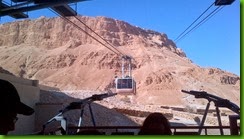
Here we are, right up at the top!ABIsendpics (95)

The tour also stopped at the Dead Sea (Yam HaMelach), another one of my don’t-mind-if-I-miss-it sites, but it was interesting to feel the water – at first.  My sister brought a bathing suit, but I just took off my shoes and waded in a bit, swishing my hands around as I went. 

So this is interesting:  it turns out my entire skin is made up of a network of fine cracks that exist only for the purpose of letting in the sea’s deadly mixture of salt, sulphur and bromides to inside my skin, where they can inflict the most pain.

They did.  It was painful, almost right away.  I washed it off and it was STILL painful.  Later on that evening, my legs started to burn, and as I write this, two days and two showers later, they are still itchy from the “healing mud.”  Feh. 

Another one to chalk off the bucket list, anyway, and never worry about not having carped the diem.

Wednesday:  Yad VaShem, Home Again

I’ve been thinking of Yad VaShem (Holocaust History Museum) as sort of a flu shot.  It’s not that I WANT a flu shot, but it’s good for me and at some point every fall, I work up the nerve to get one.  Except that every time I’m in Yerushalayim, I have young kids in tow, and even Naomi is too young (kids under 10 are not allowed).

No pictures are allowed inside Yad VaShem, which is a very good thing.  The museum is free, and we declined to rent the ₪20 audio guide – figuring that a decent museum should explain itself to you.  (We may have been influenced in this snobbery by our mother’s background in Museum Studies.)

Despite this, there were about fifteen big groups making their way through the museum while we were there, blocking the exhibits with guides shouting out explanations of all the exhibits.  In the groups that included teenagers, many of the teenagers were wearing the audio guide headsets, listening to those along with their guide (simultaneously?). 

My sister thought this was ridiculously excessive and I agree – if so much work and thought has been put into the exhibits themselves, what good does it do to stand a bored guide in front of them to shout about it to the viewers?

Because of the clumping of the groups at the entrance to every room and in front of every key exhibit, it was  hard to pass through without getting a little annoyed.  And then, at the very moving exhibit of shoes taken from concentration-camp victims, an Israeli girl was giggling and pointing at them.  Sheesh. 

Still, annoyance fades somewhat as you pass through room after room of exhibits that are so overwhelming and painful and brilliantly-thought-out.  I was very much Holocausted to death (um, to coin an awful phrase) in Hebrew school as a kid, so I feel like I’m sadly inured to a lot of it… but at a few points it got through to me in a very moving way.

My phone started beeping loudly in the Hall of Names, which was embarrassing, as it’s meant to be a quiet place where you hear names intoned of victims of the Shoah (Holocaust).  Whoops – it was Elisheva, texting to arrange lunch.

After Yad VaShem, we made our way via Light Rail Train to the Merkazit (central station) to meet Elisheva.  Everybody got a salad except me – McDonald’s!  Elisheva said a big, passionate goodbye to her aunt, and then in a flurry of confusion, we boarded the 960 bus back to Haifa.

     abitrip - Copy (3)

It’s been an eye-opening couple of weeks, being a tourist here in my own country.  The Hebrew I’ve learned has been very helpful, and although not a “vatik” (old hand) here, things don’t feel as fresh and new and scary as they did when we were here ten months ago on that pilot trip.

Yet I think I’ve enjoyed showing my sister around so much because it’s all new to me as well.  My sister’s really the first relative who’s visited – hopefully, there will be more opportunities to guide future relatives’ “tours,” and perhaps those, too, will be full of firsts (still lots of places I haven’t been!)… but at some point, it may start to feel like a “been there, done that,” kind of thing.

For now, though, it’s all just a heck of a lot of fun.

What did my sister miss???  If you had only twelve days in Israel, what would be on your “can’t miss” list?

Going out for a tiyul… or am I?

image Every once in a while, here in the depths of ulpan (Hebrew boot camp for newcomers), I find a word so utterly baffling that I simply MUST let the world know of its bizarrity.  One of these words is… TIYUL (tee-ool / טִיוּל). 

I thought I had a handle on this word, really, I did!  It means outing, everyone knows that.  It’s not like we haven’t been on tiyulim!  Like our family trips and outings to places like Yerushalayim, Acco and Nahariya. 

So I was tootling along nicely until I came to this line in one of Ted’s readings from ulpan:  “I went for a tiyul in the backyard.”

Huh?  That’s not really an outing, exactly, is it?  And then I remembered that the boardwalk by the beach is called a “tayelet” (טַיֶּלֶת).  Indeed, there’s a whole verb to go with the word tiyul:  le-tayel (לטייל), which you can use to describe all the wonderful places you can take a tiyul to.

It turns out, when I wrote about what a lazy language English is when it comes to going places, that Hebrew has its lazy moments, too… and tiyul is definitely one of them. 

If you say you are going for a tiyul, you had better clarify quick (especially if your paycheque is involved!)… because you could be on your way to Europe, or the backyard, or Acco, or Eilat, or the mall.  Your front porch.  Really, anywhere.

Our shiny new dictionary, an Oxford no less, translates this word as walk, journey, excursion, trip, and outingGoogle Translate adds promenade, tour, hike, tramp, sightseeing, drive, and ramble.  Granted, it lists a few other words for some of these, but doesn’t dismiss the fact that any one of them can legitimately constitute a tiyul.  And Morfix, my favourite online Hebrew dictionary, has the chutzpah to add the word stroll to the list.

You definitely can’t stroll to Europe.

When I mentioned this to my teacher, the ambiguity of the word, she kind of shrugged, and then, actually laughed.  It’s true, and I think Israelis realize it.  They have loved this word to death and is so beloved that it has come to mean absolutely nothing.  You could be going to see the sea, the nearby dog park, or Machu Picchu, and you’d use the same word.

Think I’ll shut this down now.  Getting late; time for a tiyul to the bedroom!

Eyfo HaSherutim? איפה השרותים?

bathroom klalitFeeling like a savvy Israeli doesn’t happen for me very often. 

Today, I took a page out of Batya’s book (okay, blog) when we were out and about in Nahariya.  Strange city, ambling around having a good time with friends from our pilot trip… when Naomi Rivka announced that she needed a bathroom.

(we only took Naomi Rivka – GZ stayed home with Elisheva, yay!)

And I looked up, and like the chorus out of Life of Brian (if you haven’t seen it, you must), there was the local Klalit (they spell it Clalit in English) health clinic.  Using Batya’s rationale, we ARE Clalit members and thus, sort of, “customers” of theirs. 

I also knew that the closest public alternative was the bus-station bathroom, which would almost certainly be sub-par, and also, possibly, be available only for a fee of 1 shekel.  I learned this the hard way in Afula, where you hand over your shekel to an apathetic guy behind a desk who does NOTHING, and then enter the most hideously filthy bathroom which – for ONE shekel! – lacks seats.  It’s like a third-world country, except you’re paying for the privilege.

So… why be a freyer (sucker) if you don’t have to be???  Into the Klalit clinic we went, marched up to the front desk, and asked for the sherutim (literally, services or facilities).  The bathroom wasn’t great (actually required a bit of cleaning before she could use it), but it was free and there was soap, warm water and towels to wash up with afterwards.  (No hand sanitizer!  I have yet to see a health or recreation facility here with hand sanitizer.  Weird, since it’s practically synonymous with these places outside of Israel.)

Anyway, there isn’t much that makes me feel confident these days, but being able to find my kid a bathroom the INSTANT she demands one (it really did just appear there, like a mirage) is one heck of a happiness-booster. 

Oh, yeah, and then we stopped at a sandwich shop and I showed everybody the extensive sandwich menu so they could deliberate before I took a call.  And then… when I turned back a few minutes later, realized I was the only one in the crowd (two were just starting ulpan) who could actually read the menu.  Oops! 

We skipped that joint – too expensive, too complicated – and found a falafel / shawarma place that only had two choices (falafel / shawarma, and half / whole).  Thoroughly yummy!

While wandering around Nahariya, we happened to find delightful store we found in Nahariya called Gan Li / גן לי.  Okay, it’s true, I have a fetish for anything school related, but this is actually the first decent, comprehensive, school-and-art-supplies shop we have seen since we got here.

For months, we’ve been buying binders in one store, a hole punch in another, a filler paper at another, and pencils and pens somewhere else entirely.  Gan Li even had Akiva’s artist ink, and some decent markers he can use for drawing with.  And some cheap (₪9) no-name highlighters for Naomi Rivka and magnet pens for our fridge (₪5 each).  It’s not that the prices were so fantastic, it’s the fact that everything was all in one place that I found so very exciting!

image Oooh!  Ever a sucker for fun new card games, I bought the game Sleeping Queens (note:  links point to the English Gamewright version; the Hebrew one is licensed by FoxMind), for ₪40-something instead of the ₪60-something in the big chain bookstores.  But that’s a subject for another post…

All in all, a nice day spent with nice new friends in Nahariya.  And it was nice travelling home in comfort instead of sitting cross-legged on the bus all the way back (meandering every which way down the coast and through Acco) wondering where I’d find the nearest bathroom.  I’m Israeli; I already know!!!

Chol HaMoed in Israel!

Utterly exhausted… and here’s a slideshow that maybe explains why.  :-)

Creepy Dolls Museum

dolls (5) (800x449)I’m sure you can find creepy olde-tyme dolls anywhere; it’s just somehow charming and reassuring that you can find them in Israel, too.

We found some really creepy ones as part of an exhibit of historical toys in the otherwise quite interesting Madatech – Museum of Science and Technology in Haifa, to which we were admitted FREE!! thanks to our still-valid Ontario Science Centre museum membership, which reciprocates with many other science museums around the world. 

After enjoying the science museum for a couple of hours – perhaps the subject of another post! – we happened to wander into this room, which is the creepy-doll exhibit.  The exhibit features this charming poster in English and Arabic; I didn’t spot a Hebrew version, but perhaps it was elsewhere.

dolls (1)

Elisheva in particular was deeply tickled by this invitation to go “back in time… to a time when playing with toys meant taking them down off the shelf, and not downloading them from the internet.”  Hmm… is that really what “playing with toys” has come to mean to our kids today?

[Although it seems to me that if you got a good enough 3-d printer, you could indeed download your toys from the Internet, or at least, printable schematics for print-your-own assemble-at-home toys.]

In any event, I’d hate to mock “toys that succeeded to survive, and thus enable a glance at toys… manufactured by… craftsmen, carpenters and peasants…”

Yes, these are truly a peasant-crafted wonder, with their strange, beseeching expressions, cast in plaster or rubber or china, bodies stuffed with sawdust or horsehair or something else similarly historic, each one more precious and/or creepy than the last. 

Can’t you just hear them screaming out at you from the pages of history???

dolls (12) (800x449) 

Here’s a motley group of mainly rubber dollies…

dolls (22) (800x449)

I guess it’s not fair to single out this one because she’s a puppet and her mouth is weird cuz it has to open and close.  Tough; I did it anyway.   dolls (13) (800x449) 

Kiss, kiss?  Just a little bit psycho dollies…    dolls (11) (800x449)

dolls (7) (800x449) 


Very busy dollies – yo-yo’ing…

dolls (8) (800x449)

Hosting a tea party…

dolls (20) (800x449)

Or just hanging out with a very similar but shorter friend…  dolls (6) (800x449)


This doll didn’t look like she could be trusted with her scissors, quite…

dolls (19) (800x449)

“Hey, I’d better get off these train tracks before someone runs me down!!!”

dolls (18) (800x449)

“To infinity and beyond!”

dolls (16) (800x449)

And one final deeply flawed attempt at dollie winsomeness:  dolls (17) (800x449)

Mainly, I think we all left the exhibit convinced that despite random moments of coolness in the past and despite how that meddlesome Internet spoils the fun and innocence of children’s play, most toys today (except for the very cheapest, which includes many of the lower- and medium-end ones sold here in Israel) are better – cuter, better-working, longer-lasting and funner – than toys a long time ago.

(Note:  if you are making aliyah OR spending large amounts of time in Israel, check for deals like this because FREE!! is a great price!  This membership is still good until December and also gets us into the Weizmann museum which is a shlep away in Rehovot but apparently includes some great stuff including dinosaurs.  I will also here point out that my friend Shira mentioned this long before we made aliyah and I totally forgot, then thought of it “all on my own”!)

Even if you have no membership from outside of Israel, entrance to Madatech, all of these dolls included!, is a deeply discounted ₪20 for new olim within the first year of aliyah!

Google