Like the MamaLand Empire!

Have you Liked the AliyahLand adventure?
      ...and sign up for weekly aliyah tips by email (it's free).

Showing posts with label stuff. Show all posts

Guest Post: Ordering online in Israel vs ordering online in America

image

Image result for eytan buchmanAre online stores here in Israel up to snuff?  Most people will tell you things are getting better… which may be true, but today’s guest post, courtesy of hummus-loving marketing guru Eytan Buchman, begs to differ – slightly.  Things may be better than they were, but as he explains, sometimes you still feel like you’re crossing over into the Twilight Zone...


Ordering online in America:

Go to Amazon.
Click Buy
Get it to your door that day.

Ordering online in Israel:

imageFind a website

They don’t sell things online. Weird.

You find a comparison website. It feels like a scam.

It sends you to

Gift ideas for friends and family in Israel? Look no further!

image

How dumb is this post topic?  Who writes about gift-giving in January?

Right.  Yay!  Can you see my hand up, waving proudly, from all the way over here?

If I was a better, smarter blogger, more interested in dollar signs (and shekel symbols), I would have posted this in December.  Hmm… guess not.

And I could save it for December 2015, but really…?  The way my brain works, it’ll never happen if I put it off.

Anyway, I’m reminded of gifts today because our winter-holiday-seasonal gift arrived from Akiva’s sister in Canada. 

She mailed it on November 24th, and today it is January 27, so that’s a little over 2 months.  And I’m not saying what it cost to mail.  We’ll open it when the kids are home from school, and I can’t wait to see what’s inside.

So that’s one kind of gift.  Don’t get me wrong.  One of the highlights of living here is GETTING STUFF.  I love receiving packages.  Our local post office knows us well and I’m sure they have our number on speed-dial.

But there are other ways to send something special that feel just as “gifty” without breaking the bank on postage charges.

Giving or getting gifts to and from Israel can be a huge challenge, which calls for a little creativity.

Try an “intangible” gift that won’t take up space

If you’re in Israel and want to send gifts back to North America… (if you’re sending the other way, read on anyway)

Instead of buying something bulky and overpriced in Israel and paying more than you spent on the gift to ship it to North America or Europe, think about "intangibles" you can buy and ship for nearly free.

Some good ideas:

First Pesach Shopping in Israel

IMG_00004340Things have changed here in Israel.  I almost hate to say it, because I’ll probably have every olah vatikah on my back about how terrible things used to be and how easy we have it today.  Sorry!

On my way out the door today to do the annual Pesach Shop – Israeli version, I was scaaaaaaared.  I’ve heard terrible things about how hard it is for us Ashkenazim here. 

Since a majority of Jews here are Mizrachi (roughly what we in chu”l called Sephardi), a majority of certified kosher-for-Pesach products contain (or may contain) what I still in my head call “kitniyos” – the beany-type things that also include rice, corn and peanut-flavoured Bamba snacks.

It’s that “may contain” that had me running scared.  Needing to read ingredient lists of fifteen bazillion tins and boxes and bags and…. eek.

For reassurance, I googled “Pesach shopping in Israel” and pulled up this Unofficial Guide to Pesach Shopping in Israel from A Mother in Israel.  It didn’t really help much.  In a few ways.

She (being Hannah, the aforementioned Mother in Israel) says: 

  • “The best way to avoid the kitniyot issue is to shop at a haredisupermarket.”   Um, none of those here in the Krayot.
  • “My handy-dandy list says we ate 23 kilograms of potatoes last Pesach.”  No handy-dandy list, and we’re short 2 people plus all the guests we knew back in Canada, so all bets are off in terms of what we’ll eat.
  • “In the US, the OU publishes a list of products considered kosher for Passover, even without a special stamp (Domino sugar comes to mind). No such list exists here.”  Ditto for the COR in Toronto.  Uh-oh.
  • “I like to shop about a week before the holiday.”  Alright, I was okay with this one.  Exactly one week to go.

Trepidatiously, we headed out for our local Osher Ad, whose name means Happiness Forever, and which pretends to be the local Costco but falls slightly short on a few counts.

But NOT – I repeat NOT! – in the Kosher-le-Pesach-for-Ashkenazim department!!!

But first – a delightful moment, when I stumbled upon the “charoset aisle.”  Only in Israel. 

Charoset, which I call “charoses,” isn’t exactly a delicacy in our house.  Usually, it’s a last-minute confection whipped up from some ground nuts, grated apples, sweet Kedem kiddush wine, and cinnamon.  Usually, I throw the stuff at my sister and tell her to figure it out.  And she does, because it’s not rocket science.

Still – in the absence of my sister, it’s nice to know it’s available in containers like this.

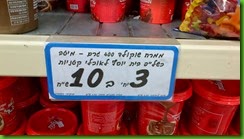
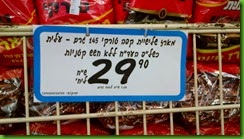
Anyway, the biggest and most delightful surprise was the SIGNS, clearly and prominently posted above or below to almost every item in the store.

Some of the signs said “לאוכלי קטניות”, which means “for eaters of kitniyot,” like this one.
  IMG_00004341

(yeah, I wanted to buy chocolate spread… oh, well)

Other signs said “ללא חשש קטניות”, which means “no suspicion of kitniyot.”
IMG_00004342

(but I didn’t buy this coffee anyway; it was just an example)

Some of the signs were smaller, some were bigger.  All were very, very helpful.

In most product categories, there were a few decent choices even for us kitniyos-haters.  The real exceptions were oil and mayonnaise.  In Canada, I always bought a bottle of cottonseed oil (as the kids here would say, ichsa) and used as little as possible. 

Here, it doesn’t seem like they have any, so the Ashkenaz-friendly choices were a rather murky-looking palm oil and (at twice the price) hazelnut.  I went with palm – and again, will use as little as possible.  I bought two big bottles of olive oil for a good price, so hopefully, we’ll rely on those for most things. 

Despite hating waste, I am always happy to throw away any unused Pesach oil at the end of the holiday.

As for mayo, they had a great big tub of Gefen, same as in the States, but I didn’t want a great big tub for 20 shekel.  Fortunately, Naomi Rivka spotted the small sign next to the more reasonably-sized tubs of kitniyos-free mayo.  I didn’t peer at the fine print to see what oil they used in there.  Again, we use it sparingly and throw away happily after yom tov, but sometimes it comes in handy.

As I took the mayo off the shelf, I noticed an older couple peering at the labels and whispering to each other.  Turned out they were not only Ashkenazim but also speaking English, a rarity here, and I was happy to show them the little mayonnaise jar before we moved on.

I’ve heard margarine is almost impossible for us Ashkenazis to buy.  And again, ichsa.

Anyway, lest you think our First Pesach Shop was TOO EASY and therefore not enough to toughen us up and turn us into True Olim… I decided, subconsciously perhaps, to throw two wrenches into the works.

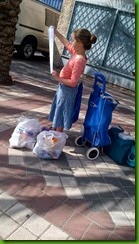
Overall, our Great Big Pesach Shop (phase 1) took about 3 hours and ultimately made us late for Naomi Rivka’s dance class, but that was mainly because I made her pose at the bus stop so I could take her picture with our lengthy receipt… only to realize that we were at the WRONG BUS STOP.
 IMG_00004344 IMG_00004345

Oh, but wait.  Before I tell you about that… see that nice long 800 shekel receipt she’s holding???  After I finished paying, I tucked it neatly inside one of the couple-dozen grocery bags… and forgot which one I’d put it in.

Which was okay until it was time to leave the store and the security guard stopped me.  No receipt, no exit – period.  He sits there all day with a stamper, stamping receipts, and woe upon anyone who has hidden her receipt inside one of a couple-dozen tightly packed grocery bags in a bundle buggy.

“Go back to the cashier,” he said (after a few times of me saying, “what?”).  “She can print you a copy.” 

I had no idea this was possible, but I did as I was told, leaving Naomi with the guard. 

The cashier immediately stopped what she was doing (checking out a couple’s groceries) and called for a supervisor.  And then everybody waited.  And waited.  The supervisor didn’t call or stop by.

“What are we waiting for?” asked the husband of the couple.

“She needs her receipt,” the cashier told him.

I apologized but weirdly for Israel, he didn’t seem at all disturbed.  Eventually, when nobody called or came, he suggested that she could try again AFTER they paid for their groceries, so she finished checking out their order.

She did call again, but nobody came.  So eventually, she just scrolled through the last half-hour of receipts on her cash register (handy!  I didn’t know they could do that!), I pointed to mine, and she printed it and handed it to me.

I walked to the front, handed it to the guard, who stamped on it.  He barely even looked up and for sure didn’t do anything like correlate what was written on the receipt with the groceries in my bag.  “First time shopping here?” he asked, in a not entirely kind tone of voice.  “First time shopped for Pesach in Israel,” I said.  “First Pesach in Israel.”

Just before we left the store, the couple whose grocery-checkout I’d held up for a couple of minutes came by with their stuff and very kindly asked if we needed help.  I assumed they meant getting out to our car, so I just said we were okay.  Which we were.

Well, except for waiting at the wrong bus stop.  But even there, a nice lady randomly handed Naomi Rivka a bag of (kosher-for-Pesach!) chips.  Sometimes, I really like living in Israel.

The right bus stop was across the street and the minute I realized my mistake (and let another bus go that could actually have gotten us home quickly enough), we saw our bus pulling out, so we had to wait nearly 20 minutes for the next one.

That was easily both the biggest change and the hardest thing about Pesach shopping this year:  no car.

Well, also not going with my mother.  That part was sad.  I’ve been replace; I already heard last week from my sister, who had been called in to fill in for me.

It’s not that I help my mother, or, really, that she helps me.  We just usually do it together.  And then sometimes buy a haggadah afterwards.  And pizza (since they put in the Second Cup in the same plaza, it’s often a coffee occasion as well). 

And just Being Jewish Women together, shopping and preparing for yom tov just the way our ancestors did in Egypt, in Israel, in Poland or wherever.  Which I guess was also what this outing was about with Naomi Rivka.

It was nice.  We have a long way to go before we’re ready… but it’s a start.

Is it just my imagination, just our store, or has Pesach shopping in Israel really gotten easier???

First, but not last: me, Immigrant Mom.

IMG_00003766  I got fed up with Israeli shoe stores the other day.  They’re terrible!  Everything’s expensive, with a limited selection of overpriced, weird-brand shoes.  I hate buying new shoes at the best of times, but in an Israeli shoestore?  Forget about it!

But Naomi Rivka needed a new pair, urgently, because she’s always telling us her feet hurt.  There’s nothing visible on the outside, but I suspect they hurt either because she wears Crocs all the time or, occasionally, her terrible pair of Israeli-shoestore model gym shoes.  (I blame the Crocs – I loved them at first, but now cannot wear them at ALL).

Happily, there’s a Payless shoe store in Lev HaMifratz, one of the big malls in Haifa, and we happened to be going past it yesterday on our way to get passport photos (finally!) from another mall.  In Canada, my attitude was always, if I have to buy retail, give me Payless.  I knew the one here was very similar, and carried the same (ie REAL, not Israeli) brands.

I wasn’t disappointed by the selection – but I was stumped, at first, by my Hebrew.

Problem was, I had no idea what size she needed.  I wanted to measure her feet.  I needed one of those shoe-measuring thingies, a staple of every shoe store, throughout my childhood.  You know… THIS thing:

(Did you know that in English, it’s called a “Brannock Device”?  Me neither – thanks, Google!)

There were two sales guys talking at the front counter to one customer and I didn’t want to interrupt, but luckily, a sales gal came along when I needed her.

“Efshar limdod et ha…”  Is it possible to measure…? I began.

Ugh.  Okay, yes, I got 94% in ulpan, which included basic body-part terminology, but still don’t really know how to say foot.  I don’t know if there IS a word for it, I think it’s just כף רגל / caf regel, which sort of means “palm of the leg.”

Problem #2 hit me the moment the salesgirl nodded eagerly.  The verb למדוד / limdod, “to measure,” also means “to try on.”

“Of course,” she said, “choose whichever size you need and try them on.”

“But which size does she need?  I don’t know.  Can you measure her leg?”  Argh – foot!  Foot!

“You can try whatever size she needs.”

Argh.  We were going in circles.

Aha!  I knew what we needed.  Naomi had just been trying to teach me the word for ruler…

“In North America,” I explained slowly, “when I want to buy shoes, in the store, there is a,” turned to Naomi Rivka in English.  “How do you say ‘ruler’?”

“סַרְגֵל / sargel.”

That’s when the salesperson’s ears perked up at Naomi Rivka’s yummy little accent.  She leaned over a bit.  “Do you speak Hebrew?” she asked Naomi Rivka.

“Ktzat,” (a little), Naomi Rivka replied sweetly.

No, no, no, no, no. 

NO.

Because I knew exactly what she was thinking. 

No WAY was she going to speak to my 8-year old instead of directly to me.  No WAY was I unable to handle a basic shoe-buying transaction without my kid as an intermediary.

It was the first time this has happened… but certainly not the last.

I could NOT let this happen to me, to turn into the classic, stereotypical Immigrant Mom.

So I didn’t let it.  I cleared my throat and take charge, a little.  We reached an uneasy truce whereby the salesperson admitted that she’d never heard of having a ruler in the store to measure kids’ feet (huh?!?), but she would let us try on any shoes we wanted.   (gee, thanks!)

She peered at Naomi’s feet, clad hugely in Crocs, and suggested Size 3, which was obviously way too big.  Then, she offered another pair which was slightly smaller, but way over what I wanted to pay (“yakar miday,” thanks, Ulpan!). 

I’d already noticed several pairs of a decent brand in a few kids’ sizes, on sale for ₪50 – THOSE were the shoes I wanted!

I guess, realizing she wasn’t going to get a huge commission, she finally left us on our own while she wandered the quiet store, and I pulled a couple of pairs so we could try them on. 

The very best ones were not too flimsy and not too padded, but they were black, and I worried that Naomi Rivka would reject them because they weren’t girly.  There was a sparkly pair also for ₪50, but they felt cheap and had a weird lump in the sole. 

Happily, Naomi Rivka loved the black pair, even though the salesperson had tried to tell us they were for boys.  Until you show me actual physiological differences between boy feet and girl feet, I will continue to believe that feet are feet.

We paid our ₪50 – will I ever stop loving the fact that tax is included in sticker prices?! – and got the heck out of the store, feet and wallet relatively unscathed. 

Just wish I could say the same for my ego.

Eyfo HaSherutim? איפה השרותים?

bathroom klalitFeeling like a savvy Israeli doesn’t happen for me very often. 

Today, I took a page out of Batya’s book (okay, blog) when we were out and about in Nahariya.  Strange city, ambling around having a good time with friends from our pilot trip… when Naomi Rivka announced that she needed a bathroom.

(we only took Naomi Rivka – GZ stayed home with Elisheva, yay!)

And I looked up, and like the chorus out of Life of Brian (if you haven’t seen it, you must), there was the local Klalit (they spell it Clalit in English) health clinic.  Using Batya’s rationale, we ARE Clalit members and thus, sort of, “customers” of theirs. 

I also knew that the closest public alternative was the bus-station bathroom, which would almost certainly be sub-par, and also, possibly, be available only for a fee of 1 shekel.  I learned this the hard way in Afula, where you hand over your shekel to an apathetic guy behind a desk who does NOTHING, and then enter the most hideously filthy bathroom which – for ONE shekel! – lacks seats.  It’s like a third-world country, except you’re paying for the privilege.

So… why be a freyer (sucker) if you don’t have to be???  Into the Klalit clinic we went, marched up to the front desk, and asked for the sherutim (literally, services or facilities).  The bathroom wasn’t great (actually required a bit of cleaning before she could use it), but it was free and there was soap, warm water and towels to wash up with afterwards.  (No hand sanitizer!  I have yet to see a health or recreation facility here with hand sanitizer.  Weird, since it’s practically synonymous with these places outside of Israel.)

Anyway, there isn’t much that makes me feel confident these days, but being able to find my kid a bathroom the INSTANT she demands one (it really did just appear there, like a mirage) is one heck of a happiness-booster. 

Oh, yeah, and then we stopped at a sandwich shop and I showed everybody the extensive sandwich menu so they could deliberate before I took a call.  And then… when I turned back a few minutes later, realized I was the only one in the crowd (two were just starting ulpan) who could actually read the menu.  Oops! 

We skipped that joint – too expensive, too complicated – and found a falafel / shawarma place that only had two choices (falafel / shawarma, and half / whole).  Thoroughly yummy!

While wandering around Nahariya, we happened to find delightful store we found in Nahariya called Gan Li / גן לי.  Okay, it’s true, I have a fetish for anything school related, but this is actually the first decent, comprehensive, school-and-art-supplies shop we have seen since we got here.

For months, we’ve been buying binders in one store, a hole punch in another, a filler paper at another, and pencils and pens somewhere else entirely.  Gan Li even had Akiva’s artist ink, and some decent markers he can use for drawing with.  And some cheap (₪9) no-name highlighters for Naomi Rivka and magnet pens for our fridge (₪5 each).  It’s not that the prices were so fantastic, it’s the fact that everything was all in one place that I found so very exciting!

image Oooh!  Ever a sucker for fun new card games, I bought the game Sleeping Queens (note:  links point to the English Gamewright version; the Hebrew one is licensed by FoxMind), for ₪40-something instead of the ₪60-something in the big chain bookstores.  But that’s a subject for another post…

All in all, a nice day spent with nice new friends in Nahariya.  And it was nice travelling home in comfort instead of sitting cross-legged on the bus all the way back (meandering every which way down the coast and through Acco) wondering where I’d find the nearest bathroom.  I’m Israeli; I already know!!!

Ongoing wish list

If anyone’s coming from North America, and there is a chance they will see me, here’s what I want…

(a partial list, to be added to and subtracted from)

  • Starbucks instant coffee
  • Rubber gloves
  • Vanilla extract (yes, I do know I can make my own with a vanilla bean… and eventually, I probably will)

Bigger items “To Buy” wish list – stuff we need for our home, now or eventually – would make excellent big-ticket / birthday gifts for grown-ups!!!:

Big-ticket purchases we will need when we leave the merkaz klitah:

  • washer/dryer (maybe don’t need a dryer, at first?)
  • stove, or countertop two-burner thingy like we have here.
  • maybe a full-sized oven?
  • fridge, with an actual capacity to hold things
  • beds
  • other furniture… ???
  • large freezer, eventually?

What we own here so far:

  • clothing
  • boxes, artfully arranged to resemble a bookshelf
  • suitcases
  • two fans
  • a broken blender
  • toaster
  • toaster oven
  • books
  • folding table
  • shelf thingy in shower room

Weird moments of holiness…

IMG_00002711… when you buy a clock at the supermarket and the cardboard packaging includes a rabbinical quote:

לא כל הימים שווים ולא כל השעות שוות. יש ימים ארוכים ויש קצרים, יש יום שנדמה לו לאדם כשנה, יש שנים שהן בעיניו כימים אחדים. יש רגע שנראה שהוא לא יסתיים לעולם ויש חיים החולפים כחלוף עין.

- הרב חיים סבתו

IMG_00002712A bad translation is provided – the verse says something like [my translation], “Not all days are equal and not all hours are equal.  There are days that seem long and days that seem short; a day can seem to a person like a year, but there are years that can seem like single days.  A moment can seem as though it will never end, but there are lives that are over in the blink of an eye.”

Thank you, Israeli wall clock, for that sobering dose of reality.

Everything you wanted to know #5: Appliances and voltages

I asked:

Every site says different things on transformers vs converters and kitchen appliances. I know it's been asked many times before, so I just want personal experiences: what small kitchen appliances did you bring, what did you run them on, and how well did they work (& how long did they last)???

And luckily for you, if you’re looking to this site for answers, smarter people than I am actually responded!!!

  • ask me again on a weekday, please [I posted this question on a Friday morning here – ie late afternoon in Israel!]
  • Personally, I'm not one for transformers. Never owned or used one. If you have an almost new, expected to last a decade or more appliance that's one thing, but otherwise get appliances that will be good for Israel, even if the price seems high. I'm here over 40 years. Transformers aren't free either, and some appliances don't work that well with them. Also, don't overstock on clothes, tablecloths etc. You'll need more closets and more space. They also cost money.
  • I agree…!
  • To be honest I would try to sell your 110 v appliances and buy new top quality 220v ones - go to the 220v store up North and check out prices there and buy from there and put on your lift. WE bought a 220v immersion blender for Pesach more than 6 years ago there and I am still using it!!! It's now chametzdig and dairy
  • I agree… . I didn't come with any appliances at all. Of course, I came marrying into a family here. But even what Rebecca brought over didn't last very long. Nothing more than 5 years. Transformers are great for a once in a while use, like the iron that we use perhaps 5-6 times a year. For things used often, it does shorten the appliance's life span. Better to put 220 stuff on your lift, or buy it here.
  • I agree - buy 220 there and ship it here- because it's being shipped, it doesn't get taxed (in Ontario). We use all the kitchen appliances we used to use- but more often (there is fresh food here so we make more of the stuff that we used to buy over there- we make the baby food, the sauces etc..)
  • For small appliances, you can check the price of 220V appliances in Israel on websites like zap.co.il, bestbuy.co.il, lior-electric.co.il and compare to the cost of bringing a 220V appliance from the US.
    for large appliances, take into consideration that appliances bought in Israel will have local service and warranty, and be appropriate for Israeli conditions - e.g. washers that heat their own water (only a small amount needed) instead of having to heat up the whole water heater so washer can take from it.  [This seems like a good rule of thumb] In general, a transformer might be good for an occasional appliance that you really like, but best to avoid them if you can get a 220V appliance to do the job. also the transformer can convert voltage but not cycles, which can be relevant for some appliances. and they are not supposed to be used for electronic equipment or high-wattage appliances.
  • It might be a bit premature to show up with appliances. They say that the electricity will finally arrive here in 2016.  [What a joker – I hope!]

But seriously… the blender is kind of new, so that hurts a bit.  And the hand blenders, and the mixers, and the Pesach mixer.  But the hardest is my beloved Cuisinart, although… precious as it is, is definitely on its last legs.  I just searched for the post where I blogged about it when it was a brand-new birthday present and discovered that it is older than one of my children (bought for my birthday, I guess eight years ago?).  So I guess they will have to go.

I think the kind of appliances people say to buy and ship are LARGE appliances, which we will definitely need to buy sooner rather than later (even if you’re renting, apartments generally come without any appliances).  But what I was asking about was mainly the small ones, so I guess we will have to buy them when we arrive … or do without. :-(

I suspect that we will be hemorrhaging money for the better part of the first year…

Addendum:  Computers and Power Supplies:

Two late-breaking comments were particularly important so I wanted to add them – actually, this is one issue I researched early on because I just bought a new desktop back in December…

  • However, some electronic equipment, such as a computer or router, might have a power supply that can work on either 110V or 22V input.

  • BTW we brought our computer, monitor and printer as well as our video camera - all of the worked fine with just an adapter (but make sure you switch your CPU to 220 v setting - otherwise you will blow the transformer and lose everything :)

So there you have it – the definitive responses… from actual folks who have been there and done that.

Google