Like the MamaLand Empire!

Have you Liked the AliyahLand adventure?
      ...and sign up for weekly aliyah tips by email (it's free).

Showing posts with label pilot. Show all posts

Do you know how to protect yourself on Jerusalem’s sidewalks?

image

This is actually more of a public service announcement than a blog post.  Know what the biggest threat is to pedestrians in Jerusalem?  From what I’ve learned this week it definitely isn’t terrorism… it’s slippery sidewalks.

Yup, those fabulous shining stone walkways that make Jerusalem look so lovely for so much of the year… are apparently (almost literally) deadly.

If you’ve ever walked through the Old City at night in the rain, you probably figured that already.  But maybe, like me, you thought you were the only one.  Nope, nope, nope.  If you’ve ever stopped yourself from running for a bus in our nation’s capital because you were scared you’d slip and fall and break your neck… it turns out you’re not alone.

Except some people aren’t just afraid of falling.  They’ve actually fallen, and maybe not suffered

When NOT to come on your Israel pilot trip…

image

I never thought I’d be saying this.  Keep in mind:  I’m not saying don’t come at all!  A pilot trip is one of the best investments you can make in your own aliyah!  Please come visit before you move here. 

But what I’m saying is… think before you plan.  Be nice to those of us hosting and welcoming you to our communities.  Pretty please?

Why mention this now?

We’re in the middle of the last week of school, and also, I suppose, the start of the aliyah season, because we have several pilot-trip families converging on KShmu over the next couple of weeks.  Which is terrific – I’m always so, so,  happy to show off our community if I can.

How to choose YOUR OWN best destination in Israel

image

How up are you on your Israeli geography?

One of the things I found most maddening before we moved to Israel was place names.  Beyond Jerusalem, Tel Aviv and Haifa, I had barely heard of other places here.  Maybe Beersheva, because it’s in the Torah.  Some places were in the news (Chevron), so they were somewhere in my consciousness.  Others, not so much.

That quickly became a problem when we started planning to move here.

Maybe this is something you’ve experienced? 

Anyone who has been anywhere in Israel, even if they’ve never lived there, has anywhere between three and a dozen places to recommend.  They’ll come up to you anywhere, anytime, and spout this list like it’s gospel (or, you know, the Jewish equivalent).

Telling Kiryat Arba from Kiryat Shmona

These places are not all cities.  Some are cities, some are neighbourhoods within cities, some are kibbutzim or moshavim, some are, I don’t know, hilltops somewhere with a few idealists in trailers parked on top.

Two things that are definitely not “us.” Thing #2.

image

Thing #1 is a hard decision we made last night, late at night, in Tzfat, over yummy Asian food:  we’re putting the children back in school. 

(As a family who loves homeschooling, that’s a tough decision.  I’ve decided to keep posts about homeschooling over at my other blog, and if you’re interested, you can read about why we won’t be homeschooling in Israel this year.)

Thing #2 is Tzfat.

So why is Tzfat not “us”?

I wanted to say it’s not “me,” but my husband has graciously gone along with me on this.

Tzfat is a wonderful city, and we both adore it.  We met it first on our pilot trip, but I’d heard tons about it before that from all the travellers who’d been there and raved.  This included my mother and just about every woman from our shul. 

Women love this place, I must warn you.

(Men do, too, but for some reason, women love to come back to North America and talk about it non-stop.)

What’s so special about Tzfat?

Everything. 

But “special” can be both a good and a bad thing.

My unofficial motto for the city is:

Tzfat:  No Rules Apply.

The perfect pilot trip to Israel: 10 things you MUST include

image 

Planning aliyah?  Mazel tov!  Or rather, b’shaah tovah, another common expression when something great (like a baby’s birth) is about to happen, but hasn’t yet.

A year ago, we had only the faintest idea of where we wanted to end up.  Today, we’re living here.  And we’re apparently experts on Life in Israel.  Having spoken to lots and lots of olim, I now have a way better idea of how to plan a pilot trip and what to expect while you’re over here.

Please note:  Nefesh b’Nefesh has a great site, where they have comprehensive information about where to go and what to do on a pilot trip, and what serious things you should consider.  These things are important, and they are written by professionals who work in that business full-time.  I am not a professional.  I can only write from my own perspective.

I’m going to leave it up to you to put together your list of Places to Include on the pilot trip.  It’s important, but that’s not what I’m talking about here.  I’m talking about steps that will help you FEEL the country and get to know what it’s like to live here on a daily basis.  If we were coming today, these ten things would be among my top priorities.

1) Supermarket visit – ideally more than one. ** WE DID THIS

We actually spent a lot of time in supermarkets on our pilot trip.  I was fascinated with seeing what brands there were, and all the different types of meat and dairy products.  Another store that’s fun to visit is

Savouring the soil: exploring Kiryat Shmuel with Nefesh b’Nefesh Go North pilot trippers

DSCN0633

Talk about sudden transitions.  A year and a bit ago we were here on a pilot trip.  And yesterday, we stepped into the role of olim vatikim (experienced, or long-time olim) met and spoke with a pilot trip of 20 prospective olim coming to check out northern Israel. 

Our task, along with five other KShmu residents’, was to speak briefly about What We Like About Kiryat Shmuel.

I really should put the word “hosting” in quotes, because the event wasn’t at our tiny place, but in the lovely home of true veteran olim – a couple who have been here for 17 years and raised 5 kids in Kiryat Shmuel. 

Pit stop between Akko and Haifa

As part of a packed Nefesh b’Nefesh Go North pilot trip itinerary, KShmu wound up as one very quick stop on the journey between Akko and Haifa (which, okay, the whole Krayot region kind of is).

The highlight of the event was the 5-minute bus tour of KShmu, which left from our friends’ house and did a nice, leisurely figure-8 around the neighbourhood, ending at the train station – one of the area’s best features (having grown up in a suburb, I don’t count it as a strike against KShmu that one of its nicest attributes is that you can get out of it easily… but some might!).

It was great to get the bus tour… not least because nobody gave us a tour when we first moved in and we’re still trying to figure out where the library is.

On our own pilot trip, beyond the 3-day Nefesh b’Nefesh intensive tour, we got a couple of brief private walking tours (Maaleh Adumim, Ramat Beit Shemesh) and one private car tour (Rechovot), and I think it really made a difference in helping us get a feel for each city.

(Although in the end, we didn’t choose any of those places!)

Questions from the pilot trippers

The pilot trippers asked a variety of questions about life in KShmu:

  1. Does Kiryat Shmuel have its own ulpan?  (No, but the one in Kiryat Yam is very close.)
  2. Is there a Young Israel shul here?  (No, I think the only northern Young Israel is in Karmiel; there are a variety of shuls, but none with davening and/or shiurim in English.)
  3. What kinds of schools does KShmu have?  (A variety, for all ages, including dati le’umi torani, yeshiva-type schools and Chabad, plus a very active Bnei Akiva branch.  Many residents also choose residential schools for high school, either in the north or in the centre of the country.)
  4. What is there for Anglo retirees to do here?  (umm… umm…)
  5. How much do apartments and houses cost?  (It varies; from $250K and up to buy, from $600 and up to rent.)
  6. Where’s the nearest hospital?  (There are 3 in Haifa, including Rambam, a tertiary-care facility; plus, Clalit has the big Zevulun clinic a few minutes away beside the Kiryon mall; plus, there are good clinics of Clalit along with Macabi and others, in the area.)
  7. What are the work opportunities here?  (There are lots of medical-related jobs in Haifa.  For high-tech, jobs, you can either working from home, in Haifa, or in nearby communities like Yokneam… it’s also very easy to commute to other areas – I work one day a week in Herzliya, near Tel Aviv, and know somebody who takes the train every single morning to Nahariya.  I also know lots of olim who have found factory and other employment in the area.  Plus, you can always tutor English!)

All great questions, none of which I thought to ask when we visited communities on our own pilot trip.  Though, to be fair, others did a lot of the asking for me.

Apples to oranges?

I don’t know how KShmu stacked up against the other towns they saw. 

To be fair, a place like Akko, Maalot or Karmiel is a city, while KShmu is just a neighbourhood, and a small one at that (so small that when I talk to people who live in Haifa, I have to explain that yes, I do live in the same city as them, and tell them exactly whereabouts we are…).

I hope a few of them were able to see possibility in the place, in any event… or at least, not come away thinking we’re crazy for choosing to live here.

The pilot trip blur experience

On our own pilot trip, last February, we shlepped around from place to place, gathering information, but also meeting people, seeing the inside of Israelis’ houses for the first time (nicer houses than we’d be able to live in, but that’s mainly because of the logistics of fitting in a big group). 

Picturing ourselves living here every day of our lives.

You don’t have a lot of time for musing on a pilot trip.  You don’t have a lot of time for personal reflection… and if you do the group thing, you’ll spend all your time in an English-speaking Nefesh b’Nefesh bubble, not exactly feeling like you’re in the “real Israel.”

Separating terroir from trivialities

Most of the thinking I did on our pilot trip was influenced by small and insignificant things.  Like if someone had a nice painting in her house when she welcomed our group, or  they served tasty cookies, it counted (subconsciously) as a plus for that city. 

When you only have 20 minutes to decide if you’re going to live in a place, you can’t really pick up a ton of meaningful information, no matter how many questions you ask, so the trivialities take on a disproportionate significance.

But maybe as you walk from house to house, view to view, city hall to city hall, you soak up through your feet a little of the soil of each place, its terroir, as the French say [thanks to an astute French friend for fixing my spelling!].  A little of what makes it and its produce – in this case, the people living, growing and thriving there – special and distinct.

I don’t know if KShmu is right for any of the potential olim who were here yesterday, but I wish them and all pilot trippers a klita ne’ima, a pleasant absorption; sinking and being absorbed gracefully, and peacefully, into the dusty terroir of this eternal land.

[photo credit:  Akiva Teddy MacLeod]

My new hometown: Haifa, a mixed-up love story.

IMG_00003904 Nearly two years ago, I narrowed down my personal Top 3 “places to live in Israel.”  To refresh your memory, those choices were Karmiel, Ma’alot, and Nahariya.

Quit laughing.

Then came our pilot trip, a year ago, when we came home having decided “for sure” – Karmiel.  Our new Israeli home had a name and it was a beautiful one.

Okay, quit laughing.  Again.

I still think it is a beautiful name… and a beautiful city, with a lot of what we were looking for.  But here we are nonetheless.

In case it isn’t clear, we’re not in Karmiel. 

We’re nowhere near Karmiel.  Nope, we’re in Haifa and it looks like we’ll be staying here for the foreseeable future.

To me, this is a great big “huh???”

What the heck am I doing in a city I knew nothing about before we came to Israel, other than that it wasn’t Tel Aviv or Yerushalayim??? 

If you’d asked me two years ago for a fact about Haifa, I probably couldn’t have come up with a single one.  Maybe, maybe I would have remembered that the Baha’i gardens are here.  I wouldn’t have known if it started with a “h” or a “ch.”

So here it is:  חֵיפָה. 

  • The first consonant is “ch” as in “I’ve got something yuchhhy stuck in my throat.” 
  • The first vowel is actually “ey” as in “prey.” 
  • Which means nearly everybody pronounces it wrong.

Say it:  “chey” “fa”.  The origins of the name aren’t clear – it could come from the word “חפה” (chafa, a cover or shield, because of the mountain that “covers” the city) or a short form of “חוֹף יָפֶה” (chof yafe, which means beautiful beach), or from somewhere unknown.

Of course, when I say “we’re in Haifa,” I mean… technically speaking.

Technically, Kiryat Shmuel is part of Haifa, though I’m not sure there is a solid contiguous connection, because we’re actually about half an hour away from what anybody sane would consider Haifa, namely, the big green sparkly mountain that I’m growing increasingly fond of.

The big green sparkly mountain off in the distance, a considerable distance away.

In contrast, here is flat, tiny Kiryat Shmuel:

Here is “beautiful downtown Kiryat Shmuel,” right across from the Central Shul:

Here is the most exciting thing that ever happened in Kiryat Shmuel:

http://www.krayot.com/wp-content/uploads/2012/06/hanut.jpg

(translated news report:  “driver in his twenties, apparently lost control of his private car, went tonight (Wednesday) into a hat shop in Kiryat Shmuel Shapira Street”)

(note:  this is right across from our house!)

So that’s Kiryat Shmuel.

Still – due to some bureaucratic fluke, our apartment is technically in Haifa, and that’s where I have to go if I want to do something like register my kids in school, like I did last week for Gavriel Zev.  Naomi Rivka will continue in her Kiryat Yam school, which we’re very happy with, for the rest of the year.

I probably should have remembered my mother saying Haifa was beautiful. 

IMG_00003898She must have seen only the good bits; as a former British oil refinery and port town, there are plenty of not-so-good bits around here as well.  She must have seen the green, mountainy parts, and maybe skipped the bits that look like a giant used car lot – slash – car tire factory.

IMG_00003897It’s meaningless to say Haifa is a city of contrasts, because what city isn’t?  But still – there are contrasts. 

Between the nice green parts and the falling-down parts.   (This caved-in formerly-residential dwelling has a sign above it saying “parking forbidden – private.”)

Between the Jewish parts and the not-so Jewish parts (rambling down the street and encountering groups of Arab schoolchildren).

IMG_00003899Between the parts that feel familiar (big office towers) and the parts that feel foreign (this wreck of a building with a winter rose blooming out front).  

Oh, yeah, and the port.  What a big crazy deal THAT is.

You can see the port cranes in the distance (on the left) here – behind a different wrecked old building and a nice new office building.

IMG_00003903

When buildings collapse here, it seems like they just leave them and go build somewhere else.

As I said, our Haifa address is sort of just a technicality, but having grown up in a suburb of a big city, it feels very familiar to me, this living one comfortable rapid-transit ride away from the hustle and bustle (and from what I consider the country’s most depressing shuk, or market).

I’ve also been wondering, because of the seeming randomness of our ending up here… 

Is this the best place in Israel that we could have picked?

Answer:  I can’t answer that.  It’s an impossible question.

Was Toronto the best place in Canada for our family?  Maybe, maybe not.  We didn’t “pick” Toronto, it just happened to be where we were, and it’s most likely that even my grandparents and great-grandparents didn’t pick Toronto but were simply sent there, by relatives or government officials or Fate.

We liked it there, in Toronto – dare I say, we loved it there?  It’s a great city.  But was it the BEST?

We had a tough time on our pilot trip because, everywhere we went, everybody told us what was great about where they lived.   Everybody we met loved where they lived; they honestly believed they lived in the BEST place, and many of them thought we should pick their place, too, because it was simply the BEST.

And in the end, we picked none of them.

We picked this kinda-smelly rinky-dink third-rate town (literally, a distant third after Tel Aviv).  And I think we’re starting to like it.

We may indeed have found ourselves in the best possible place… for us, for now.

Last night, coming home by train from the south, I enjoyed the sight that always welcomes us these days when we’re on our way home:  the famous evergreen mountain, Mount Carmel, covered in magical lights, winking and welcoming me – weirdly – home.

There’s an old Hebrew song called “the evergreen mountain,” about Mount Carmel – specifically, its forest. 

Two years ago, when I was in Canada and the Carmel Forest was on fire, the deadliest fire in Israel’s history, which destroyed perhaps half the forest area, I wouldn’t say I didn’t care… but I didn’t take it personally. 

Today, and probably forever, it’s personal.  I care about this evergreen mountain; I’ve started to love the lights, and even the weird rambling wreck of a city in whose shadows I live and work and play every day.

Here’s the song:

Here are a few of the words:

פקחתי את עיני, היה אז חודש שבט,
ראיתי מעלי ציפור קטנה אחת
ותכלת השמיים וענן יחיד
וראיתי -
את ההר הירוק תמיד.

…

ההר הירוק כל ימות השנה,
אני עוד חולם ושואל
לנשום רוחות יך כבראשונה,
לשכב בצילך כרמל.

Thanks, Google Translate!

I opened my eyes, it was then the month of Shevat,
I saw above me one little bird
And the blue sky and single cloud
And I saw -
The ever-green mountain.

Green Mountain all year round,
I still dream and ask,
To breathe your winds as they were before,
To lie in your shadow, Carmel.

To lie in your shadow, Carmel.

One year ago today… (and milestones)

One year ago today… we were here!

Actually as of last week, Rosh Chodesh Adar, but tomorrow is also the 10th of February, which is when we left Canada for our pilot trip.

We had so many questions then!  Some are still unanswered, but many , as everybody kind of hinted, have kind of answered themselves. 

The biggest question was, “where are we going to live?”  Which turned out to be a non-issue.  We were offered a place here, and here is where (for the time being) we will stay.  Here is as good a place as any, and maybe far better than some.

Beyond the pilot trip thing, we’ve been too busy with LIFE and all for me to comment on our big milestone:  we passed the six-month mark.

Six months is a big deal for me for a few reasons.  I mean, it’s kind of obvious – a year is an important, measureable amount of time.  But even half a year means you’re not messing around; maybe you’re actually serious about this whole “Israel” thing.  Very few people (that I’ve known) have the privilege of spending a whole half-year here.

But here’s another, maybe stranger reason.  Good friends of mine came last year for six months.  It was a hard six months for them, and a long six months for us, missing them back in Toronto.  My friend was gone and my kids’ friends, so it was a big double-whammy.

At their end, here in Israel, everything that could go wrong did, pretty much (except, b”h, they all came home alive!).  Plus, they had a newborn (when they left, and a bigger baby when they came back), which never makes things easier.

Anyway, maybe because of them, for our whole first six months here, I was always thinking in the back of my head, “If we were staying for only six months…”  As in, “we’d have five more months to go, still lots of time,” or “we’d be halfway through already,” or “we’d be packing to leave by now and saying goodbye to our favourite people and places.”

Those milestones came and went… but we didn’t.

At six months, we found an apartment.

At six months, Akiva finished ulpan.

At six months, my work started picking up to a point where it might be possible to sustain ourselves someday.

At six months, I could start to understand the Hebrew around me.

At six months, I realized that if I won a lottery tomorrow, I wouldn’t spend it flying to Canada, I’d use the money to bring the rest of my family here.  (It would have to be a BIG lottery, I suppose.  And some family members might come kicking and screaming.  Okay, all.  You can bake and sing and knit and build sets and whatever-else just as well on this side of the pond!)

Here’s what Naomi Rivka had to say in a letter to her friend, around about six months:

image

“Things are not really going as well as you would think!” (arrow points to girl)  “I look happy, but no!”

While this is Gavriel Zev’s deep and heartfelt reflection:

image

“You know how I was 5 in Canada?  Well, I’m six now.  And we weren’t going to stay in our apartment, either.”

But I think we’re all keeping our senses of humour, and maybe that will keep us together even as we enter what I suspect will be the difficult half of our first year…

How do I know our sense of humour is intact? 

At the bottom of Naomi’s note to her friend is this tidbit – a magic trick.  Kind of.

image

Insruction for craft:  subject:  magic!

1.  Cut out cards shown below (arrow points right)

2.  Needed more than 1 person.

3.  Turn cards upside-down and 1 person needs to jog out of room.

Wait!

2 1/2.  Glue cards on cardboard.

4.  Scramble up cards and tell the person which card you want them to find.

5.  If the person is magic, he/she will find card.


How can you not laugh?  Even if, some days, the laughter can barely make its way through the tears.

To find more posts about our pilot trip, step back in time to last February, or (for things slightly more tangentially related) click here.

Being a tourist in my OWN country!

Haven’t posted in a while because I’ve been busy.  With what???  Showing off this new homeland that I love so much to my sister, who’s visiting from Canada.

If you had only fourteen days in Israel (twelve when you subtract Shabbat), what would you see and do???  That’s the question my sister had to answer when she arrived at Ben Gurion two weeks ago today.

It’s hard to believe that almost a year ago (well, ten months), we were strangers here on a pilot trip.  My sister has been visiting for the last couple of weeks, which has given me a chance to do a bit of touristy stuff that I’ve really never had a chance to do – except this time, to do it as a real Israeli, kind of.

(Kind of because I gave my Canadian passport to the Arab-run hostel we stayed at in the Old City of Jerusalem… I think they’re Christian, but I was still nervous about what they’d do if an Israeli tried to check in.  More about the hostel later.)

So where did we go?

First of all, I actually wasn’t quite finished Ulpan (Hebrew-language boot camp) yet… my sister arrived a week before my final exam, so not exactly ideal timing, as it was the most intensive week of the entire course.  But I’m nothing if not resilient, and you can’t negotiate with holiday-season airfares.

Thursday:  Tel Aviv / Yaffo

abelish (2) My sister arrived on a Thursday morning, and didn’t want to just head north right away without experiencing a bit of the “merkaz” (central part of the country) vibe. 

I suggested that for the same train fare, we could spend some time in Tel Aviv and Yaffo (Jaffa) instead.  Well, she suggested Yaffo, which was a great call (apparently, she’d read up a little on the plane!). 

In Yaffo’s Old Port, we walked in the footsteps of Napoleon (kind of) and viewed a fascinating historical presentation / tour of an underground marketplace called Jaffa Tales.

Then, we headed to the shuk (market), not far away in the new city of Tel Aviv.  I don’t love the shuk in Tel Aviv; it’s bustling enough, but not much there is kosher.  Having said that, however, there’s a lovely bakery inside that makes the most luscious cheddar-cheese buns.  They’re not cheap, but I bought some to eat on the train back.

After that, plus a quick falafel break (my sister says this disproves my claim that there’s no kosher food around, but I really don’t count falafel stands), we hopped on a bus back to the train station.

This was the day of the big snow in Yerushalayim but Tel Aviv seemed completely unaffected and the day was lovely; brilliantly sunny and definitely warm enough for someone who’d just arrived from Toronto.  It was also Elisheva’s 18th birthday, so – after waiting 5 hours for a bus out of Yerushalayim – she joined us up north for an impromptu (read:  made by Ted/Akiva) birthday supper.

Friday:  Teveria

Okay, I admit – I didn’t want to travel anywhere on a winter Friday when Shabbos came in just past 4:00 pm.  So I sent my sister and Elisheva out to Teveria, thinking they’d have a grand old time seeing the Kinneret and whatever historical stuff is out there.  But no… it was a freezing, rainy, miserable day by any standard, even a Canadian one.  Everything there was closed and, oh, did I mention it was a fast day?  (the 10th of Tevet)  They came back frigid and miserable, but we had a nice cozy Shabbos together later on.

Sunday:  Haifa

My sister wasn’t really all that interested in seeing Haifa, but the weather – though chilly – had cleared up and I didn’t want to shlep around when there are some lovely things to see nearby.  I’m really glad we did.

abigail haifa (5)The day was full of firsts, even for a “veteran” (4 months) Haifan (well, Krayot person) like me.  After a quick Metronit ride into town, we rode the funky-weird Carmelit subway line (world’s shortest subway, only 6 stops!) up the mountain to the Bahai Gardens.

From the bottom of the Bahai Gardens (the free tour walks you down the stairs and lets you out near the middle of the gabigail haifa (16)arden, so it’s an easy walk the rest of the way down), we found a very unhelpful Tourist Centre in the German Colony (no kosher food, as I predicted – even falafel) where I noticed in a brochure that there’s a cable car ride up the mountain. 

The unhelpful, borderline-rude woman behind the counter directed us to take the Metronit to a certain stop for the cable car… at which point we found out that it was nowhere nearby.  We were also aiming to visit the Cave of Eliyahu (Elijah), which was also nowhere nearby.  So we walked… and walked… and walked…

abigail haifa (27)Finally, we reached the cable car, which looks a bit like a baseball hanging from a string and is run by several incomprehensible but friendly Arabs who mainly sit around eating lunch and pressing the button to make the cable car run.

abigail haifa (32)The ride was slightly scary, but we made it to the top, which opens onto a disappointingly dull monastery (Stella Maris).  There was no information or description of the site whatsoever, although a priestly type in a long robe offered us a choice of ancient mimeographed brochures in our choice of German or Italian.

After that dullness, we rode back down and noticed we were spitting distance away from Eliyahu’s Cave, so we stomped off there, despite Elisheva’s warnings that it was weird and tacky and boring.

It was all that and MORE!  The cave itself was decorated in the type of Rabbinic art-kitsch that one can find in many living rooms – pictures of rabbis and holy sites.  There are some historical things up on the walls as well, which do provide a little interesting background, but it’s not exactly a tourist site.

Just as we were giving up and getting ready to leave, a bearded man in a long robe (his was white) came in carrying a shofar.  He asked in Hebrew who we were and where we were from and if we had any special requests, and then offered a really lovely and long bracha, after which he blew the shofar (also long) rather dramatically. 

In terms of showmanship, I felt that the Jewish site had won hands-down.  So there, monastery.

Another quick Metronit ride (one transfer) brought us home, and I was glad to be so close to home at the end of the day.

Monday, Tuesday, Wednesday, Thursday:  Eilat / Petra

In an effort to help me not fail the ulpan exam, my sister took off that night by herself via Egged overnight bus for Eilat and Petra, where she stayed until another overnight bus on Thursday night.

Shabbat:  Home

To celebrate my birthday, completing ulpan and sister’s visit, and to commemorate my father’s fifth yahrzeit, we had a small but nice kiddush here for some of the people we know who live within walking distance.  It was lovely.

Sunday:  Caesarea, Akko, Rosh HaNikra, Yerushalayim

I accidentally or on purpose told my sister I didn’t want to leave for Yerushalayim until Monday, so she booked herself a tour of the north on Sunday.  I was just in Akko during Chanukah and wasn’t at all interested in going again, so she left by herself early Sunday morning on a train to meet her tour bus in Caesarea. 

ABIsendpics (5) I stayed home and wrapped up some stuff here, then headed straight to Yerushalayim, where I met up with Elisheva and checked into the most bare-bones hostel you can imagine.

Let me first say:  I am NOT a fussy traveller.  I have stayed in hostels before in all sorts of places.  Thus, I am no stranger to bare-bones accommodation.  Yet I can easily, comfortably state that this hostel was the biggest dump I have ever stayed in.  It was pretty terrible, but over the course of 3 nights (and the sleeping wasn’t too bad), we sort of got used to it.  (Or is that what they call Stockholm Syndrome?)

The hostel is in a very Arab part of the old city, and its location (just inside the Jaffa Gate) is the only thing it really has going for it… well, that and the price, which was ₪70 per night (about $20) in an “8-bed” (ie 4 bunk beds) women-only dorm.  As I said, I presented my Canadian ID because I wasn’t sure how much they’d love having an Israeli staying on the premises.  Still, I felt secure and comfortable – especially the second night, when I had a second blanket and they brought another heater into the room in an effort to put down the chill.

After I checked into the hostel, I figured I had about 4 hours to kill (turned out to be more like 6), so I wandered the Old City, which was really kind of great.  I let myself get lost, safe in the knowledge that my trusty GPS would get me out if I was stuck.

ABIsendpics (24)I headed back to the hostel to change into warm evening clothes, and met Elisheva when her classes ended at 7.   Eventually, my sister arrived at the Jaffa Gate from her tour of the north.  We took her straight to the Kosel / Kotel where everybody said a little something and marvelled at its antiquity and sanctity… or at least at the ability to sit down for a minute after a busy day of touring.

Afterwards, we got dinner with Elisheva at a lovely if rather pricey Asian place (formerly Japanika, now called Sushi Bar, on Shlomtzion Hamalka, off Yaffo).

Sleeeeeeeep… I was so tired from all that walking.

Monday:  Yerushalayim
ABIsendpics (28) A full day to be a tourist in Yerushalayim; my dream come true!  Woke to the sound of prayer calls, church bells and Arab schoolchildren, and stumbled out of bunk bed to find the CityTour / Egged “Route 99” tourist bus, which – for a very reasonable ₪60 – tootles around the city on a two-hour route that shows you the most important bits of everything, along with the names of 300 miscellaneous neighbourhoods that nobody in a million years is ever going to remember.

ABIsendpics (32)After the bus tour ended, we had three hours to kill before the FREE (!) walking tour we’d planned for the afternoon, so I took her to Machane Yehuda (the Shuk / Market) for lunch.  My idea of lunch in Machane Yehuda is:  buy cheese, buy pita, buy iced coffee, wash somewhere, find a sunny bench, eat. 

Her idea of lunch was a little more complicated, and shifted halfway through the search to include a salad and pesto.  But eventually, we both had accumulated a variety of delicious things and we made our way back (for various reasons) to a bench outside the Old City to eat them all.

abitrip (6) - Copy  The walking tour was also two hours and it was GREAT.  It is literally FREE but they tell you up front that it’s nice to tip ₪10-15 at the end.  I figured if the tour was any good at all, it would still be worth it ($3-5?!?).  It was wonderful (and they only mention the tip thing twice – once at the beginning and once at the end, though they do plug some of the other tours they offer around the Old City; fair enough, I think). 

We got to see all four “quarters”abitrip (7) - Copy of the Old City and the guide was clearly very, very experienced, pointing out historic sites and sharing fascinating legends about every part of the city.  Way better than just walking around and trying to notice things on your own.
We both tipped him happily at the end of the tour.

Not wanting to call it a day just yet (even though it was almost dark already), we headed back to the hostel to change (days were hot; nights were FREEZING) and then out again to buy tickets for the Sound & Light Show at the David Citadel Museum. 

The show was a little hokey, and probably would have been more enjoyable at a warmer time of year, but still impressive.  They project images on the stone walls of the Citadel (which has nothing to do with David HaMelech, our tour guide explained), showing the history of Yerushalayim from the earliest times… in a slightly whitewashed and somewhat more peaceful, calm manner than I suspect things happened in real life.

After that, we got dinner – tasty, tasty Big Apple Pizza on Ben Yehuda Street, and marched back home to sleep, exhausted.

Tuesday:  Dead Sea & Masada

ABIsendpics (67)This was a packaged tour that I bought online, and it was good.  Just good, not great, but good is sometimes good enough.  Ditto with the guide:  not tons of fun, but he did a good job, and he was guiding and explaining as he drove our little van, which he did expertly and well.  My sister told me afterwards that he was holding a microphone; I didn’t see that at the time or I might have been more alarmed.  I assumed it was mounted on the dashboard.

ABIsendpics (59)This was really my first time seeing and  appreciating the quite-deserty desert that covers most of this country.  We passed the mountains where the Dead Sea Scrolls were discovered and they seemed – well, more mountainy than others I have seen before because they’re so bare – in the Rockies, mostly what you notice are the trees and forests.  None of that to distract you here.

We stopped at the Ahava Factory Outlet, which I assumed would be our only ABIsendpics (80)chance to buy Ahava products.  We both resisted, but it turned out there would be plenty more opportunities… the Ahava Company maintains quite a presence down there around the Yam HaMelach (Salt Sea, its Hebrew name).

Masada has never been high on my list of places to go.  I’m not sure how I feel about Jewish zealot groups hiding out from the Romans and their group suicide makes it a bit controversial that we continue to memorialize them.  ABIsendpics (87)Still – the views were breathtaking and I’m glad I went.  Happy we didn’t have to walk up like the many teenagers who were there with Birthright groups.  ABIsendpics (92)They have a lovely cable car, nothing scary like the one in Haifa.
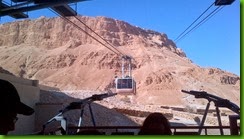
Here we are, right up at the top!ABIsendpics (95)

The tour also stopped at the Dead Sea (Yam HaMelach), another one of my don’t-mind-if-I-miss-it sites, but it was interesting to feel the water – at first.  My sister brought a bathing suit, but I just took off my shoes and waded in a bit, swishing my hands around as I went. 

So this is interesting:  it turns out my entire skin is made up of a network of fine cracks that exist only for the purpose of letting in the sea’s deadly mixture of salt, sulphur and bromides to inside my skin, where they can inflict the most pain.

They did.  It was painful, almost right away.  I washed it off and it was STILL painful.  Later on that evening, my legs started to burn, and as I write this, two days and two showers later, they are still itchy from the “healing mud.”  Feh. 

Another one to chalk off the bucket list, anyway, and never worry about not having carped the diem.

Wednesday:  Yad VaShem, Home Again

I’ve been thinking of Yad VaShem (Holocaust History Museum) as sort of a flu shot.  It’s not that I WANT a flu shot, but it’s good for me and at some point every fall, I work up the nerve to get one.  Except that every time I’m in Yerushalayim, I have young kids in tow, and even Naomi is too young (kids under 10 are not allowed).

No pictures are allowed inside Yad VaShem, which is a very good thing.  The museum is free, and we declined to rent the ₪20 audio guide – figuring that a decent museum should explain itself to you.  (We may have been influenced in this snobbery by our mother’s background in Museum Studies.)

Despite this, there were about fifteen big groups making their way through the museum while we were there, blocking the exhibits with guides shouting out explanations of all the exhibits.  In the groups that included teenagers, many of the teenagers were wearing the audio guide headsets, listening to those along with their guide (simultaneously?). 

My sister thought this was ridiculously excessive and I agree – if so much work and thought has been put into the exhibits themselves, what good does it do to stand a bored guide in front of them to shout about it to the viewers?

Because of the clumping of the groups at the entrance to every room and in front of every key exhibit, it was  hard to pass through without getting a little annoyed.  And then, at the very moving exhibit of shoes taken from concentration-camp victims, an Israeli girl was giggling and pointing at them.  Sheesh. 

Still, annoyance fades somewhat as you pass through room after room of exhibits that are so overwhelming and painful and brilliantly-thought-out.  I was very much Holocausted to death (um, to coin an awful phrase) in Hebrew school as a kid, so I feel like I’m sadly inured to a lot of it… but at a few points it got through to me in a very moving way.

My phone started beeping loudly in the Hall of Names, which was embarrassing, as it’s meant to be a quiet place where you hear names intoned of victims of the Shoah (Holocaust).  Whoops – it was Elisheva, texting to arrange lunch.

After Yad VaShem, we made our way via Light Rail Train to the Merkazit (central station) to meet Elisheva.  Everybody got a salad except me – McDonald’s!  Elisheva said a big, passionate goodbye to her aunt, and then in a flurry of confusion, we boarded the 960 bus back to Haifa.

     abitrip - Copy (3)

It’s been an eye-opening couple of weeks, being a tourist here in my own country.  The Hebrew I’ve learned has been very helpful, and although not a “vatik” (old hand) here, things don’t feel as fresh and new and scary as they did when we were here ten months ago on that pilot trip.

Yet I think I’ve enjoyed showing my sister around so much because it’s all new to me as well.  My sister’s really the first relative who’s visited – hopefully, there will be more opportunities to guide future relatives’ “tours,” and perhaps those, too, will be full of firsts (still lots of places I haven’t been!)… but at some point, it may start to feel like a “been there, done that,” kind of thing.

For now, though, it’s all just a heck of a lot of fun.

What did my sister miss???  If you had only twelve days in Israel, what would be on your “can’t miss” list?

Eyfo HaSherutim? איפה השרותים?

bathroom klalitFeeling like a savvy Israeli doesn’t happen for me very often. 

Today, I took a page out of Batya’s book (okay, blog) when we were out and about in Nahariya.  Strange city, ambling around having a good time with friends from our pilot trip… when Naomi Rivka announced that she needed a bathroom.

(we only took Naomi Rivka – GZ stayed home with Elisheva, yay!)

And I looked up, and like the chorus out of Life of Brian (if you haven’t seen it, you must), there was the local Klalit (they spell it Clalit in English) health clinic.  Using Batya’s rationale, we ARE Clalit members and thus, sort of, “customers” of theirs. 

I also knew that the closest public alternative was the bus-station bathroom, which would almost certainly be sub-par, and also, possibly, be available only for a fee of 1 shekel.  I learned this the hard way in Afula, where you hand over your shekel to an apathetic guy behind a desk who does NOTHING, and then enter the most hideously filthy bathroom which – for ONE shekel! – lacks seats.  It’s like a third-world country, except you’re paying for the privilege.

So… why be a freyer (sucker) if you don’t have to be???  Into the Klalit clinic we went, marched up to the front desk, and asked for the sherutim (literally, services or facilities).  The bathroom wasn’t great (actually required a bit of cleaning before she could use it), but it was free and there was soap, warm water and towels to wash up with afterwards.  (No hand sanitizer!  I have yet to see a health or recreation facility here with hand sanitizer.  Weird, since it’s practically synonymous with these places outside of Israel.)

Anyway, there isn’t much that makes me feel confident these days, but being able to find my kid a bathroom the INSTANT she demands one (it really did just appear there, like a mirage) is one heck of a happiness-booster. 

Oh, yeah, and then we stopped at a sandwich shop and I showed everybody the extensive sandwich menu so they could deliberate before I took a call.  And then… when I turned back a few minutes later, realized I was the only one in the crowd (two were just starting ulpan) who could actually read the menu.  Oops! 

We skipped that joint – too expensive, too complicated – and found a falafel / shawarma place that only had two choices (falafel / shawarma, and half / whole).  Thoroughly yummy!

While wandering around Nahariya, we happened to find delightful store we found in Nahariya called Gan Li / גן לי.  Okay, it’s true, I have a fetish for anything school related, but this is actually the first decent, comprehensive, school-and-art-supplies shop we have seen since we got here.

For months, we’ve been buying binders in one store, a hole punch in another, a filler paper at another, and pencils and pens somewhere else entirely.  Gan Li even had Akiva’s artist ink, and some decent markers he can use for drawing with.  And some cheap (₪9) no-name highlighters for Naomi Rivka and magnet pens for our fridge (₪5 each).  It’s not that the prices were so fantastic, it’s the fact that everything was all in one place that I found so very exciting!

image Oooh!  Ever a sucker for fun new card games, I bought the game Sleeping Queens (note:  links point to the English Gamewright version; the Hebrew one is licensed by FoxMind), for ₪40-something instead of the ₪60-something in the big chain bookstores.  But that’s a subject for another post…

All in all, a nice day spent with nice new friends in Nahariya.  And it was nice travelling home in comfort instead of sitting cross-legged on the bus all the way back (meandering every which way down the coast and through Acco) wondering where I’d find the nearest bathroom.  I’m Israeli; I already know!!!

Soldiers “R” Us: the warm, fuzzy army

chayelet irena naomi I’ve posted about them before, but okay, I’m STILL fascinated by chayalot – women soldiers, who are really more like girls because they’re just in their late teens and act more like a group of kids on a school trip than the highly-trained group of killers one normally associates with the word “army.”

I remember thinking about this when we were on our pilot trip back in February, and I took this picture of a bunch of them chayalim platformhanging about on a train platform, very much like they were waiting for a teacher to come and read them the schedule for the days’ activities.  Only kind of like Boy Scouts, because they were all wearing uniforms.  And oh, yeah, a lot of them do carry pretty scary-looking weapons.

But other than that, they’re just a bunch of kids… and it seems like one of the big army projects around here is sending kids – girls and boys – to tutor immigrant children and generally help them adapt to life in Israel.  They accomplish this through the medium of Hebrew classes and various lessons in painting and crafts.

Once, when Naomi’s regular teacher (Irena, shown in the big hug above) didn’t show up, I went to the office to find out why and discovered two big army guys, sitting around a table, cutting up used soda bottles.  “We’re making flowers!” they announced.

Surely this is how I would prefer to spend my army service, given the choice.  It’s sort of a messianic vision a la Yeshayahu (Isaiah):  nations will beat their swords into ploughshares, and soldiers will spend their days making pop-bottle flowers?  But perhaps the other army guys make fun of them for getting stuck in what may be regarded as even lower than a desk job.

(That same afternoon, a couple of actual Israeli Scouts (Tzofim) came in to volunteer, just a couple of years younger than the chayalim (far older than any Scouts I’ve seen recently in Canada), and looking not at all ashamed of their slightly goofy-looking Scout uniforms, scarf and all.  Not sure if there is a relationship between scouting and the army, but it seems like good preparation, if they also have to wear uniforms and make pop-bottle flowers with immigrants.)

Today, after a week of preparatory crafts, the chayalim and staff here put together a Chanukah party.  One chayal brought along a recorder and sheet music, the others corralled the children and ensured that the celebratory events went along with, okay, not-quite-military precision.

I assume the soldiers do these things mainly during fairly peaceful periods, and that if need be, they are deployed to somewhere more national security oriented.  I really don’t know at all how the system works, and lack the Hebrew to ask the chayalim and chayalot about it myself. 

How do they pick which ones will “volunteer” to teach the immigrant kids, as opposed to, say, foot patrols in the Golan?  Do they choose soldiers who have been wounded or frightened, or are otherwise unable to perform more rigourous duties?  Or do they rotate through the ranks, so everybody gets a turn?  Do they only pick soldiers who want to work with kids, or does everybody perhaps have to take a turn?

Although all branches of the army are easily identifiable by their distinctive shoulder patches (tag yechida / תג יחידה), which probably carry a lot of useful information for Israelis-in-the-know, I personally have no idea what any of the patches actually mean.  So the red flower logo on Naomi Rivka’s chayelet could mean she is in fact serving with the “Pop-Bottle Flowers” brigade.  I may never know.

But it is a very different thing, growing up with “friends” like these in the army than growing up in Canada, where (for most kids) the army is something distant, cold, and perhaps menacing. 

Kids who grow up in Israeli families probably know lots of friends and relatives who are serving, but for newcomers, adults and kids, the omnipresence of the army and the prospect of serving yourself (or sending your kids to serve, if you’re a parent) can be one of the most daunting and disturbing aspects of life here. 

So whether it’s done explicitly as a PR move or not, this project of sending cute, perky young soldiers to help little kids get used to life in Israel is utterly and completely brilliant.  The message:  Soldiers are young, fun-loving kids, just like you… just regular Israelis, just like you.

Notes from an aliyah pilot trip

Forgot to mention – I wrote this article – Notes from an aliyah pilot trip – about our pilot trip for the Canadian Jewish News and it ran over Pesach.

They used this picture of us, which I thought was an absolutely TERRIBLE picture, but my daughter said it’s one of the best pictures of me she’s seen.  I don’t know what she’s seeing, but when I look at it I see a bitterly cold February day on which we’re supposed to be standing looking out at Karmiel while I was busy regretting my decision to leave my jacket behind in the tour bus.

It really is Karmiel, though. 

Isn’t it pretty?

Again, in case you missed the link, click here to read the article.  Hard to sum up 2 weeks’ worth of very emotional work in 700 words, but I actually think I did quite nicely…

And the winner is…

Some of you may have noticed that we’re back from Israel, just in time for Purim and Naomi Rivka’s birthday… and a whole bunch of snow that I was really, REALLY hoping would be finished by now.

And the question hanging in the air everywhere we go is – “nu???”  (at least, that was the implication from about a dozen people at kiddush yesterday)

The goal of our pilot trip was to whittle down a long list of prospective home towns into at least a somewhat shorter list.

What we learned on this trip:

  • Despite the title of this post, there ARE no losers.
  • Everywhere is amazing.
  • There are no bad cities, only choices that would be harder or easier for us, given our own limitations.
  • Every city we visited had some huge advantages and some huge downsides.
  • Just about everybody we met loved the city where they lived and couldn’t imagine living elsewhere.
  • Just about everybody we met was amazing and giving and open and welcoming.  We expected this, to some extent, but still – it blew me away.
  • But, therefore… it came to feel (for me, at least) a bit personal.  Like if we choose City B, then we are going to offend Shmuli from City A and Rivka from City C… and so on.
  • But we cannot please Shmuli and Rivka, nor should we really try…

But we also learned that we cannot live everywhere, let alone on the fence.  We need to start making actual plans, so instead of coming home with a short list, we jumped ahead and picked our landing spot:  Karmiel. 

Here’s a virtual tour of Karmiel that is actually pretty cool!

You can also read the Nefesh b’Nefesh page about it.  They always start on a high note.  Then, there’s the wikipedia page, which usually includes the more controversial details sometimes left out of the NbN pages.  Or there’s the English version of the “official” Karmiel website, on which you can read a quote from the mayor, who says, “The age of on-line information invites the surfers to expected and unexpected” – the rest of the quote, scintillating though it may be, has been lost, perhaps in translation.

Here are some of the criteria that make me hopeful that Karmiel will work for us – keeping in mind that this is a VERY complicated equation:

  • Merkaz klitah for a short stay on arrival
  • Ulpan in town, along with other government offices
  • Good buses in town and to other cities – it’s possible, though difficult, to go carless
  • Urban feel with many walkable areas
  • The city feels clean and green – clean is probably year-round, though green, we understand, will probably fade with the heat.
  • The climate is cooler and drier than many other areas
  • More diverse, religiously, than some other areas – I’m aware that this could be (or become) a minus, but at least, coming from chutz la’aretz it will feel familiar.
  • Cost of renting is lower than in the central parts of Israel
  • Direct buses from Jerusalem – with train service planned within the next ___ (however-many) years
  • A “Young Israel” type shul that is mainly Anglo and at least claims to serve a diverse crowd
  • And finally… the annual Nefesh b’Nefesh Go North picnic is held right in Karmiel!  So no matter how clueless and lost we are by the time it rolls around, we ought to have no problem getting there.  :-)

That’s long enough for now.  I thought about putting together a list of why we’d rejected the many other possibilities, but decided that wouldn’t be fair.  Ultimately, we liked everywhere we saw, for different reasons.  I tried hard to keep an open mind and visualize myself living in each and every place we visited, and they were all a good fit in one way or another, so the choice was ultimately kind of painful.

Also, if I’m listing reasons for “rejection,” I could honestly write you a list of minuses of Karmiel as long as my arm, or longer… and yet that seems to be where we’re going.  Go figure.

When we left for Israel, I kept saying, “I’ll know it when I see it.”  I kind of thought that was a figure of speech – but in the end, that’s pretty much what it’s come down to.  We saw it, we knew, and I think we’re both pretty pleased with the decision.

Now, if we thought choosing a hometown was hard… the next step is – gulp – actually getting there.

Fwd: Israel pilot trip Day #11? - The Second-Last Day

Hello, my loves!
This was  our second and last day of bus shlepping - and we are both pretty glad.  It is not enough time to really see each place, so it's a little bit of a tease ... Maybe because they want us to come back to live and then see some more in our free time.

Today, we drove up into the crazy forests and hills of the Galil, the area just west of the Yam Kinneret (it's sometimes called the Sea of Galilee on maps, but nobody actually calls it that).  After we drove for a while, we came around the corner and there, in a valley, looking very tiny compared to Lake Ontario, was the Kinneret.  Everybody here is very excited because it's almost FULL - Israel doesn't get much water in the summer, so the rain that falls in the winter has to last all year.

Our first stop was a city called Karmiel, which means Hashem's vineyard.  There are lots of grapes growing all around, and olive trees and many other green, growing things.  We got a tour of the city and stopped at City Hall to meet the mayor.  He invited us all onto his office's porch to look out over a big park in the centre of town.  Karmiel has many Russian-speaking people, who came here straight from Russia when they were finally allowed to leave after many years.  It is an organized, clean city, though we couldn't find a nice coffee shop during our lunch break there.  They have plenty of stores and malls, though, and we did buy some iced coffee in a grocery store near City Hall.

Then, after "lunch," we were back in the bus for our trip to Tzefat.  It's a very holy city where lots of famous rabbis lived.  Abba got to daven mincha in the shul of the Ari - well ,outside the shul, because there were tourists inside and it wasn't exactly mincha time, so they just grabbed 10 people and davened.  The Old City of Tzefat is a strange place with narrow stone roads and art galleries.  I climbed to a deck on top of one of the galleries and took this picture looking out over the mountains and hills nearby.

There is also a big coffee factory in Tzefat and everybody on the bus was sitting around sniffing the air and saying how good it smelled (you cannot smell it through the whole city, just the area around the factory!).  Anyway, I would have liked to smell the coffee... But could not.  My nose was totally plugged and since coming back, up and down a million more hills, I cannot hear out of one of my ears either.  I hope it clears by tomorrow, because it can be painful to go up in a plane with a blocked ear. :-(

The best thing in Tzefat - well, best for me, because Abba loved the whole city - was meeting up with Mrs. Z (a friend from shul in Toronto).  The organizers invited some new olim to come talk at a youth centre ("youth" is defined as aged 18 to 45, but we were told they never turn away any "youth" even if they're a bit older), and they asked her to stand up and talk about their lives here.  She explained about how Hashem helped them find jobs and good schools for their kids.   They're apparently having a very good time, but we didn't see the kids, and Mr. Z was away at a wedding in Yerushalayim, so we couldn't meet up with him.

Tzefat took a long time, so after that we took a new shortcut road back to Nahariya, and it only took about 45 minutes.  Things look far on maps, but this is a tiny country, and nobody is too far away.

This is going to be my last email.  We have lots of work tomorrow, like classes about schools and work and also meetings with the organizers so they can see if any of the cities we like would be a good home for our family, and talk more about the good things and bad things about living up here at the top of the country (some things are a bit more expensive and in some areas you need a car, but on the other hand, it is cooler and greener in the north than anywhere else in Israel).

We are finishing our meetings by 4pm tomorrow, then packing into a taxi to take the train south to the airport.   There's no more kosher McDonald's at the airport, but they have a few kosher restaurants there, I think, so hopefully we'll get there early enough to get some food while we wait for the plane... to come home.

We will be home very soon now, and I am so excited to see you all!!!  I wish you could see how excited every single person is that Purim is coming.  It is a very busy, happy holiday here.  Practically every bakery has hamentaschen (oznay haman) year-round, but more now than ever.  Last night, we bought ones that were chocolate hamentaschen with halva filling.  Yummy!

Tonight, it is late and we are very, very tired.

See you very soon!!!

Google