Like the MamaLand Empire!

Have you Liked the AliyahLand adventure?
      ...and sign up for weekly aliyah tips by email (it's free).

Showing posts with label homes. Show all posts

What You Must Know: Purchasing And Selling Real Estate In Israel

image

I get asked about real estate surprisingly often given that I know nothing.  So I’m sharing this guest post by a lawyer who knows all the ins and outs of Israeli real estate market.

Since laws change quickly, please don’t take this as legal advice.  Check everything you’re not sure about with your own lawyer before you make any major decisions.  Except the decision to read this article, of course.  You have my permission to do that without consulting a lawyer.  :-)

--------------------

This article is the first of two that will cover the various aspects of buying real estate in Israel. The first article will provide a general overview of the Israeli real estate system, the major differences between transactions in Israel and the United States, and the most important considerations in such a transaction. The second article will cover special issues when the property is new and being bought from the contractor, and also taxation associated with purchasing and selling property in Israel.


What type of property are you buying?

“each type of land involves a slightly different purchase process”

There are two types of property in Israel: privately-owned (private land) and state-owned property administered by the Israel Lands Administration ("Minhal"). Private real property, like in the U.S., is owned by the buyer with title vesting in him. Land is registered in the land registry (Tabu) under the name of the buyer. On the other hand, title to Minhal property does not pass to the purchaser. Instead, the buyer gets a long-term lease to the property which is usually for 49 years with an option for an additional 49 years. Over 80% of the land in Israel is Minhal land, so the buyer should not be deterred from buying it. However, private land is often viewed as preferable. As each type of land involves a slightly different purchase process, one of the first things to check is whether the property is private or Minhal.


Choosing an agent

A quick tour of K Shmu aka Kiryat Shmuel

Enough of you seemed interested in my descriptions of Kiryat Shmuel, our new neighbourhood, to warrant another post with a quick tour of the neighbourhood.

First, like almost any place in Israel, it can be ugly here.  This is our building, which I’d classify as Pretty Darn Ugly, even by Israeli standards.  It is redeemed a bit by the beautiful little girl standing in front.

 IMG_00004181

That flowery “lawn” will be a dust bowl within 2 months, so it’s probably at its most charming right now.

But the upside of Ugly is Cheap – apartments here range from ₪1800 for a 2-bedroom (that’s what we’re paying) all the way up to about ₪3000 for the same number of rooms in a heck of a lot more spacious layout in the good part of “town.”

Some houses in the good part of town.

IMG_00004182 IMG_00004200 IMG_00004196 IMG_00004197

These are nicer than where we live, obviously. 

Basically, you get what you pay for.  Cheap = Ugly; Expensive = Pretty.  But it’s nice to know, if you are thinking of moving into the area, that there seem to be rentals available in just about every level and price bracket, as well as a good assortment of properties for sale.

The last house pictured, by the way, has been under construction since we moved here, with no end in sight.  They are making progress… just very, very tiny progress.

I’ve referred a few times to “downtown” Kiryat Shmuel, and here it is… a makolet (mini grocery store) and a post office.  I think there’s a hair dresser somewhere as well.  Upstairs, tucked in and hidden around the back, is the local “vaad” – the folks you pay for your water and sewage.  Somewhere near there is a teeny tiny public library, but we have yet to find it.

IMG_00004186

Someone in the post office is apparently learning English (notice the sign taped up to the partition):

image IMG_00004189

Notice they’re not post-office related words at all:  strudel, milk shake, stereotype?   Weird.

This is the Merkazi Beit Knesset (central shul - Sefardi):

IMG_00004190

Downtown KShmu also features a really nice park with actual, natural shade trees (a rarity around here):

IMG_00004192

… Right across from a very noisy, active Bnei Akiva “sneef” (branch).

IMG_00004194 

… and a community centre where Naomi goes to dance classes once a week (doh, forgot to take its picture). 

This corner is quite the hangout on a Friday night, after all the sensible people are tucked in safely at home with a book.  Teenagers take over the playground, the yard, the street and don’t give it back until morning.

Back to the central part of KShmu, where we live, we have the “main park,” a huge Shabbos hang-out for families and kids.

IMG_00004208 IMG_00004209 IMG_00004211

And the nice new food store – it just opened right before we came.  There’s also a Clalit health clinic, if you peer at the top-left corner.  It’s bigger than it looks, taking up the entire second storey above the food store.  Naomi Rivka says the food store is a trick because it looks like it’s 2 levels, but it’s really not.

IMG_00004210 

And then… it’s back towards our block, the old part of town.  No idea when this area was built, because my theory is that the salt air ages everything to look decades-old inside of, well, a decade. 

There are a few private houses here, along with some older ground-floor apartments that are “almost” like houses because they’ve been built out with patios, etc.

IMG_00004215 IMG_00004220IMG_00004222

IMG_00004219

(Notice the motorcycle parked just inside the doorway?  Not that there is a door.  Most of these older buildings omit that nicety.)

In my experience, most places – even those that look terribly run down on the outside – look decent, and even possibly VERY nice, on the inside.  I think nobody bothers with outside maintenance unless they have to, ie if something is threatening to fall off their house with disrepair.

Naomi’s teacher, for instance, lives in a building with a dingy entrance very similar to the one here with the motorcycle in it.  But when we went in a couple of weeks ago on Shabbos, it turns out the apartment itself is beautiful, modern, and spacious, with a full-sized ground-floor patio.

I guess folks here take the Pirkei Avos saying “don’t look at the jug, but rather, at what it contains” seriously.

This is our nearest miklat, shelter, because these old buildings and houses were not built with shelters of mamads (part of the current building code). 

IMG_00004218

Conveniently, but mystifyingly, there’s a shul that uses the shelter as well (see the sign above the door).  And there’s a sign on the door that says something about where the keys can be found.  This sign fails to reassure me.

A parkette with bench across the street that is pleasant right now, in the spring, but probably brutally hot in the summer:

IMG_00004221 

And we return, at last, to the dingy apartment block we call home.

IMG_00004223 IMG_00004178

Thanks for stopping by!!!

IMG_00004207

My new hometown: Haifa, a mixed-up love story.

IMG_00003904 Nearly two years ago, I narrowed down my personal Top 3 “places to live in Israel.”  To refresh your memory, those choices were Karmiel, Ma’alot, and Nahariya.

Quit laughing.

Then came our pilot trip, a year ago, when we came home having decided “for sure” – Karmiel.  Our new Israeli home had a name and it was a beautiful one.

Okay, quit laughing.  Again.

I still think it is a beautiful name… and a beautiful city, with a lot of what we were looking for.  But here we are nonetheless.

In case it isn’t clear, we’re not in Karmiel. 

We’re nowhere near Karmiel.  Nope, we’re in Haifa and it looks like we’ll be staying here for the foreseeable future.

To me, this is a great big “huh???”

What the heck am I doing in a city I knew nothing about before we came to Israel, other than that it wasn’t Tel Aviv or Yerushalayim??? 

If you’d asked me two years ago for a fact about Haifa, I probably couldn’t have come up with a single one.  Maybe, maybe I would have remembered that the Baha’i gardens are here.  I wouldn’t have known if it started with a “h” or a “ch.”

So here it is:  חֵיפָה. 

  • The first consonant is “ch” as in “I’ve got something yuchhhy stuck in my throat.” 
  • The first vowel is actually “ey” as in “prey.” 
  • Which means nearly everybody pronounces it wrong.

Say it:  “chey” “fa”.  The origins of the name aren’t clear – it could come from the word “חפה” (chafa, a cover or shield, because of the mountain that “covers” the city) or a short form of “חוֹף יָפֶה” (chof yafe, which means beautiful beach), or from somewhere unknown.

Of course, when I say “we’re in Haifa,” I mean… technically speaking.

Technically, Kiryat Shmuel is part of Haifa, though I’m not sure there is a solid contiguous connection, because we’re actually about half an hour away from what anybody sane would consider Haifa, namely, the big green sparkly mountain that I’m growing increasingly fond of.

The big green sparkly mountain off in the distance, a considerable distance away.

In contrast, here is flat, tiny Kiryat Shmuel:

Here is “beautiful downtown Kiryat Shmuel,” right across from the Central Shul:

Here is the most exciting thing that ever happened in Kiryat Shmuel:

http://www.krayot.com/wp-content/uploads/2012/06/hanut.jpg

(translated news report:  “driver in his twenties, apparently lost control of his private car, went tonight (Wednesday) into a hat shop in Kiryat Shmuel Shapira Street”)

(note:  this is right across from our house!)

So that’s Kiryat Shmuel.

Still – due to some bureaucratic fluke, our apartment is technically in Haifa, and that’s where I have to go if I want to do something like register my kids in school, like I did last week for Gavriel Zev.  Naomi Rivka will continue in her Kiryat Yam school, which we’re very happy with, for the rest of the year.

I probably should have remembered my mother saying Haifa was beautiful. 

IMG_00003898She must have seen only the good bits; as a former British oil refinery and port town, there are plenty of not-so-good bits around here as well.  She must have seen the green, mountainy parts, and maybe skipped the bits that look like a giant used car lot – slash – car tire factory.
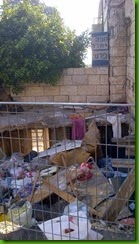
IMG_00003897It’s meaningless to say Haifa is a city of contrasts, because what city isn’t?  But still – there are contrasts. 

Between the nice green parts and the falling-down parts.   (This caved-in formerly-residential dwelling has a sign above it saying “parking forbidden – private.”)

Between the Jewish parts and the not-so Jewish parts (rambling down the street and encountering groups of Arab schoolchildren).

IMG_00003899Between the parts that feel familiar (big office towers) and the parts that feel foreign (this wreck of a building with a winter rose blooming out front).  

Oh, yeah, and the port.  What a big crazy deal THAT is.

You can see the port cranes in the distance (on the left) here – behind a different wrecked old building and a nice new office building.

IMG_00003903

When buildings collapse here, it seems like they just leave them and go build somewhere else.

As I said, our Haifa address is sort of just a technicality, but having grown up in a suburb of a big city, it feels very familiar to me, this living one comfortable rapid-transit ride away from the hustle and bustle (and from what I consider the country’s most depressing shuk, or market).

I’ve also been wondering, because of the seeming randomness of our ending up here… 

Is this the best place in Israel that we could have picked?

Answer:  I can’t answer that.  It’s an impossible question.

Was Toronto the best place in Canada for our family?  Maybe, maybe not.  We didn’t “pick” Toronto, it just happened to be where we were, and it’s most likely that even my grandparents and great-grandparents didn’t pick Toronto but were simply sent there, by relatives or government officials or Fate.

We liked it there, in Toronto – dare I say, we loved it there?  It’s a great city.  But was it the BEST?

We had a tough time on our pilot trip because, everywhere we went, everybody told us what was great about where they lived.   Everybody we met loved where they lived; they honestly believed they lived in the BEST place, and many of them thought we should pick their place, too, because it was simply the BEST.

And in the end, we picked none of them.

We picked this kinda-smelly rinky-dink third-rate town (literally, a distant third after Tel Aviv).  And I think we’re starting to like it.

We may indeed have found ourselves in the best possible place… for us, for now.

Last night, coming home by train from the south, I enjoyed the sight that always welcomes us these days when we’re on our way home:  the famous evergreen mountain, Mount Carmel, covered in magical lights, winking and welcoming me – weirdly – home.
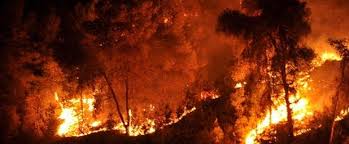
There’s an old Hebrew song called “the evergreen mountain,” about Mount Carmel – specifically, its forest. 

Two years ago, when I was in Canada and the Carmel Forest was on fire, the deadliest fire in Israel’s history, which destroyed perhaps half the forest area, I wouldn’t say I didn’t care… but I didn’t take it personally. 

Today, and probably forever, it’s personal.  I care about this evergreen mountain; I’ve started to love the lights, and even the weird rambling wreck of a city in whose shadows I live and work and play every day.

Here’s the song:

Here are a few of the words:

פקחתי את עיני, היה אז חודש שבט,
ראיתי מעלי ציפור קטנה אחת
ותכלת השמיים וענן יחיד
וראיתי -
את ההר הירוק תמיד.

ההר הירוק כל ימות השנה,
אני עוד חולם ושואל
לנשום רוחות יך כבראשונה,
לשכב בצילך כרמל.

Thanks, Google Translate!

I opened my eyes, it was then the month of Shevat,
I saw above me one little bird
And the blue sky and single cloud
And I saw -
The ever-green mountain.

Green Mountain all year round,
I still dream and ask,
To breathe your winds as they were before,
To lie in your shadow, Carmel.

To lie in your shadow, Carmel.

Things that are weird in Israel #2: Plastic Toilets

IMG_00002901I was astonished when I first saw it, but now I’m already starting to get used to seeing these everywhere we go, so I wanted to post before the novelty wore off…

Actually, there isn’t really much more to say.  There is a toilet, and it is plastic.  All the visible parts are plastic, including the seat, the bowl, the part that holds water.  I haven’t looked inside to see if everything inside is plastic, too.  Oh, and the brand name – which is ubiquitous here – is “Plasson.”

Some toilets have dual-flush handles (plastic), a little one inside a big one; ours has flush buttons, but the “large” flush gets stuck so I have taped over it.  (You can always use two small flushes if need be, but the truth is that small is always enough.)

This is actually what we call the “potty room,” given that the two functions of our former bathroom are divided into two different rooms, a pretty common design for Israeli homes.  It is literally, a potty, in a room.

  IMG_00002902

Next door is the “shower room,” where the sink also lives.  You’d think it would make sense to divvy up the tasks this way, but in fact, I don’t like it very much.  You always have to wash your hands after using the potty room, and if somebody is using the shower room, you have to go all the way to the kitchen.  However, since this is a smallish apartment, that’s not much to complain about, I guess.  But the nice soap is in the shower room.

Some homes avoid this difficulty by having a “spare sink” just floating somewhere in the hallway; also useful for negel vasser (morning handwashing) on awakening, as well as netilas yadayim (washing before a meal with bread).  However, as one of our family members has already gleefully noted, the shower room, since it does not contain a toilet, can be used for handwashing and bracha-making anyway (which isn’t usually fitting to do in a room with a toilet, though some halachic authorities have ruled that a modern bathroom is nowhere near the same as the kind of toilet facilities that existed when the Talmud was being written and so a bracha might be able to be said in there… but we don’t anyway).

So enough of that.

Another weird feature worth mentioning about Israeli bathrooms is the window.  Ours, though tiny, has not one but TWO windows.  The first is on the door – almost every bathroom has this, for some reason.  It’s translucent; perhaps so you can see if somebody’s using the bathroom by the light coming through?

 IMG_00002903

(notice the door handle, and taped-over lock – I had to put masking tape over both sides of this because of a peeking little boy)

The other window is above the toilet, and it’s huge – it’s the sole “ventilation” system for the bathroom – which opens up right into… the “utility porch,” a little sunroom just off the kitchen where I hang our laundry.

Here are the two windows, from the shower room (left) and potty room (right), opening, essentially, right into the kitchen:

IMG_00002904

Notice that you can see right in.  Comes in handy for passing stuff to somebody in the shower, like if they forgot their towel.  Not so handy when somebody in the shower hangs her towel over the window and it falls out into the kitchen.  Just saying.

Notice the little air freshener lurking in the corner, just to the right of the potty room window.  I have scrubbed and scrubbed the floors and other surfaces within an inch of their lives, but there is STILL a little bit of a smell if I let the air freshener expire.  I’m normally pretty offended by artificial scents like this, but frankly, the smell it’s covering up is worse.  Plus, there’s a huge open window right next to the air freshener, so most of its smell wafts away.

Okay, I seem to be blogging a lot about smells, and the downside of life here… so my next post will be (slightly) more uplifting, I promise.

Previously in this series…

Google