Like the MamaLand Empire!

Have you Liked the AliyahLand adventure?
      ...and sign up for weekly aliyah tips by email (it's free).

Showing posts with label transit. Show all posts

Three things that are better in Israel since we came

image

A few months ago I was interviewing longtime olim and they all talked about the different ways that Israel was different since they came 20, 30, or even 40 years ago.  Which is nice, to think that the general trend is onward and upward, but not always so encouraging for those of us who are coming now (for example, hearing that you don’t have to wait a year to get a phone line when we’re already used to it being practically instant back wherever we came from!).

But things aren’t just changing in the long term.  We’ve only been here for 5 years (Five?!  How did that happen??!?) and already there are things that I’m noticing that have changed in little ways, making life better and better still…

Here are 3 of my favourites.  If you’re here in Israel already, I’d love to hear yours in the Comments!

1) Fruit

Actually, I didn’t think the fruit situation here COULD get much better.  Except for the fact that a) fruit here is so seasonal, and b) we sometimes like frozen fruit for baking and smoothies.  In Toronto, we used to just keep a tub of blueberries, some strawberries, mangos, whatever, in the freezer to toss into things.  Here, we couldn’t really do that, creating the irony of a bounty of strawberries davka (exactly) during the chilly winter season when you really don’t feel like an icy smoothie.  Where were the strawberries during the summer when I desperately wanted them? I wondered.

And now, guess what?  FROZEN fruit has come along to solve some of our fruit problems including strawberries, blueberries (impossible to get fresh where we live), and more. 

image

There are even these smoothie-oriented mixes, though they all have “weird” stuff in them like

What’s cheaper??? Three things you’ll love paying less for in Israel

image

We all love to kvetch.  Or maybe I’m just speaking for myself.  I definitely love to kvetch!  But sometimes, it’s worth stepping back and looking around at how much is truly wonderful about this unbelievable place we live.

Here are three that I’m really enjoying this week:

1. Public Transportation

This is my number one.  In fact, this was what caught my eye on Facebook today.  Someone was kvetching about the high cost of buying and renting a car—and they were right.

True, cars are expensive, but public transit is almost laughably cheap.   It’s even cheaper than when we arrived in 2013.  In an era when nothing goes down in price, fares were actually LOWERED around most of the country a couple of years ago!

Here’s what I’m talking about:

I took the kiddies to Jerusalem two days ago.  The three of us went from north of Haifa to Jerusalem and back, taking local buses in both cities, inter-city buses, and trains.  The train was an hour, a one-hour bus ride, then several local trips within Jerusalem.  Then, five hours later, an inter-city bus ride back to Haifa and one local trip to get home.

Total cost?  ₪60 per person. That’s under $20 (US).

Oh, and we could have traveled for another 12+ hours on the same fare, had we been so inclined, because it’s good for 24 hours from purchase.

Where, outside of Israel, can you get around cheaper than that?

(NOTE:  This isn’t what trains look like in Israel nowadays!  This is an authentic 1970s-era train on display in the Railway Museum here in Haifa.  Photo © Deror Avi via Wikimedia)

Two years ago, we were in Ottawa and I wanted to leave my family there and get back to Toronto by bus.  It’s a five-hour train ride, so farther

5 failproof ways to enjoy chol hamoed in Israel

image

If there's a downside to living in a Jewish country, it may be the fact that everybody celebrates the same holidays.  That means everyone is on vacation at the same time.  Which means, in turn, that every attraction, every highway, every bus route and train line, is going to be jam-packed if you're heading to the most popular destinations - and even some unpopular ones.

This Pesach was our (hmm...) eighth chol hamoed living in Israel (Sukkos / Pesach year 5774, Sukkos / Pesach 5775, Sukkos / Pesach 5776, Sukkos / Pesach 5777 - omg, I can't believe it.)

Our very first chol hamoed (Sukkos 5774), we headed to Yerushalayim, little suspecting that everybody else in the country had the exact same idea.  Public transportation in Yerushalayim isn't entirely reliable at the best of times, and this was NOT the best of times.  We spent a large chunk of the day stuck in traffic.  Very frustrating!

I'm not saying Jerusalem is out of the picture.  But based on our experience and some others over the years (!), I've come up with a few rules for planning chol hamoed activities with the least possible stress.

Here are five tips that will help you sail through chol hamoed with the greatest of ease:

1. Book ahead

Lots of attractions here let you pre-book a specific time slot.  We did that for a few activities this chol hamoed, including the Dialogue in the Dark exhibit at the Israel Children’s Museum in Holon, a jumping / bouncy castle attraction (also in Holon, we made a day of it), a local trampoline place, and the movie theatre.   Last year, I also bought tickets to a play at the Haifa Children’s Theatre Festival.  During previous chol hamoeds, we’ve done various circus things.  There are always choices like this, which allow you to plan ahead.

The movie theatre is a great example.  Sure, they charge something trivial like 5 shekels extra to pre-book, but you get to pick not only your movie time but also your seats.  Yet the throngs at the box office bely the fact that this is 2017 and such a thing as the Internet even exists.  People show up and then act surprised that there are so many other people; they get into the theatre and act surprised that the good seats are already taken.  Plan a good surprise – prebook and you can waltz right in anytime.  We had to kick people out of our seats, but I tell myself they could have booked online, too.

2. Show up on time

Top 5 non-touristy things to do with your mother in Israel

image

My mother left last week after a too-short 2-week visit before which she insisted that all she really wanted to do was “take the grandchildren to school.”  Fair enough.  It can’t have been easy coming back to Israel after the vacation of a lifetime she spent here with my father 9 years ago.  Basically, she didn’t want to do anything touristy… so we didn’t.

Instead, here are five of the activities I enjoyed most during her visit:

1. Haifa – why not?

I think this was the first full day my mother was here, and it was basically a “Why not?” inspiration.

My mother had spent about a week in Haifa on her trip with my father, so she was already familiar with the city, unlike 95% of tourists, and actually liked it… unlike me.  Okay, yes, I technically live in Haifa, but I’m kind of ambivalent about the city.  But we were sitting home one morning, it was a sunny day, and the shuk is literally one bus ride away.

So there was practically nothing to lose.

Oh, the other reason was that I’m crocheting a blanket and I needed a ball of yarn to match one I already had because otherwise I would have run out mid-project.  And there’s a yarn store I go to quite close to the shuk. So off we went, hopping on the bus and paying our 10 shekels or so for the pleasure.

The yarn store was actually a minor hit – nothing like the fancy stuff my mother buys, but it was mundanely familiar and she bought a little stitch-counter accessory for another 10 shekels.  Down the street was a store selling socks that actually go over the knee, which I desperately needed, and we each picked up a couple of pairs. 

(Though I confused my mother by asking the shop lady for “tights,” and she said they didn’t have “tights,” and my mother kept insisting they had tights right over there, until eventually I had to explain that “tights” in Hebrew isn’t the same as tights in English.  In Hebrew, it means leggings or bicycle shorts, depending on the length.)

While downtown, I also introduced her to Cofix and the pleasure of 5-shekel coffee, which we took with us to the shuk. 

And the shuk, as it turned out, was more charming than I’d remembered. 

I hadn’t been in over a year because I avoided it during shemittah – most of the vendors are Arab and I wasn’t sure about the produce there.  Also, all the citrus stuff was in season and every single vendor was offering samples.  I think my mother managed to eat the equivalent of about 5 oranges, just from samples.  I bought some small stuff, including local garlic, because more and more stores are just carrying the stuff in nets that comes from China, for no good reason that I can tell.

The best part was that with a short walk out of the shuk, we were back on the same bus, headed home, and inside of 25 minutes, we were here lounging on the sofa.

Or, perhaps the best part for you reading this, is that there are NO pictures.  I brought my phone, but it remained a phone for the entire time.  In Haifa, I guess, I’m not really a tourist at all.

2. Get your mother lost in Akko

image

This one was another “why not?”

Definitely not for everybody, but it’s super-close to here, so I figured it would be nice for a sunny-day wander through the Old City.  Unlike Jerusalem’s Old City, it’s easy to get to and on a weekday morning, there was plenty of parking (don’t try that on Shabbat, as I understand that Israelis from all over the country travel up there for hummus and more). 

The road less settled: 8 reasons to consider living in the REST of Israel.

image

I love Israel – absolutely every inch of it.  But as you may have noticed, we’ve made the decision to live outside of the centre of the country.

Not that I’m knocking the centre of the country – it’s great.  I love it, and I travel there regularly.

But there is life for English-speaking olim beyond Yerushalayim and Tel Aviv, Raanana, Rechovot and Beit Shemesh.  With that in mind, here are eight great reasons why (whether you’re here already or thinking of aliyah) you really ought to consider the REST of the country…

1) It's ALL holy.

It says in Kesuvos 112 that “anyone who walks four Amos in Eretz Yisrael is guaranteed a share in the world to come.”  Now, there is some dispute about the Biblical boundaries of the country, and so some bits of desert around Eilat may not count.  But the fact is that the mitzvah is to live here in the country itself, on the holy land Hashem gave to Avraham Avinu.  Not just one or two selected cities.

2) It's not THAT far away.

Things that are cool in Israel #9: Tripping over history

image

Are you a dummy about history?

Don’t know your Maccabees from your Hasmoneans?  Can’t tell Greeks, Romans and Babylonians apart?  Well, relax – there’s no way you could be dumber about Israeli history than I am.

And the great thing about living in Israel is you just kind of ABSORB history by living here.  It’s all over – so much so that at certain times and places, you’re actually tripping over it.  Like today, when we went and visited a whole bunch of graves.

Even if you find graves kind of creepy (who doesn’t?), even the gravest sites in Israel have been thoroughly sanitized by time and by the nice archaeology people who are in charge of removing the bones to Elsewhere for a proper burial before they swing the doors wide to tourists.

Sure, Israel has some big-name graves (Rabbi Shimon bar Yochai and Maimonides being two of the biggies), but we decided to head a little off the beaten path today to celebrate one of Northern Israel’s cultural treasures – the grave of Rabbi Yehudah Ha-Nassi (Judah the Prince), otherwise known throughout the Talmud as “Rabbi.”  Why does this guy merit the one-name appellation, out of all the rabbis who have ever lived, throughout Jewish history?

Rabbi Yehudah Ha-Nassi is better known as the REDACTOR of the Mishna.  He was the editor, the guy who pulled together all the oral traditions floating around and single-handedly, perhaps, saved Judaism as we were poised on the brink of a very long exile.

After Rabbi Yehuda Ha-Nassi requested to be buried there around the year 217, the village of Beit She'arim in the Jezreel Valley became THE trendy burial site for Northern Israel.  Lots of famous and wealthy people hurried to follow his example.  So there are lots and lots and lots of long-ago relatives to visit, in a lovely park-like setting on a deliciously breezy hillside.

Arabs, on the train

image

I'm sitting on the train, it's late, and I'm on my way home.
Far too exhausted to be paying attention.

I step past a family of Arabs, their boxes spreading into the aisle.  There are grandparents, parents, a little girl.  They chatter all the way north.

I may be exhausted, but I can't help paying attention.  My life depends on paying attention around Arabs, I've been told. 

Even when they're travelling as a family?  Even when they've got a little girl babbling on their laps?

I don't understand their language.  Are they talking about me?  Arabic sounds horrible, guttural and strange.  I know Hebrew must sound that way to others; to me, it sounds like the Tanach, like poetry.  The Arabs' Arabic is sprinkled with Hebrew here.  They say "b'seder," and other Hebrew words.  Do other Arabs outside of Israel feel like they are contaminated with Jewishness?

I don’t know if they’re talking about me, but I’m thinking about them.  Not them, exactly. 

You know:  Terrorists.

Oh, yeah; that.

I'm writing a blog post about terrorism in Israel.  I start hunting for a picture of a knife to go with the post, then realize my screen faces towards them.  Will they know what I'm thinking about?  Will they think I am thinking about them? 

I quickly search for the word "girl" even though I do not want a picture of a girl to go with the post.  Slowly, I creep back towards the pictures of the knives, choosing a relatively tasteful one instead of something bloody and garish.  Not my style, anyway. 

The child is facing away from me, sitting with her parents.  The older people are facing in my direction.  Perhaps their eyes are old; perhaps they can’t see what I’m doing.

I modify the picture in furtive bursts,

On a roll (it’s not what you think it’s about)

image

Have you tried Israeli toilet paper lately?

It's actually quite good – as toilet paper.  Definitely better than it was, I'm told.  Which is good, because good old TP has been re-imagined (or perhaps always was) the National Nose-Wipe.

In fact, the toilet paper here is quite good.  Apparently, it used to be simply awful - crunchy and non-absorbent, I assume, since those are the things it would take to make TP simply awful in my book.

I know what I'm talking about.  In England on my honeymoon, years and years ago, I stayed in the World's Worst Hotel, near Paddington Station, which we thought would be cute - but it wasn't. 

There was no bathroom in the room itself, just a little water closet ("loo") up half a flight of stairs.  And the paper in there was absolutely awful.  It was that folding, single-paper dispensing kind that we'd had in my elementary school.  However, unlike anything I had ever seen before, each "sheet" of this paper was treated with some sort of smelly antiseptic chemical and then - mysteriously - waxed so that it was guaranteed to never absorb a single drop of anything.  It was crispy, it was stinky, plus, it simply did not do the job.

Compared to that, anything is better, and as I said, toilet paper in Israel is way more than halfway decent.  It's soft, it's 2-ply, and there are cute puppies on the brand we buy.  There are even premium 3-ply grades you can buy for extra indulgence.

But I still think it’s gross how everybody uses it to wipe their noses.  Maybe this happens elsewhere, too, but I have only ever observed it on a sweeping scale here.

Sure, actual "facial tissues" (aka Kleenex, but they're called "tissue" here in Hebrew) are available, in various colours, small and big packages.

But forget about all that. 

Trains and buses: Getting around in Israel (with a helpful vocabulary list!).


As I write this, I'm getting ready to take a couple of buses and head over to Teveria (Tiberias).

Taking buses and trains is fun and easy in Israel, and it’s been a core part of our experience here, in mostly good ways.  If you’d asked two years ago, here's what most olim could have told you about taking public transportation:
  • Israeli bus drivers make change - if not cheerfully or graciously, than as an accepted part of their many duties. 
  • Israeli public transportation is, mostly, prompt and on-schedule.
  • Trains in Israel are a pleasure - except when they're closed or on strike.
  • Drivers are not so helpful if you're looking for a particular destination, but passengers universally are.
  • Local bus fares are generally good for 90 minutes, with any number of stopovers, in any direction.
  • Buses never have washrooms – even long-haul buses like the Haifa to Eilat run (6 hours).  There are 2 stopovers in miserable little truck stops.
  • Trains are generally more comfortable than buses – especially if you need to get up, walk around and/or use the washroom.  You might pay a few shekels more, but it’s worth it.
Haifa's wonderful new high-speed "Metronit" buses.


Though Israel is low-tech in a lot of surprising ways, there is one bit of high-tech that has made travelling by public transit a real pleasure, and that’s…

The Magic Info Number

Uncommon beauty: Haifa’s Technion campus.

image

Sometimes, asking “where’s the most beautiful place in Israel?” feels a bit like asking, “what’s the most beautiful callus on your feet?”  The answer’s obvious:  there isn’t one.

Call me a snob, but I’m Canadian.  I can’t help it:  Canada is breathtaking.  Just driving down the highway from Toronto to Ottawa, nowhere special, you pass through forests so primordially green that they can make you weep.  Not to mention British Columbia and the Rocky mountains (oops, I just mentioned them).

Israel, by contrast, has some nice bits.  I don’t mean to suggest that it doesn’t.  But it also has a heck of a lot of stretches that look pretty much like this:

IMG_00004620

The bleakness is not awe-inspiring.  For the most part, it’s just kind of scruffy and, well… dull.

So when I find beauty, even a scrap of it – by which I mean the slightest expanse of green – I fall in love.

Kurt Vonnegut wrote in his book Cat’s Cradle, “Peculiar travel suggestions are dancing lessons from God.”  (Click here to view/share this graphic via Facebook.)

israel

Today’s travel suggestion came in the form of a meeting at the Technion, Israel’s premier university of technology.  It’s also the country’s oldest university (founded in 1912, though they didn’t start actually having classes until over a decade later, so I’m not sure it counts).

And my “dancing lesson” came in the form of discovering a jewel in the middle of Haifa’s occasionally “meh” landscape.  (Okay, yes, Haifa is built on a very steep mountain range and that in itself is cool and kind of awesome to look at.  But many parts of the city are scruffy at best, even if it is starting to grow on me, a little.)

Still alien? Passing the one year mark.

small alien

I did an experiment this morning.

I woke up, stretched etc as usual.  And then thought to myself, “I’m waking up… in Israel.”

Nothing.

“Here we are… in our apartment… in Israel.”

Nope.  No response.

I guess I was trying to shock myself back into feeling the newness of it… except it really isn’t new anymore.

Last Wednesday was our “aliyahversary.”

If aliyah was a baby, we’d have been blowing out candles, feeding it cake.

It might be taking its first steps by now.

Things that are weird in Israel #7: School Buses

image Know what I haven’t seen since we got here?  Oops, did my picture and headline give it away? 

Okay, you guessed it – one of those junky yellow school buses with their rubbery, incident-proof seats and the SMELL that hovers around you the minute you walk in, no matter how many of those rattley windows you open.

For some reason, they don’t seem to exist here.  And I say that having visiting many cities now… let me know if you’ve seen them where you are, but I simply haven’t.

For the first few weeks after school started, I remember thinking, every single morning, “hmm… there sure are a lot of tours coming and going from this area.”  Tours?  To Kiryat Yam?  Every single morning?

Silly me:  those were the school buses.  They look like regular coach buses, with coach bus company names on the side and the ubiquitous – yet somehow slightly sleazy – curtains on the window. 

image

I have often watched kids clambering aboard (the stairs seem impossibly high for very young children) and thought about asking them if they knew how lucky they were.

Lucky to have air conditioning, arm rests, cushioned seats covered in REAL fabric (do Israeli children have fewer incidents on buses than in North America???).  Seats shaped roughly like actual human spines, rather than bookshelves:

image 

(photo credit:  Bill McChesney)

Rather than children going off to a mundane day of study, they look like tiny tourists, off to see the world.  Of course, it’s a lovely metaphor, but it probably feels just as mundane, after the first day, as travelling on a city bus, or a plain ol’ yellow school bus. 

But to me, it nonetheless says something about how this country treats its children.  That they are to be trusted, and driven in both safety and comfort.  That the destination is important, even if it feels like dull routine.

Whatever you think, one way or the other, don’t do what I did and google “Israeli school bus.”  Take my word for it: this post is the most cheerful one you’re likely to find on the subject.

(top photo credit:  H. Michael Miley)

Haifa’s Sinyon: all it’s cracked up to be?

sinion Israelis love the Far East:  they travel to Asia in huge numbers and it stands to reason that they’d like to bring a little of that Asian exoticism back home with them.

This winter, to great self-conducted fanfare, the “Sinyon” (this seems to be the official English spelling) opened in Haifa, proclaiming itself Israel’s first “Chinese mall experience.”  The word “kenyon” (קַנְיוֹן) means mall, and “Seen” (סִין) means China, so, with their love of portmanteau words, the creators of the Sinyon stuck the two together:  Chinamall = Seen-ee-yon.  Whoopee!

According to the company’s website, “it” (they don’t say what; Chinese people?) has had “huge success in Las Vegas, Johannesburg and Bangkok.”  It boasts a great location near Hof HaKarmel train station and 2000 free parking spaces.

I doubt they’ll need all 2000.  More like 20… but then, to be fair, we went in the middle of a working weekday afternoon.

IMG_00004452

My short summary of the experience might go as follows:  the best thing about the Sinyon is that it’s just one short bridge-crossing away from the REAL Azrieli Haifa mall, where you can find real stores, as opposed to cheesy little rip-off kiosks.

Some attempt has been made (see the picture at the top) to create a nice Asian ambience.

IMG_00004444

There is also a restaurant, offering greasy typical-Israeli Chinese food, served by an Asian-looking woman who speaks great English.

 IMG_00004445

More Asian “ambience”:

imageimage

I’ll be honest… we hope eventually to host friends and family members here in the area around Haifa… so I’m always on the lookout for interesting things to do nearby.

This will not be one of them.

Having been to (and eaten in) excellent Chinatowns in Montreal, San Francisco, Toronto; heck, even Washington, D.C., I’d be embarrassed to even suggest to somebody that they might have even a remotely Chinese experience in the Sinyon.

One big plus:  It was certainly easy enough to get there – it’s one ten-minute bus ride through the mountain from the Merkazit HaMifratz central bus station (Haifa has 2 central bus stations, one on either side of the mountain, with an awesome tunnel connecting them).  The bus ride was a real highlight of our trip to the Sinyon.  Sadly, the Sinyon itself was not.

In terms of the merchandise, there is no “theme” and the stuff is all over the place.  Mostly poor quality, cheap and cheesy.  Bracelets, underwear, backpacks, and a low-quality off-brand-name toy store selling “Barbara” dolls with the word “Barbara” written in Barbie script.  I wouldn’t even really call it a mall; more like a triangular strip of stores.  We didn’t find anything there that we couldn’t buy cheaper in any local "shekel-o-Rama."

Welcome to China, the website proclaims!

image

It also brags that, “The Sinyon mall targets all family members… [with] diversified activities for the whole family, drawing its inspiration from the colorful Chinese culture.” 

image

It may well be that we didn’t see it at its best, but these only-slightly-flawed posters that greeted us just inside the door (most likely printed in China!  yay, Asia!), seemed to be about it in terms of expressing the “colorful Chinese culture.” (as opposed to the black-and-white Israeli one?)  The posters read, “Family this main and the best in life,” and “Time to drink champagne and dance one the table.”

image 

Like I said, the Sinyon’s best feature may be its proximity to the real mall.  But by the time we got there, I was tuckered out from looking for real Chinese culture and annoyed that I was fleishik and over-full from the substandard overpriced sticky-starchy Chinese-food lunch that would have taken second place to most food court Chinese (though I should note the presence of dumplings, hot & sour soup, and chicken-corn soup on the menu; I got a dumpling and Elisheva had the soup.  Both were reasonably good, unlike the sticky glop that is most of their food items).

I’ve heard rumours that more Sinyonim / Chinamalls are coming soon to other Israeli locations… at least, their website hints that this is the start of a trend.  If one opens near you, you might want to visit once out of curiosity… but if your experience is anything like ours was, I’m fairly certain you’ll want to stay away after that.

Is there anywhere in this country to find real Asian culture???  I really would love to know…

Things that are weird in Israel #6: Cracking the Sherut Code

IMG_00004022 This is one of the big cliches about Israeli life, so I kind of feel bad even mentioning it.  But not bad enough to not mention it, and here’s why - because I’ve finally cracked the code! 

(Sort of – I’ll explain in a minute.)

The sherut, monit sherut, or shared taxi-van, was actually our very FIRST Israel experience, way back when, on our ill-fated trip to Yerushalayim five years ago.  It’s almost everybody’s first Israel experience – you get off the plane, wander stunned out of the airport and into the hands of a guy who, for 50 shekel, will stuff you into an oddly curtained van with a bunch of other stunned passengers, heading into Yerushalayim or wherever you happen to be going.  (price may vary!)

Then you doze a bit and, eventually, the driver tells you you’re there, and you fall wearily out of the van with your luggage.

Sherut = “shared” = Service

Monit SherutSo that’s the sherut.  Easy to remember because, although the word means “service” in Hebrew, it sounds like “shared” in English.  It’s a taxi, that you SHARE, with a bunch of smelly in-transit strangers.

Here in the Krayot, however, there are other little yellow “service taxis” that are vans, albeit more run-down (still with the tacky curtains), that ramble around on regular, predetermined routes.  

(This grizzled guy in the picture?  That’s exactly who drives every single one of these – except the one time I got a female driver.)

These are almost like buses, and in fact, run mainly along well-travelled bus routes.  Ever since we got here, I’ve been trying to figure out why people take them instead of the regular buses.

In my head, I even made up this short list to compare the two:

City Bus Monit Sherut
Comes less often, (sort of) on a schedule Comes more often, whenever it feels like
Many passengers, luggage, standing room if full Only 10 passengers, no standing room
Easy to enter with stroller/shopping Harder to enter with stroller/shopping, plus nasty glares from other passengers if you are carrying much more than a handbag.
Stops at stops Stops anywhere, usually with a screech and the thud of a dying cat.
Accepts transit pass (Rav Kav) or cash Takes cash only, preferably small change or they’ll yell at you.
Discount if you buy 10 fares Can’t buy multiple fares ever ever ever
Discount for kids’ fares No discount for anyone; don’t even ask or they’ll yell at you.
Transfer free to any other buses / metronit in the krayot for a full 90 minutes No transfer to anything else ever; don’t even ask or they’ll yell at you.
Full price 6.90nis Full price 6.90nis… or so I thought!

You can see that city bus is coming out waaaaay ahead, financially, except for one thing.  See that last item?  Here’s what I just learned two weeks ago:

The monit sherut only costs full fare if you’re going the longest distance!!

Remember I said I’d cracked the code?  That’s the code! 

If you’re not going all the way, the fares are on a sliding scale.  From our house to the ulpan or the library where I volunteer (too lazy to walk sometimes!) only costs 3 shekels, instead of nearly 7 for the bus.  That’s about a buck. 

For a dollar, especially if I’m running late, especially if I’m not going somewhere else immediately afterwards, it’s sometimes worth it.

So, in answer to my question (it only took 6 months to figure out!):

Why do people take the monit sherut? 

Because they…

  • a) are going too far to walk,
  • b) are going somewhere directly on the sherut’s route,
  • c) aren’t transferring anywhere afterwards, and probably
  • d) aren’t going far enough to want to pay full fare.  They may also
  • e) want to catch a bus at a screeching halt in the middle of a block (or get off in the middle of a block) rather than walking from a more distant bus stop.

I did say the little sherut buses come more often, but that’s not always true.  Just like the feral cats all over the place here, they come and go whenever they please.

One more fun thing about the sherut:  drivers are in a BIG hurry. 

Time is money, but only if they’re driving.  So they don’t want your money when you get in.  They want your money while they’re driving, because then, money is money (or something).  Drive, drive, drive:  it’s their prime directive.

So you sit down first (unless you want to get yelled at) and discuss niceties about where you’re going and how much it costs later.  Which is nerve-wracking if you’re only going a few “stops,” because you don’t have long to take care of the entire transaction – especially if the driver doesn’t realize the city has a library and where it might be.

Usually, you shout to the driver (over his blaring music or a Russian newscast) where you’re going, he shouts back the fare, then you begin the process of “passing” the money. 

The Ritual of “Passing” the Money.

Don’t stand up!  Just hand your money over to the person in front of you.  They pass it to the person in front of them, and so on, all the way up to the driver.  Then, whatever’s left of your money after your fare has been deducted comes wending its way back to you via the same sweaty palms who passed it up in the first place.

Each participant murmurs the code to the next in line:  “ta’avir la nehag” (for a girl, “ta’avri la nehag”).  Everybody knows what’s going on, but they still say it – it’s a magical incantation to keep the money safe on its journey. 

(In ulpan, we learned to say “timsor / tims’ri la nehag,” which is technically correct – but so, in English, is adding the phrase “good fellow” when asking your best buddy to do you a favour.  You can say it, but normal folks will think you’re odd.)

Anyway, it doesn’t matter if it’s five shekels you’re passing, or five hundred, you WILL get your change.  This passing is not considered a “nicety,” as it would be where I come from.  (Okay, in Toronto it would probably be considered an extreme “weirdity” to hand a stranger a 100-dollar bill to give the driver.)

Passing the money is as mandatory as if you were at the dinner table and someone asked you to pass the water pitcher.

If you don’t like handling other people’s sweaty change, you could try positioning yourself near the back of the sherut to avoid this weirdity.  But I’m still at the stage where I find it charming – plus, with only 10 seats, there’s usually no choice left.

So what’s the plural of sherut???

If you know anything about Hebrew, you’ll know that the plural of sherut is “sherutim,” but you’d be wrong, because that means bathroom

Because its full name is “monit sherut” (service taxi), the proper plural is “moniyot sherut” (service taxis).  Or, as Elisheva loves to say in her fake-broad Ashkenazi accent, “moniyos sherus.”  Apparently, they’re also referred to as “monit special.”

Have you had an exciting sherut experience?  Share it here!!!

Being a tourist in my OWN country!

Haven’t posted in a while because I’ve been busy.  With what???  Showing off this new homeland that I love so much to my sister, who’s visiting from Canada.

If you had only fourteen days in Israel (twelve when you subtract Shabbat), what would you see and do???  That’s the question my sister had to answer when she arrived at Ben Gurion two weeks ago today.

It’s hard to believe that almost a year ago (well, ten months), we were strangers here on a pilot trip.  My sister has been visiting for the last couple of weeks, which has given me a chance to do a bit of touristy stuff that I’ve really never had a chance to do – except this time, to do it as a real Israeli, kind of.

(Kind of because I gave my Canadian passport to the Arab-run hostel we stayed at in the Old City of Jerusalem… I think they’re Christian, but I was still nervous about what they’d do if an Israeli tried to check in.  More about the hostel later.)

So where did we go?

First of all, I actually wasn’t quite finished Ulpan (Hebrew-language boot camp) yet… my sister arrived a week before my final exam, so not exactly ideal timing, as it was the most intensive week of the entire course.  But I’m nothing if not resilient, and you can’t negotiate with holiday-season airfares.

Thursday:  Tel Aviv / Yaffo

abelish (2) My sister arrived on a Thursday morning, and didn’t want to just head north right away without experiencing a bit of the “merkaz” (central part of the country) vibe. 

I suggested that for the same train fare, we could spend some time in Tel Aviv and Yaffo (Jaffa) instead.  Well, she suggested Yaffo, which was a great call (apparently, she’d read up a little on the plane!). 

In Yaffo’s Old Port, we walked in the footsteps of Napoleon (kind of) and viewed a fascinating historical presentation / tour of an underground marketplace called Jaffa Tales.

Then, we headed to the shuk (market), not far away in the new city of Tel Aviv.  I don’t love the shuk in Tel Aviv; it’s bustling enough, but not much there is kosher.  Having said that, however, there’s a lovely bakery inside that makes the most luscious cheddar-cheese buns.  They’re not cheap, but I bought some to eat on the train back.

After that, plus a quick falafel break (my sister says this disproves my claim that there’s no kosher food around, but I really don’t count falafel stands), we hopped on a bus back to the train station.

This was the day of the big snow in Yerushalayim but Tel Aviv seemed completely unaffected and the day was lovely; brilliantly sunny and definitely warm enough for someone who’d just arrived from Toronto.  It was also Elisheva’s 18th birthday, so – after waiting 5 hours for a bus out of Yerushalayim – she joined us up north for an impromptu (read:  made by Ted/Akiva) birthday supper.

Friday:  Teveria

Okay, I admit – I didn’t want to travel anywhere on a winter Friday when Shabbos came in just past 4:00 pm.  So I sent my sister and Elisheva out to Teveria, thinking they’d have a grand old time seeing the Kinneret and whatever historical stuff is out there.  But no… it was a freezing, rainy, miserable day by any standard, even a Canadian one.  Everything there was closed and, oh, did I mention it was a fast day?  (the 10th of Tevet)  They came back frigid and miserable, but we had a nice cozy Shabbos together later on.

Sunday:  Haifa

My sister wasn’t really all that interested in seeing Haifa, but the weather – though chilly – had cleared up and I didn’t want to shlep around when there are some lovely things to see nearby.  I’m really glad we did.

abigail haifa (5)The day was full of firsts, even for a “veteran” (4 months) Haifan (well, Krayot person) like me.  After a quick Metronit ride into town, we rode the funky-weird Carmelit subway line (world’s shortest subway, only 6 stops!) up the mountain to the Bahai Gardens.

From the bottom of the Bahai Gardens (the free tour walks you down the stairs and lets you out near the middle of the gabigail haifa (16)arden, so it’s an easy walk the rest of the way down), we found a very unhelpful Tourist Centre in the German Colony (no kosher food, as I predicted – even falafel) where I noticed in a brochure that there’s a cable car ride up the mountain. 

The unhelpful, borderline-rude woman behind the counter directed us to take the Metronit to a certain stop for the cable car… at which point we found out that it was nowhere nearby.  We were also aiming to visit the Cave of Eliyahu (Elijah), which was also nowhere nearby.  So we walked… and walked… and walked…

abigail haifa (27)Finally, we reached the cable car, which looks a bit like a baseball hanging from a string and is run by several incomprehensible but friendly Arabs who mainly sit around eating lunch and pressing the button to make the cable car run.

abigail haifa (32)The ride was slightly scary, but we made it to the top, which opens onto a disappointingly dull monastery (Stella Maris).  There was no information or description of the site whatsoever, although a priestly type in a long robe offered us a choice of ancient mimeographed brochures in our choice of German or Italian.

After that dullness, we rode back down and noticed we were spitting distance away from Eliyahu’s Cave, so we stomped off there, despite Elisheva’s warnings that it was weird and tacky and boring.

It was all that and MORE!  The cave itself was decorated in the type of Rabbinic art-kitsch that one can find in many living rooms – pictures of rabbis and holy sites.  There are some historical things up on the walls as well, which do provide a little interesting background, but it’s not exactly a tourist site.

Just as we were giving up and getting ready to leave, a bearded man in a long robe (his was white) came in carrying a shofar.  He asked in Hebrew who we were and where we were from and if we had any special requests, and then offered a really lovely and long bracha, after which he blew the shofar (also long) rather dramatically. 

In terms of showmanship, I felt that the Jewish site had won hands-down.  So there, monastery.

Another quick Metronit ride (one transfer) brought us home, and I was glad to be so close to home at the end of the day.

Monday, Tuesday, Wednesday, Thursday:  Eilat / Petra

In an effort to help me not fail the ulpan exam, my sister took off that night by herself via Egged overnight bus for Eilat and Petra, where she stayed until another overnight bus on Thursday night.

Shabbat:  Home

To celebrate my birthday, completing ulpan and sister’s visit, and to commemorate my father’s fifth yahrzeit, we had a small but nice kiddush here for some of the people we know who live within walking distance.  It was lovely.

Sunday:  Caesarea, Akko, Rosh HaNikra, Yerushalayim

I accidentally or on purpose told my sister I didn’t want to leave for Yerushalayim until Monday, so she booked herself a tour of the north on Sunday.  I was just in Akko during Chanukah and wasn’t at all interested in going again, so she left by herself early Sunday morning on a train to meet her tour bus in Caesarea. 

ABIsendpics (5) I stayed home and wrapped up some stuff here, then headed straight to Yerushalayim, where I met up with Elisheva and checked into the most bare-bones hostel you can imagine.

Let me first say:  I am NOT a fussy traveller.  I have stayed in hostels before in all sorts of places.  Thus, I am no stranger to bare-bones accommodation.  Yet I can easily, comfortably state that this hostel was the biggest dump I have ever stayed in.  It was pretty terrible, but over the course of 3 nights (and the sleeping wasn’t too bad), we sort of got used to it.  (Or is that what they call Stockholm Syndrome?)

The hostel is in a very Arab part of the old city, and its location (just inside the Jaffa Gate) is the only thing it really has going for it… well, that and the price, which was ₪70 per night (about $20) in an “8-bed” (ie 4 bunk beds) women-only dorm.  As I said, I presented my Canadian ID because I wasn’t sure how much they’d love having an Israeli staying on the premises.  Still, I felt secure and comfortable – especially the second night, when I had a second blanket and they brought another heater into the room in an effort to put down the chill.

After I checked into the hostel, I figured I had about 4 hours to kill (turned out to be more like 6), so I wandered the Old City, which was really kind of great.  I let myself get lost, safe in the knowledge that my trusty GPS would get me out if I was stuck.

ABIsendpics (24)I headed back to the hostel to change into warm evening clothes, and met Elisheva when her classes ended at 7.   Eventually, my sister arrived at the Jaffa Gate from her tour of the north.  We took her straight to the Kosel / Kotel where everybody said a little something and marvelled at its antiquity and sanctity… or at least at the ability to sit down for a minute after a busy day of touring.

Afterwards, we got dinner with Elisheva at a lovely if rather pricey Asian place (formerly Japanika, now called Sushi Bar, on Shlomtzion Hamalka, off Yaffo).

Sleeeeeeeep… I was so tired from all that walking.

Monday:  Yerushalayim
ABIsendpics (28) A full day to be a tourist in Yerushalayim; my dream come true!  Woke to the sound of prayer calls, church bells and Arab schoolchildren, and stumbled out of bunk bed to find the CityTour / Egged “Route 99” tourist bus, which – for a very reasonable ₪60 – tootles around the city on a two-hour route that shows you the most important bits of everything, along with the names of 300 miscellaneous neighbourhoods that nobody in a million years is ever going to remember.

ABIsendpics (32)After the bus tour ended, we had three hours to kill before the FREE (!) walking tour we’d planned for the afternoon, so I took her to Machane Yehuda (the Shuk / Market) for lunch.  My idea of lunch in Machane Yehuda is:  buy cheese, buy pita, buy iced coffee, wash somewhere, find a sunny bench, eat. 

Her idea of lunch was a little more complicated, and shifted halfway through the search to include a salad and pesto.  But eventually, we both had accumulated a variety of delicious things and we made our way back (for various reasons) to a bench outside the Old City to eat them all.

abitrip (6) - Copy  The walking tour was also two hours and it was GREAT.  It is literally FREE but they tell you up front that it’s nice to tip ₪10-15 at the end.  I figured if the tour was any good at all, it would still be worth it ($3-5?!?).  It was wonderful (and they only mention the tip thing twice – once at the beginning and once at the end, though they do plug some of the other tours they offer around the Old City; fair enough, I think). 

We got to see all four “quarters”abitrip (7) - Copy of the Old City and the guide was clearly very, very experienced, pointing out historic sites and sharing fascinating legends about every part of the city.  Way better than just walking around and trying to notice things on your own.
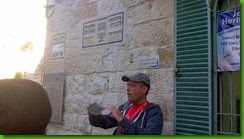
We both tipped him happily at the end of the tour.

Not wanting to call it a day just yet (even though it was almost dark already), we headed back to the hostel to change (days were hot; nights were FREEZING) and then out again to buy tickets for the Sound & Light Show at the David Citadel Museum. 

The show was a little hokey, and probably would have been more enjoyable at a warmer time of year, but still impressive.  They project images on the stone walls of the Citadel (which has nothing to do with David HaMelech, our tour guide explained), showing the history of Yerushalayim from the earliest times… in a slightly whitewashed and somewhat more peaceful, calm manner than I suspect things happened in real life.

After that, we got dinner – tasty, tasty Big Apple Pizza on Ben Yehuda Street, and marched back home to sleep, exhausted.

Tuesday:  Dead Sea & Masada

ABIsendpics (67)This was a packaged tour that I bought online, and it was good.  Just good, not great, but good is sometimes good enough.  Ditto with the guide:  not tons of fun, but he did a good job, and he was guiding and explaining as he drove our little van, which he did expertly and well.  My sister told me afterwards that he was holding a microphone; I didn’t see that at the time or I might have been more alarmed.  I assumed it was mounted on the dashboard.

ABIsendpics (59)This was really my first time seeing and  appreciating the quite-deserty desert that covers most of this country.  We passed the mountains where the Dead Sea Scrolls were discovered and they seemed – well, more mountainy than others I have seen before because they’re so bare – in the Rockies, mostly what you notice are the trees and forests.  None of that to distract you here.

We stopped at the Ahava Factory Outlet, which I assumed would be our only ABIsendpics (80)chance to buy Ahava products.  We both resisted, but it turned out there would be plenty more opportunities… the Ahava Company maintains quite a presence down there around the Yam HaMelach (Salt Sea, its Hebrew name).

Masada has never been high on my list of places to go.  I’m not sure how I feel about Jewish zealot groups hiding out from the Romans and their group suicide makes it a bit controversial that we continue to memorialize them.  ABIsendpics (87)Still – the views were breathtaking and I’m glad I went.  Happy we didn’t have to walk up like the many teenagers who were there with Birthright groups.  ABIsendpics (92)They have a lovely cable car, nothing scary like the one in Haifa.
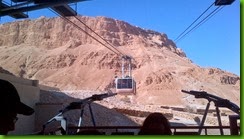
Here we are, right up at the top!ABIsendpics (95)

The tour also stopped at the Dead Sea (Yam HaMelach), another one of my don’t-mind-if-I-miss-it sites, but it was interesting to feel the water – at first.  My sister brought a bathing suit, but I just took off my shoes and waded in a bit, swishing my hands around as I went. 

So this is interesting:  it turns out my entire skin is made up of a network of fine cracks that exist only for the purpose of letting in the sea’s deadly mixture of salt, sulphur and bromides to inside my skin, where they can inflict the most pain.

They did.  It was painful, almost right away.  I washed it off and it was STILL painful.  Later on that evening, my legs started to burn, and as I write this, two days and two showers later, they are still itchy from the “healing mud.”  Feh. 

Another one to chalk off the bucket list, anyway, and never worry about not having carped the diem.

Wednesday:  Yad VaShem, Home Again

I’ve been thinking of Yad VaShem (Holocaust History Museum) as sort of a flu shot.  It’s not that I WANT a flu shot, but it’s good for me and at some point every fall, I work up the nerve to get one.  Except that every time I’m in Yerushalayim, I have young kids in tow, and even Naomi is too young (kids under 10 are not allowed).

No pictures are allowed inside Yad VaShem, which is a very good thing.  The museum is free, and we declined to rent the ₪20 audio guide – figuring that a decent museum should explain itself to you.  (We may have been influenced in this snobbery by our mother’s background in Museum Studies.)

Despite this, there were about fifteen big groups making their way through the museum while we were there, blocking the exhibits with guides shouting out explanations of all the exhibits.  In the groups that included teenagers, many of the teenagers were wearing the audio guide headsets, listening to those along with their guide (simultaneously?). 

My sister thought this was ridiculously excessive and I agree – if so much work and thought has been put into the exhibits themselves, what good does it do to stand a bored guide in front of them to shout about it to the viewers?

Because of the clumping of the groups at the entrance to every room and in front of every key exhibit, it was  hard to pass through without getting a little annoyed.  And then, at the very moving exhibit of shoes taken from concentration-camp victims, an Israeli girl was giggling and pointing at them.  Sheesh. 

Still, annoyance fades somewhat as you pass through room after room of exhibits that are so overwhelming and painful and brilliantly-thought-out.  I was very much Holocausted to death (um, to coin an awful phrase) in Hebrew school as a kid, so I feel like I’m sadly inured to a lot of it… but at a few points it got through to me in a very moving way.

My phone started beeping loudly in the Hall of Names, which was embarrassing, as it’s meant to be a quiet place where you hear names intoned of victims of the Shoah (Holocaust).  Whoops – it was Elisheva, texting to arrange lunch.

After Yad VaShem, we made our way via Light Rail Train to the Merkazit (central station) to meet Elisheva.  Everybody got a salad except me – McDonald’s!  Elisheva said a big, passionate goodbye to her aunt, and then in a flurry of confusion, we boarded the 960 bus back to Haifa.

     abitrip - Copy (3)

It’s been an eye-opening couple of weeks, being a tourist here in my own country.  The Hebrew I’ve learned has been very helpful, and although not a “vatik” (old hand) here, things don’t feel as fresh and new and scary as they did when we were here ten months ago on that pilot trip.

Yet I think I’ve enjoyed showing my sister around so much because it’s all new to me as well.  My sister’s really the first relative who’s visited – hopefully, there will be more opportunities to guide future relatives’ “tours,” and perhaps those, too, will be full of firsts (still lots of places I haven’t been!)… but at some point, it may start to feel like a “been there, done that,” kind of thing.

For now, though, it’s all just a heck of a lot of fun.

What did my sister miss???  If you had only twelve days in Israel, what would be on your “can’t miss” list?

Yom Yerushalayim

IMG_00002465  Planning our aliyah, I said over and over that I didn’t think we could live in Yerushalayim, for many reasons, but that there’s no point in living in this country if we can’t get there on a regular basis. 

So today was the test of that:  how easily can we get to Yerushalayim from up here in the north?  (and also, another importanIMG_00002464t question, how affordably?)

The answer is:  it’s an easy trip – for an adult.  For the kids, it’s a bit much.

For an adult, it costs ₪42 (about $12-14) from the Haifa bus station, plus the local fare to get to the bus station.  Normally, that’s ₪5.50, but because they’ve just unveiled and are working the kinks out of a new super-duper high-speed Haifa transit system, the Metronit, it’s temporarily free to get to the bus station – bonus!!!

Time-wise, the Metronit makes it much easier, replacing a bus that was annoyingly slow the 2-3 times we had to take it during our short stay here.  But in order to get to the station free and save the ₪5.50 (per person!), we have to walk to the Metronit, which is not exactly close.  So what with kid-walking-speed taken into account, the travel time to the Haifa station is still about one hour.  Drat.

The bus to Yerushalayim leaves once an hour (a bit more often during rush hour).  Once you’re on the bus, it takes exactly 2 hours to get there, not a bad stretch of time, but a restless one for little people.  We brought books and other forms of entertainment, but it still felt a little on the long side.

(The bus was full both ways.  On the way home, as luck would have it, the last seat on the bus, ie mine, was waaaaay up at the front of the bus, far away from Ted/Akiva and the kiddies.  So I had a nice, relaxing ride while they made him crazy the whole way back to Haifa.  The last couple of passengers, both times, spent the trip sitting on the floor.)

Arriving in Yerushalayim, I noticed a difference in the weather immediately.  They say it because it’s true:  “It’s a DRY heat.”  Yerushalayim is bone-dry right now.  So’s Haifa, but here, we have the damp, salty Mediterranean air, with a humidity often reaching into the 90% range.  There, you drink and drink and drink and drink… and it all evaporates out your pores.

It is VERY dry in Yerushalayim; did I mention that?  But that means that when there’s a breeze, it feels nice.  In the shade, it feels nice.  Most importantly, the stickiness that has clung to our skin for the last 12 days finally evaporated, leaving us feeling slightly human again.

Our “errands” for the day were:  daven at the kosel (kotel, western wall), find lunch somewhere afterwards, get ice cream at the place I saw near the kosel back in February, stroll through machaneh yehudah market (shuk) and then meet an old friend so our kids could play with her kids.  Oy – too much for one day out with kids!!!

IMG_00002449  By the time the bus pulled into the merkazit (central bus station) in Yerushalayim, the kids were starving and melty, so we shuffled the priorities and added Aroma iced coffee to the list, stopping at the super-cool Big Apple Pizza near Yaffo Street.IMG_00002448

The pizza was very nice, though I refused (now that we’re officially Not Tourists) to let the kids buy sugary drinks to go along with them.  They knew we planned to get ice cream later anyway.

However, stopping off BEFORE the kosel meant a longer walk to the kosel itself… a hot, sunny shlep until we reached the Old City, where all the weird covered alleyways were about 15 degrees cooler.

Eventually, we made it to the kosel:

  IMG_00002452 IMG_00002451

It sounds redundant to say it was sunny there, too, but the big open plaza made it feel EXTRA sunny.  Some of the ladies were taking shade under a temporary construction bridge across the ladies’ section, but most of those seats were taken.  Anyway, I told the kids we wouldn’t stay long, and just did a couple of chapters of tehillim (psalms) before turning around. 

Well, not literally.  There’s a minhag (custom) to not turn your back on the kosel, just as you wouldn’t turn around and walk away from royalty; it’s just rude.  Some people don’t know and just turn around and leave; others take it to an extreme and walk backwards the whole way out.  I kind of do a compromise where I go backwards until I feel I’m not really “there” anymore and that it would be ridiculous to back up any farther.  Then I turn around.

By the time we’d worked our way back through the warrens of the Christian Quarter, the rest of the plan had kind of gone to pieces because we were late.  My friend was very time-constrained, as her son was coming home from school soon (chareidi boys’ schools started back on Rosh Chodesh Elul).

We tried to catch a cab, with no luck, so took the train to machaneh yehudah instead.  Then we caught a cab to the park where we were to meet, only 15 minutes late.  Found our friends and it was a nice playground; the kids had a good time, if not for nearly long enough.

They walked us back up almost all the way to machaneh yehudah (the shuk) and then left us on our own.  Both kids were starting to complain about their legs hurting, so I promised that by the time we got to the other side of the shuk, they would have a) fresh juice drinks, b) halva, and c) a train ride back to the merkazit.

Happily, I was able to make all those dreams come true – cups of fresh limonana (icy-cool lemon-mint slushy) and countless halva samples later  (yes, I bought some to bring home, but not much, because we’re NOT tourists!), we caught the train back to the merkazit. 

Quickly checked the time and we had FIVE minutes to catch the return bus to Haifa!!!  Pre-emptively, I had demanded a complete schedule and platform information when we arrived in the morning, knowing it might be a rush on the way home.

(Note about the bus station – if you go to a “tickets” window and ask for information, they will yell at you; if you go to the “information” window, they may still yell at you, but they will also happily give you all the information you need, and it is very, very useful!) 

(She yelled because I asked for the schedule and then clarified because I didn’t think she’d understood me, so she yelled that she was getting it already.  It may not have been actual yelling, but it was scary to my Canadian ears.)

I was happy now that I had done all that already, but I also knew that when security is tight, it can take way more than five minutes just to line up and get in to the merkazit, let alone three floors up to the departures platforms (ratzif, ratzif, ratzif… must stop calling them “ritzpah” (floor) instead of “ratzif” (platform).)

Weirdly, for some reason, there was NO security.  Like, the door was wide open and the security guy was doing something else.  He didn’t even wave us in; he didn’t even look.  We ran up the escalators, ran to the platform (ratzif!) and eventually made it into the last four seats.

Exactly two hours later, we pulled in to the Haifa merkazit, and an hour after that, we tumbled sleepily into the apartment, two hours late for a Skype call with my mother, which lasted about two minutes.

Ted / Akiva had the BRILLIANT idea of having hot dogs for supper (oops, yes, we are eating a lot of meats-with-preservatives these days; hopefully it will average out over a lifetime).  I was totally craving them after the delicious-smelling hot-dog stand we always pass in the merkazit in Yerushalayim.  It is very, very nice to be able to find kosher buns at any hour.

GOOD:  When we got home, a fedex was waiting for me with the replacement for my VISA card which was cancelled last week.  They refused to mail it to my mother’s house but spent however-much to fedex it to me across the Atlantic.  Whatever; I’m happy it’s here.  Also, we found a bank machine that worked with our cards, all the way down there in Yerushalayim.  Good to know, though it may be the only one in the entire country!

BAD:  We dropped off Ted / Akiva at the store to buy the hot dogs and I took the kids home on the local bus (yes, I spent the ₪5.50 per person – GZ was so tired on the Metronit that I had to give him a Werther’s candy to keep him awake.)  Naomi sat by herself in the back of the bus and I didn’t notice she got off without her “teek” – the brand-new extra-huge-for-school Roots backpack her Aunt Cheryl bought her when she came to Toronto 2 weeks ago.  :-(  So I have to call Egged Haifa lost-and-found in the morning and figure out how to tell them we moronically lost our bag.  Also, our teudot zehut (identity papers) are officially lost and we have to spend tomorrow shlepping around replacing them.   That’s actually kind of good news – by this time tomorrow, we may have them at last.

Google