You know what's cool about about Israel that I don't write about often enough? Prayer. (Yeah, yeah, yeah, kindly overlook the fact that I haven't blogged here in over a year.) Bevakasha.
Because I really want to talk about prayer for a second. Prayer so cheap you take it for granted. Specifically, books of Tehillim (Psalms). Here in our local "stock" shop (Max Stock Kiryat Chaim), they sell bulk packages of keychain sifrei Tehillim, 7 for ₪10. If you're in the U.S., that's less than $3.
Sometimes, asking “where’s the most beautiful place in Israel?” feels a bit like asking, “what’s the most beautiful callus on your feet?” The answer’s obvious: there isn’t one.
Call me a snob, but I’m Canadian. I can’t help it: Canada is breathtaking. Just driving down the highway from Toronto to Ottawa, nowhere special, you pass through forests so primordially green that they can make you weep. Not to mention British Columbia and the Rocky mountains (oops, I just mentioned them).
Israel, by contrast, has some nice bits. I don’t mean to suggest that it doesn’t. But it also has a heck of a lot of stretches that look pretty much like this:
The bleakness is not awe-inspiring. For the most part, it’s just kind of scruffy and, well… dull.
So when I find beauty, even a scrap of it – by which I mean the slightest expanse of green – I fall in love.
Kurt Vonnegut wrote in his book Cat’s Cradle, “Peculiar travel suggestions are dancing lessons from God.” (Click here to view/share this graphic via Facebook.)
Today’s travel suggestion came in the form of a meeting at the Technion, Israel’s premier university of technology. It’s also the country’s oldest university (founded in 1912, though they didn’t start actually having classes until over a decade later, so I’m not sure it counts).
And my “dancing lesson” came in the form of discovering a jewel in the middle of Haifa’s occasionally “meh” landscape. (Okay, yes, Haifa is built on a very steep mountain range and that in itself is cool and kind of awesome to look at. But many parts of the city are scruffy at best, even if it is starting to grow on me, a little.)
Most of this makes our life here in the Krayot seem calm in comparison.
Actually, life here in the Krayot IS calm. There is no “seem” about it. No sirens here so far, which sets us apart probably from most Israelis at this point, both north and south.
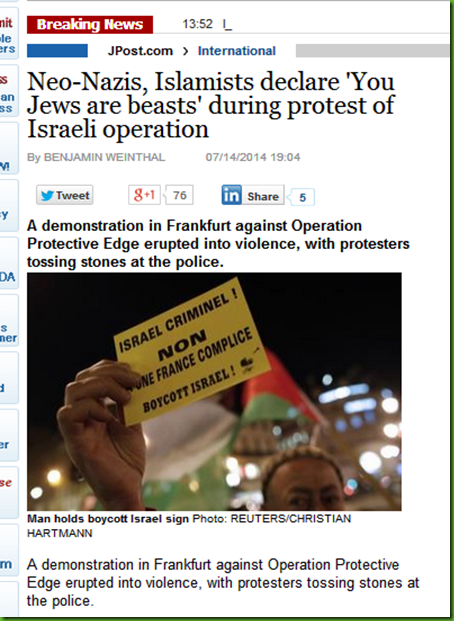
As opposed to France.
These days, if you mention France to any Jew, anywhere, they shake their heads glumly. “Oh, France,” they say, like it’s obvious that France would turn into the clearly dangerous place that it is for Jews today.
Tomorrow, we’re going to visit our friends who live in… Tzfat? Tsfat? Maybe its ultra-weird English name, Safed?
No problem, though, we’ll just catch a bus from where we live in Kiryat… no, make that, Qiryat… hmm, or Qeeriyat… Shemuel. Shmuel?
Argh.
English place names here can make you crazy.
If you’re lucky, the English version bears some resemblance to the actual place name, ie what the people who live there call it. Sometimes, it doesn’t.
A minor example: Haifa. Before I lived here, I had no idea, really, if it was a “H” or a “Ch” at the front. Is it “Hi” as in, “Hi, howya doin’?” Or “Chhhhhai” as in “Le’chhhhhayim!” (turns out it’s a Ch)
Some places are impossible to guess. For various historical linguistic reasons, even one of the most currently newsworthy areas, the Gaza Strip (let’s think of it as part of Israel for a moment) is actually called Aza in Hebrew.
Blame it on the Crusaders
But the city spelled “Acre”? Let’s pronounce it Akko. I think that one is the Crusaders’ fault.
Safed? Hmm… better pronounce that one Tzefat. If you’re Ashkenazi and not going anywhere other than shuls and graves of holy people, you may be able to get away with calling it Tzefas, but don’t try it in the rest of the country.
Some of this is the fault of Christianity, which has popularized these ridiculous names. It’s hard to unlearn 2000 years worth of Bible study. Here are some of the good place names Christians have ruined permanently.
Joppa? Say it Yaffo.
Tiberias? Teveria.
One of my favourites, for the way it fails to trip of the tongue, is the now no-longer-a-town, Capernaum… or, in Hebrew, kfar Nachum.
Halfway through her school year, our older daughter started referring to the city where she lived, most pretentiously, as Jer-oo-zalem. Another Crusader / Christian legacy, I’m sure. The rest of us stuck with Yerushalayim.
Sometimes, Israelis are so confident in the rightness of their pronunciation that they act like they don’t care a bit how it’s written in English. After all, it’s right there in Hebrew character, and Hebrew (unlike English) is a totally phonetic language.
So who needs English?
English speakers, that’s who.
Somebody has already (in Hebrew) beaten me to the punch with this article (here’s the Google English version) to complain about street signs here in the Krayot, with a pretty funny collection of signs spotted in Kiryat Bialik, considered one of the “nicer” Krayot… but not, I guess, in terms of its English literacy.
Yes, they have spelled the name of one of the world’s best-known Israeli military leaders and statesmen “Mina Aham Begin.”
Remember, these signs were all collected from the SAME very small city. Somebody in City Hall could probably just keep a list of all the street names and consult it when they need to order a new sign.
The secret – revealed!
But they probably do more like what they were doing in the passport office where we happened to be waiting for another reason a few weeks ago.
Here is the secret of English place names in Israel and how they come to be so very, very wonky.
When the clerk had to transcribe a person’s name into English for his passport, she called out to the office in general, “How do you spell ‘Danny’ in English?”
When one of her clerk friends started guessing (wrong; she left off the extra “n”) I called out the answer from where I was sitting in the waiting area.
The guy was doing about thirty passports, I think, for every living member of his family, and eventually – literally after 40 minutes - we left in disgust. But not before helping out with the spelling of 5 names in English that would have been transcribed disastrously wrong had we not been sitting right there at the time.
THAT, my friends, is how street signs are made in Israel.
I have solved the mystery, and here is how it happens: the clerks call out to their friends, “How do you spell ‘Menachem’ in English?” … and whoever answers first calls it.
More signs of madness
One that really drove me crazy when I saw it in person was a street in the Old Port of Jaffa (Yaffo?) named after famous French guy Louis Pasteur.
(“How do you spell PASTER?” the clerk called to her friend.)
(I took this picture myself while my sister was begging me to come see the sites; I knew it would come in handy someday!)
It’s not like this is hard. He himself personally wrote his name every day in English (well, French) characters. So on the sign, you spell it… like he spelled it. Apparently, that type of standardization and reliance on others goes against the Israeli spirit.
One of the wonkiest signs I turned up is nearby in Haifa, though I haven’t seen it in person: Captain Steve Street / Rechov Keptin Steve.
You can see the main illuminated sign above, but what I love is that sometimes in and around Israel, we’ve seen these smaller signs that don’t light up but do tell you a little bit about the person for whom they’re named. Usually they’re a general or politician, but occasionally, you come across something interesting. Perhaps someday soon I’ll go there in person to figure out what this sign is telling me.
In the meantime, I have the Internet, which tells me – in this article from December, 1966, that he was a Spanish captain who brought “illegal immigrants” during the British mandate (those are the article’s quotes quotes, not mine; to me, they were actually illegal at the time; it was just a bad law):
The street… was named “Captain Steve Gate” for Captain Esteban Hernandorene, who was known to the “illegal immigration workers” as “Steve.” Born in Spain in 1905, he died in Haifa last year after serving the Zim lines where his son is now an officer.
Attending the ceremony were Jewish seamen, veterans of the second wave of prestate immigrants, naval officers and Catholic clergymen. The latter took part because Captain Hernandorene had been a Catholic. Poet Nathan Alterman said of the Spanish hero that “we shall yet read songs and poems of this fleet small and grey, and of you, too, Captain.”
Now there’s a story (to read more, here’s Captain Steve’s story in his own words). I guess there is one, behind every one of those wonky street signs and place names.
Want to know something else weird? Did you catch the name of that poet?
Here’s where I got off the bus this morning to walk in to work.
Natan Alterman Street.
Until I sat down to write this, I had no idea who he was either.
Not only is there a story behind every place name… but it seems they’re all connected in this tiny, besieged land of ours. Pray for the peace (piece? peece?) of Jerusalem and the country that surrounds her.
To the stories, to the connections, to the wonky street signs… to life.
Kind of the opposite of Toronto: in the winter, maybe (just maybe) it's okay to keep a dog outside with no shade, food or water (okay, not really)... but with summer coming, I really fear for this dog.
Plus, he stands there barking at every single person going past, often late into the night. Very obnoxious.
Since the dog arrived in the neighbourhood (shortly after we did), I sort of assumed there was nothing we could do. Probably by extension from the Broken Windows Theory - this street and all the yards are kind of run-down, even by Israeli standards, so I figured nobody from the city would care. Plus, the language barrier.
But last night, I broke down and finally contacted the Haifa equivalent of the SPCA. We'll see if they're able to do anything about it.
It feels like the sort of thing I should have strong feelings about, like “Get your #$!% hands off my Israel!” But I don’t. Somehow, I’m happy as anything that Ikea is here, and would be thrilled to see more big chains like it moving in.
WalMart? Maybe not. Not much chance of that happening, but I do wonder where we draw the line.
I’m no economist, but as I understand it, there are a few arguments against big companies coming in and staking a claim here or in any small, threatened economy:
Destroys local industry. I hope you’re not talking about furniture manufacturing here. There IS no furniture manufacturing here, or hardly any. Nothing to make it out of.(palm trees?)
Crushes local retailers. I don’t think that’s a big risk in this country. It costs a lot of money to bring stuff in, even if you’re Ikea. I priced out some of the furniture at Ikea before we went… and we bought our shelves and bedroom aronot (closets) at our local HomeCenter instead.
Disrespects local culture. If you’ve ever been to Kiryat Ata, you’ll know it’s a factory town without much culture to begin with. I think Ikea probably improves the ambience. Plus, they sell 5-shekel falafel at the hot dog stand by the exit – something I don’t think they offer at their Canadian, U.S. or Swedish stores.
Channels money out of the local economy. True, but if I buy a shirt at an Israeli chain, much of the money for the shirt is probably going to manufacturers in China or abroad anyway.
True, buying “kacholavan” should be a priority (although do I really want more and more and more plastic products manufactured half an hour away in the Galil where our veggies are grown???). But it’s not always possible.
Here are my arguments FOR our local Ikea store, in Kiryat Ata:
It’s an island of sanity for olim. Seriously, nice to walk around in a store this BIG, with such a huge selection. The entire selection; everything I could have bought in my Toronto Ikea store is here. Even after seven months (not a long time!), life in Israel is a nonstop daily assault of foreignness. A little touch of familiarity… not a problem.
They’re supporting Torah study. Really! I just found this article while looking for pictures I could use with my post. It says they’re looking to hire guys in kollel to work in their off hours – a win-win (+win for klal Yisrael!).
Convenience isn’t a sin. Sure, our puritanical nature tells us that if something is too easy or too fun, it shouldn’t be allowed. But the truth is that if Israeli stores don’t know how to create a great shopping experience – or don’t care whether they do or not, perhaps they will lose out to the competition. Thanks, Darwin!
It’s funny. I’ve received two very similar objections to posts and emails lamenting the incursion of “American” culture into Israel: once when I ate at McDonald’s (“I’d rather have falafel!”) and once when I shopped at Ikea.
Both were from non-Jewish relatives, one of whom hasn’t even been here, let alone lived here. They’re entitled to opinions, but you’ve got to weigh that against the feelings of people who live here.
Judging by the numbers of Israelis in the Ikea store the day we went – many are quite strongly pro-incursion.
Now, you may be wondering… did I buy anything???
Nope.
Well, hardly anything.
(tee hee)
Two herb plants for 6 shekels each. Some drinking glasses for Pesach. A cute toy for Elisheva in the bargain-basement damaged-goods “metzion” section near the exit.
Oh, and we ate in the restaurant! All-kosher, with two sections, one a dairy espresso bar and one a meat/fish family cafeteria-style restaurant. Not amazing prices, but very tasty food.
They do serve tasty meatballs, but they don't call them Swedish, and, disappointingly, don’t offer lingonberry jam on the side – even though it is depicted on their website.
Ikea has now become Elisheva's top "thing to do in Haifa, " displacing the Bahai gardens, which she didn't really like anyway.
Maybe somebody should make a rule that these big conglomerates should ONLY be allowed to expand outside of North America in the future.
That way, North Americans can be self-righteously rid of them for good… while those of us in the rest of the world can be grateful and thrilled that somebody is paying attention to us, and giving us the chance at a fun shopping trip even if we don’t end up buying a thing.
The new Ikea store (they pronounce it “ee-kay-ah”) in Kiryat Ata is only about 10 minutes away by a very convenient city bus, by the way. Doesn’t mean I’ll be there all the time, but it feels nice to be at the centre of things for a change.
Next stop… and no, I’m not joking. Pizza Hut in the Malha Mall in Jerusalem, tomorrow. I have to be in the area on an errand – it’s not a special trip, I promise!!!
Maybe someday I’ll get this junk food / junk culture thing out of my system… until then, bring on the Big Bad Corporations!
Okay, I will open it up, since I know mine isn’t the only opinion… What do you think of all these foreign interlopers? Are they Good for Israel??? Leave a comment and let me know!




 Channels money out of the local economy. True, but if I buy a shirt at an Israeli chain, much of the money for the shirt is probably going to manufacturers in China or abroad anyway.

