Like the MamaLand Empire!

Have you Liked the AliyahLand adventure?
      ...and sign up for weekly aliyah tips by email (it's free).

Showing posts with label growing. Show all posts

It’s winter–are you taking a Donut Shower?

image

Do you shower differently in the wintertime?

Here in Israel, it’s officially Winter.  And in Kiryat Shmuel, where we're always the last to hear about such things, it's actually kind of cold these days, blessedly so.

In the next couple of weeks, we have an oddity coming up:  the one Jewish observance that's keyed to the secular calendar.  From now until the year 2100, in regular years on the night of December 4, and in leap years (2019, 2023, 2027, 2031, 2035), on the night of December 5, we start adding the words ותן תל ומטר לברכה / v’sen tal umatar livracha (Sephardi pronunciation uses v’ten instead of v’sen; both are correct), “and send dew and rain for blessing,”  to the Shemoneh Esrei.

UPDATE:
A reader has pointed out that in Israel, we start saying Tal u'Matar on the 7th of Cheshvan, which was a few weeks ago already.  Which just goes to show ya... don't trust everything you read on the internet, even if it was written with the loveliest of intentions.

And also the very commonsensical rule that halacha from chu"l doesn't always apply here in Israel.

This isn’t the first seasonal change to the Shemoneh Esrei.  You probably already noticed that we started saying משיב הרוח ומוריד הגשם / Mashiv haruach umorid hageshem, “You cause the wind to blow and the rain to fall,” all the way back on Shemini Atzeres.

But December 5th is when we get serious and really dig in (click here to find out why).  At that point, we’re not just asking for geshem, rain, we’re also asking for tal and matar – two other types of precipitation.  Why?

Because every single drop counts.  Not a single drop of dew can be taken for granted here.

There was an ad in the newspaper yesterday driving home this point. 

image

It basically says, “Yeah, we know it’s raining, but

Seasons Change: Dreaming of Spring in Israel

image

Moving to Israel, everybody told us, I’d have to give up on spring – there are no seasons here. I wish I didn’t love spring so much – it’s such a cliché – but how could I not? The smell of rain clinging to everything in sight, the soft bounce of the dirt underfoot. Mud everywhere, but also life.

I only learned to love the seasons when I started gardening in our last home, a tiny Toronto bungalow with an equally tiny lot.

The backyard was a mix of sand and shade – a gardener’s nightmare where only ants could play. Grass refused to grow, though many attempts had been made over the years.

But over the eight years we lived there, with the help of two compost piles and countless experiments with hardy native species (and countless hours weeding out perennial sunflowers), things improved, slowly.

I knew it was getting better when I spotted snails. Though many gardeners are horrified at the thought of snails, chomping up pretty hosta leaves and oozing slime trails, I took them as a compliment. Where there are snails, there is moisture and decay. And where there is moisture and decay, there is life.

My backyard had come to life.

When we moved to Israel in August of 2013, it was more of a nightmare than a season. Back in Toronto, it was also the full heat of the summer, but there was hope of fall, and the ripening of tomatoes to console us from the heat, or what we called heat.

In Toronto, the heat isn’t an enemy. It doesn’t leap on your chest and keep you down for two months, three months, four. It doesn’t make you stop, panting, for water, every block on the way to the grocery store. It doesn’t make you duck into banks just to enjoy the air conditioning. It doesn’t make the kids cry as you weave drunkenly down the sidewalk, in and out of every patch of shade. It goes away at night and lets you sleep, or at least sit on the porch with a glass of wine.

Here, it was hot. And it wasn’t summer as I knew it. Nothing was growing – well, nasty-looking succulent plants with bulbous, waxy leaves, or spikes, or unattractive protuberances. Lizards skittered in the dappled light beneath trees. When lizards are happy to play in the shade, it’s truly a hot day.

But one day, well into what I used to think of as fall, it rained. Just a little – the random specks they call teef-toof. But then it happened again, and another evening, I had to buy the kids umbrellas. The rain had stopped by the time we got out of the store, but everyone around us knew – winter was on its way.

And suddenly, suddenly, the world came alive.

Another day, a sandy front yard I passed every day on our way to my son’s kindergarten was full of green stubble – grass! The next, all the bushes, it seemed, had new, pale-green leaves; a few, here and there. The ground was awakening at last.

Now, months later, we’re nearing the end of winter. We haven’t had enough rain, everybody agrees, but all is green and lovely. Cool breezes blow through the window, citrus trees exuberantly flaunt their colourful baubles: lemons, oranges, kumquats.

It turns out there are seasons in Israel, just not the ones I’m used to. Every Israeli knows them intimately.

The occupation of the eucalyptus

image

What’s with all these trees?

One of the first things you’ll see when you come to Israel is that there are trees everywhere. Gradually, it may dawn on you that many seem to be the same kind of tree – the shaggy dog of Israeli horticulture, the eucalyptus tree. And like the iconic sabra cactus, these trees, too, are originally strangers here: imported foreigners, imposters making themselves at home on the desert landscape.

Their Hebrew name is אקליפטוס/ekalyptus. I think in Latin they’re eucalyptus camaldulensis, or Red River Gum, but I could be wrong, because there are something like 800 kinds of eucalyptus out there. These are not the round-leaved, fragrant trees of Australian legend, although they were originally an Australian import, planted by JNF a century ago for a country which desperately needed trees.

Our eucalyptus have long, pointy leaves. The trees hang out everywhere in scraggly bunches, gangly and overgrown: outside of train stations, in parks, gardens, neglected lots. Their bark is scruffy, sloughy, slipping off here and there in patches that make the trees look nothing if not mangy. And they’ll thrive just about anywhere, which is why they are here in the first place.

Over the last century or so since it first arrived, the eucalyptus has become an iconic foreigner here - so much so that one of the best-known Israeli folksongs, written by the First Lady of Israeli song Naomi Shemer, is called "The Eucalyptus Grove" (clip here).

For Israelis, the eucalyptus has come to represent permanence and homecoming after millennia of exile. As the folksong’s chorus goes,

Yet the Banks beside the Jordan,
it’s like nothing has changed,
You’ll find the same old silence:
the scenery’s still the same:
The grove of Eucalyptus,
the bridge and the old barge,
And scent of salty air upon the water. (lyrics link
)

For those who are inclined to political correctness, there is probably much to be read into this thriving occupation of an invasive non-native species, as represented by the eucalyptus.

Top 5 non-touristy things to do with your mother in Israel

image

My mother left last week after a too-short 2-week visit before which she insisted that all she really wanted to do was “take the grandchildren to school.”  Fair enough.  It can’t have been easy coming back to Israel after the vacation of a lifetime she spent here with my father 9 years ago.  Basically, she didn’t want to do anything touristy… so we didn’t.

Instead, here are five of the activities I enjoyed most during her visit:

1. Haifa – why not?

I think this was the first full day my mother was here, and it was basically a “Why not?” inspiration.

My mother had spent about a week in Haifa on her trip with my father, so she was already familiar with the city, unlike 95% of tourists, and actually liked it… unlike me.  Okay, yes, I technically live in Haifa, but I’m kind of ambivalent about the city.  But we were sitting home one morning, it was a sunny day, and the shuk is literally one bus ride away.

So there was practically nothing to lose.

Oh, the other reason was that I’m crocheting a blanket and I needed a ball of yarn to match one I already had because otherwise I would have run out mid-project.  And there’s a yarn store I go to quite close to the shuk. So off we went, hopping on the bus and paying our 10 shekels or so for the pleasure.

The yarn store was actually a minor hit – nothing like the fancy stuff my mother buys, but it was mundanely familiar and she bought a little stitch-counter accessory for another 10 shekels.  Down the street was a store selling socks that actually go over the knee, which I desperately needed, and we each picked up a couple of pairs. 

(Though I confused my mother by asking the shop lady for “tights,” and she said they didn’t have “tights,” and my mother kept insisting they had tights right over there, until eventually I had to explain that “tights” in Hebrew isn’t the same as tights in English.  In Hebrew, it means leggings or bicycle shorts, depending on the length.)

While downtown, I also introduced her to Cofix and the pleasure of 5-shekel coffee, which we took with us to the shuk. 

And the shuk, as it turned out, was more charming than I’d remembered. 

I hadn’t been in over a year because I avoided it during shemittah – most of the vendors are Arab and I wasn’t sure about the produce there.  Also, all the citrus stuff was in season and every single vendor was offering samples.  I think my mother managed to eat the equivalent of about 5 oranges, just from samples.  I bought some small stuff, including local garlic, because more and more stores are just carrying the stuff in nets that comes from China, for no good reason that I can tell.

The best part was that with a short walk out of the shuk, we were back on the same bus, headed home, and inside of 25 minutes, we were here lounging on the sofa.

Or, perhaps the best part for you reading this, is that there are NO pictures.  I brought my phone, but it remained a phone for the entire time.  In Haifa, I guess, I’m not really a tourist at all.

2. Get your mother lost in Akko

image

This one was another “why not?”

Definitely not for everybody, but it’s super-close to here, so I figured it would be nice for a sunny-day wander through the Old City.  Unlike Jerusalem’s Old City, it’s easy to get to and on a weekday morning, there was plenty of parking (don’t try that on Shabbat, as I understand that Israelis from all over the country travel up there for hummus and more). 

Weird, wacky, wonderful (Hebrew) words: שַׁלֶּכֶת/ shalechet

image

It’s way too early to be thinking about fall, but there you go – that’s what I’m thinking about.  I accidentally put on my “Elul Hebrew Songs” playlist before Shabbos and ended up listening to a whole bunch of pre-Rosh Hashanah songs and getting into THAT kind of mood.

And with all these songs comes a word that comes up all the time in the fall in Israel that I had never really even thought about before… שַׁלֶּכֶת/ shalechet.

Morfix translates the word as “fall (of autumn leaves) ; (botany) exfoliation.”  Google, as “autumn, fall, or effoliation.”  But you’ll have to take my word for it – nobody says this in English the way Israelis do here, with its many heaped-on layers of meaning.

This is a lovely word that is a haiku unto itself.  It means, vaguely, “fallen leaves on sidewalks.”  But it also refers to the crunchiness of the leaves and the mood of the leaves and the ending-and-transitioning that is fall and even, kind of, winter in Israel, which isn’t really a season but more a dampness that descends for a while and then lifts.

It’s certainly not just “falling leaves” – because when people want to talk about falling leaves, they say עלי שלכת/alei shalechet, which would be redundant if shalechet was all about leaves.

Seasons (don’t) change: 10 ways you’ll know it’s winter here in Israel.

image

Israelis love to make a big deal of the seasons changing.  Heck, you can even drive up to the northern Galil and Golan to see colourful leaves on trees.

But I’m not buying it.  It’s all just an act.

As far as I’m concerned, there are exactly two seasons here:  good weather and hot weather.

We’re in good weather right now.  I feel like a human being, as opposed to a wrung-out sponja mop.

Nevertheless, Israelis insist on referring to the bit from November to February as winter.  They walk around shivering and kvetching about the cold.  This is disorienting, because if I close my eyes, it could be any season. 

I hope this Top Ten list will help you orient yourself when it comes to figuring out if it’s winter.

Top ten ways you’ll know it’s winter here in Israel:

Uncommon beauty: Haifa’s Technion campus.

image

Sometimes, asking “where’s the most beautiful place in Israel?” feels a bit like asking, “what’s the most beautiful callus on your feet?”  The answer’s obvious:  there isn’t one.

Call me a snob, but I’m Canadian.  I can’t help it:  Canada is breathtaking.  Just driving down the highway from Toronto to Ottawa, nowhere special, you pass through forests so primordially green that they can make you weep.  Not to mention British Columbia and the Rocky mountains (oops, I just mentioned them).

Israel, by contrast, has some nice bits.  I don’t mean to suggest that it doesn’t.  But it also has a heck of a lot of stretches that look pretty much like this:

IMG_00004620

The bleakness is not awe-inspiring.  For the most part, it’s just kind of scruffy and, well… dull.

So when I find beauty, even a scrap of it – by which I mean the slightest expanse of green – I fall in love.

Kurt Vonnegut wrote in his book Cat’s Cradle, “Peculiar travel suggestions are dancing lessons from God.”  (Click here to view/share this graphic via Facebook.)

israel

Today’s travel suggestion came in the form of a meeting at the Technion, Israel’s premier university of technology.  It’s also the country’s oldest university (founded in 1912, though they didn’t start actually having classes until over a decade later, so I’m not sure it counts).

And my “dancing lesson” came in the form of discovering a jewel in the middle of Haifa’s occasionally “meh” landscape.  (Okay, yes, Haifa is built on a very steep mountain range and that in itself is cool and kind of awesome to look at.  But many parts of the city are scruffy at best, even if it is starting to grow on me, a little.)

So green it hurts: notes from a shiva in Canada

flowers1

“So green it hurts.”

Canada in June is so beautiful, so green, so clean and fresh and full of life and moistness that it breaks my heart.  But then, there’s a lot breaking my heart this week.

My brother went missing here in Canada two months ago, just as, at home in Israel, the last rains were ending… just as the earth was drying up for the summer and the last inklings of hope, of possibility were shrivelling. 

And then he died, and we left our home in Israel… to come home to Canada.

We have lived in Israel for ten months.  Not enough to be fully Israeli, but enough time that we don’t feel completely Canadian either.

And then, to get on a plane, on an otherwise sunny day in Tel Aviv, and feel the earth tremble beneath the plane’s engines, feel the rumble of the wheels on the runway, feel the body of the jet shudder as we tore ourselves away from that awesome holy place we call our home.

flowers3It hurt.

And then – arriving in Toronto after the interminable 12-hour flight, the city so green my eyes had to continually adjust, that first morning.

Too much clay; not enough sand

A friend who grew up in Israel came to the shiva, looked around, and said, “not enough sand.”  Indeed, there’s hardly any sand around here.  The earth beside Eli’s grave was clumpy, like clay.  I could barely shovel it, but shovel I did; fulfilling the right and obligation to bury our own dead as quickly as possible.

“Small clumps,” I whispered to YM, my 18-year-old son, passing the shovel so he, too, could bury his strange mentally ill uncle.  It was a cheap coffin, the most basic one they had, and I worried that the heavy blocks of damp clay would smash the wood, letting bright sunny daylight in where it didn’t belong, and revealing untold horrors.

Unlike on TV, nobody had to identify the body.  The police were very, very sure… plus, they didn’t think we’d have recognized him anyway.

The coffin didn’t crack.  Eli stayed buried, a few feet away from where we’d stood together to bury our grandparents, and then our father.

During the ten days before Yom Kippur, the year my father died, he asked if I would come visit him there, in the cemetery.  He knew I went every year anyway.  He didn’t know, at the time, that we would move so far away that regular visits would be impossible.

Travelling – but not alone

flowers2We decided to move to Israel the year after my father died.  Perhaps because of my father and his crazy-wonderful decision to send us to Israel in the first place.

It is a weird-but-true comfort, knowing that this sad journey, being torn away from Israel and thrust back into the hometown they’ve left behind, is a common journey for many olim.

We are not the only ones blinking at all this green, gawking at these great huge bodies of water (lakes the size of an ocean!), holding our hands under the tap to catch mouthfuls of the delicious, familiar cool water.  Staring, perhaps, deep into mud puddles, pooling in the bottom of a springtime grave, and be awed at all this green, all this water.

Canada is an amazing place.  The beauty here has almost knocked me over, almost literally, more than a few times since we got back.  I’ve always been a sucker for springtime, and a mid-June garden is the most beautiful kind there is, here in Toronto. 

An August garden?  Take it or leave it.  But June…. June here is utterly irresistible.

But Israel is our home. 

Tearing ourselves away – and the journey back

The first time I came back from Israel, for my father’s early January funeral, it was Israel that was green, and Toronto was trapped under a layer of grimy snow and ice.

I’m sure it’ll be a shock to fly in the other direction now – from the comparative rain forest of springtime here to the imponderable dust bowl that is the Israeli summertime.

Right now, we don’t completely belong in either place; at least, I don’t.  Too Israeli to feel at home here, and too Canadian to feel at home in Israel.

In the car, I started crying as I told my mother, “it’s just so easy here.”  Whatever you want, just ask for it; the clerks will understand.  Wherever you want to go, just drive there, on clean, well-marked streets. 

I’m sure Canada was perplexing and almost impossibly difficult when my grandparents arrived here nearly a century ago, but now, here, today, I am not an immigrant.  I am competent and even a little content.

Until that moment, in tears in the car with my mother, I had no idea how hard we’d been struggling, all those ten months in Israel.  Honestly, all along it has just felt like daily life.

imageReturning to Israel means returning to the struggle; sort of like making aliyah all over again.  Leaving all this green behind and returning to the sand, the heat, the summer.

This past week – our time out from being Israeli – reminds me of that minute or two between boxing rounds when the boxer is in his corner, getting towelled off, buffed up, fed sips of water… and then he has to get back up and get his head smashed in a little more.

Leaving Israel hurts.  Coming back to Canada hurts.  And going back, I’m sure, will hurt all over again.

Haveil Havalim: Jewish/Israel Blog Roundup, Metzorah 5774

Founded by Soccer Dad, Haveil Havalim is a carnival of Jewish blogs -- a weekly collection of Jewish & Israeli blog highlights, tidbits and points of interest collected from blogs all around the world. Hosted by different bloggers each week, you can find out more about how to participate through our Facebook Group. 

almond tree in bloomIt’s Nissan and the fruit trees are blooming everywhere here!  If you see one, remember to make the bracha.  More details, from oukosher.org.

Even though everybody but me is totally busy and occupied with Pesach preparation, here’s some of the great stuff that’s going on in the “underground” Jewish web world of blogs and bloggers and our heads.

There is a special place in my heart at this busy time of year for anyone who actually took the trouble to submit blog posts for this roundup… so I will try to repay them by not forgetting any.

pomegranate tree in bloomPesach

(a pomegranate tree in bloom)

It’s on our minds… so why not blog about it?!?

  • Don’t we all need a lesson right about now in How to do your Pesach Cleaning Cheerfully in Less than One Day ???  Here’s one from Rav Shlomo Aviner.
  • Fellow Toronto journalist and blogger Frances Kraft offers her Passover Country Potato Pie and lots of other food-related posts, if you’re looking for something yummy.
  • Ever wondered what goes on at an Orthodox seder?  Or wanted something to share with non-religious friends and family that might explain things clearly?  Ruchi Koval, who normally blogs at Out of the Orthobox, guest-posts this week at Mishegas of Motherhood, on My Big Fat Orthodox Seder.
  • Preparing for Pesach through poetry:  daily themes from Ima on the Bima, including #blogexodus 2: Tell.
  • Yeshiva University’s small Canadian branch held its convocation last week, and The Rebbetzin’s Husband Kvetches about having to wear A Cap, Gown and Kittel – and how they can make rituals like the seder more concrete.

peach tree in bloomFamily Life

(a peach tree in bloom)

  • Ima2Seven blogs about Baby #8, the main reason her blogging handle is now seriously out-of-date.  This post is about choosing a name for her Chanukah baby.
  • Seriously jealous of Mommzy, who continues to homeschool even as we’ve dropped out of the race for the time being (due to aliyah so it’s for a great cause!).  You can find tons of great Pesach resources at her blog, A Jewish Home School, including a picture book for kids called Pesach, Pesach, What Do You See?
  • Another homeschooling blog I love is Breathing Space, where a busy stay-home home-educating mom blogs this week on why I haven't called.
  • Another one from Frances Kraft, as she reflects on What’s strange about writing my book, “a memoir about the year I lost my dad and said Kaddish for him (the traditional Jewish way of mourning a parent).” 
  • Are things really greener on the other side?  Not when it comes to marriage, says Rivki Silver of Life in the Married Lane, in But That Spouse Looks So Much Better Than Mine!
  • A mikveh post… from a man.  Ben-Tzion Spitz writes at ben-tzion.com about the mikveh as A Secret of Jewish Marriage.
  • Batya supports a mother whose sons have chosen to make aliyah and enlist over at her blog, me-ander, in HaDassah, Letting Go to Support Aliyah.  And don’t forget the I'll Need a Miracle to be Ready for Passover Kosher Cooking Carnival, in which she hosted all things food (Pesach and otherwise) for this month.

fig blossom

Israel

(a fig tree in bloom)

flowering olive treeJewish World

(an olive tree in bloom)

If I’ve missed your post(s), I’m sorry!  Be sure to stop by the facebook page and find out who to submit to for next week’s sure-to-be-great Pre-Pesach HH!!

It’s all about the beauty.

IMG_00004053Israelis love this country sometimes.  They rave about it sometimes, how beautiful it all is, and I always agree, of course, because it would be rude to say anything else.

But seriously – I’m coming from Canada, one of the pristine natural wonders of the world, the Great Lakes, the Rocky Mountains, and you’re telling me some hills, some valleys, and the puddle you call the Kinneret are beautiful??

Sorry, Israel.  On a global scale… not really.

From the air, on a satellite picture, compared to our neighbours here in the middle east, sure.  But close up?  Close up is where you notice the discarded Bamba wrappers, and the preponderance of brown and the tiny scale of things and, I admit, sometimes feel a bit underwhelmed.

But today was not that day.  Today – well, I have a thing about spring; always have, and today was spring.  Spring has become even more ecstatic for me since I took up gardening nearly ten years ago.

Today, I would have to say, was probably the country, and its countryside, at its finest.  Naomi Rivka and I took a trip out to Kibbutz Lavi in the Lower Galil (aka Galilee), and found beauty, beauty everywhere.  Not natural beauty – very much cultivated, in gardens throughout the kibbutz.

Everything that could bloom was blooming!

Rakafot (cyclamen), which look so much sturdier and more robust in nature (or semi-nature) than their potbound cousins in Canada:

 IMG_00004055 

Citrus (not blooming, but bright and colourful nonetheless):

IMG_00004057 

Took this picture of bindweed, my mother’s nemesis.  Even in Israel, it’s taking over wherever it can.

IMG_00004060

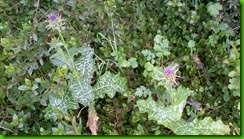
Even thistles – which really are very striking, architectural plants… as long as you don’t stand too close.
IMG_00004061

After I took that first thistle pic, I found this entire freestanding BUSH o’ thistles.  Eeyore would be proud.

 IMG_00004100

Sweet pea everywhere!  Don’t be tricked by the name.  Lathyrus odoratus may or may not be a pea relative (I forget), but it is easily distinguishable by its flattish twining stems AND is somewhat poisonous.
IMG_00004109IMG_00004105

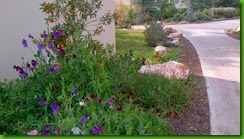
These things are EVERYWHERE!  A label in the garden labels it as salvia blepharophylla, but I really don’t think so, since those are red.

IMG_00004064

Aha… a quick web search tags it as the wild blue lupin, an Israeli native who blooms from February till May.  Here’s a whole bunch of them, growing together:
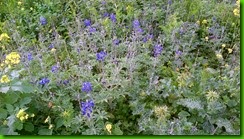
IMG_00004062 

I love a garden that is well-organized, with tags… even if the tags are sometimes wrong.  These were in a communal garden on the kibbutz:IMG_00004065IMG_00004066

(ie chives)

IMG_00004068

(lemon geranium)

We even saw some papyrus growing in a fountain in the middle of the garden!  Naomi Rivka was impressed with its height – it looks smaller in books.

IMG_00004067

This one’s an unknown… the plant itself looks like dianthus, or pinks, but the stems are taller and the (5-petalled) flowers lack the distinctive “pinking” around the edges.  Anyone want to help me out?

IMG_00004063      image image

Hate to sound like a travel brochure, but it’s true - Kibbutz Lavi boasts an extraordinary rose garden.  I don’t love roses, but did want to see it in bloom.  We were looking and looking for itn when I suddenly realized I smelled roses and I turned, and there it was, right beside me.

IMG_00004069

In Toronto, my mother planted one of these, a crocosmia plant, a few years ago… and it has done okay.  But it hasn’t truly BLOOMED the way this guy has.

IMG_00004099

Really makes you recognize what a struggle it is to garden with plants that are beautiful but so far removed from their natural climate (in this case, it comes from South Africa, but close enough).

Poppies were everywhere.  I was impressed by this one standing on its own…

IMG_00004070  

… until I noticed this bed full of them (along with some equally beautiful little girls!)…

IMG_00004079 IMG_00004080

My friend Rachel insisted on showing me around, including a quick stop at this private garden festooned with dwarves and other knick-knacks.  The plants are mainly succulents, which are not my favourites, but a garden that would probably normally strike me as slightly horried actually charmed the socks off me in my happy beauty mood today.

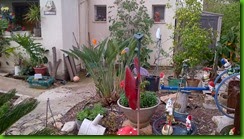
IMG_00004101  IMG_00004103 

No idea what this orange thing is; I was just trying to take a picture of this beautiful blue bird sitting on it.

 IMG_00004106

And speaking of birds… I admit, I naturally just tune out Birds of Paradise.  But Rachel pointed these ones out, and for once, I was actually impressed.  And here’s that blue bird again, too!

IMG_00004107 IMG_00004104

Unknown reddish-pinkish thing.  This one may actually be a salvia; the greyish leaves and flowering pattern makes me think it is, but if anyone wants to help me out, I’d appreciate it!

IMG_00004108 

This was in another private garden – sweet peas and kumquats, all wrapped up in each other. 

 IMG_00004111

I’ve always considered kumquats pretty useless, as citrus go, but they sure are pretty, and the combination of the orange and purple was the last thing we saw as we left the kibbutz.

Oops… forgot to mention:  the kibbutz has a wondeful giant chess set!

IMG_00004072

And that we had a great lunch in the communal dining room (we were allowed to eat there free as guests of a kibbutz member)?

IMG_00004086

(I was sitting innocently eating my lunch when Rachel asked, “Doesn’t this lunch deserve a mention on your blog?”  So I leapt up to take pictures just to appease her.)

If you like some of this flowery nature stuff, it’s worth mentioning that Kibbutz Lavi has a fantastic, beautiful, kosher luxury hotel which is available for Shabbat, chagim or any old time (they have a much better class of dining facility, I’m told – but even so, our “residents’” lunch was delicious!). 

I’d love to be able to stay there… by which I mean, afford it.  But we do hope to go back to the kibbutz for another Shabbos sometime soon; there are more humble guest accomodations available free for friends and relatives of kibbutzniks. 

The kibbutz itself is conveniently close to Teveria (about a 10-minute drive), but due to the weirdnesses of Israeli geography, experiences a breezy Galil climate rather than Teveria’s stifling summer heat.

So I guess it’s not so nice to admit that I’m not blown away by the natural beauty here.  It’s not that I don’t love Israel, but if what I want is pine trees, snow-capped mountains, cool, fresh lakes, and bounding herds of moose, I’d have stayed in Canada. 

I may not be here for the beauty, but today was still a nice chance to discover plenty of man-made beauty, or at least, “man-curated” beauty in one of my favourite parts of the country.

Google