Like the MamaLand Empire!

Have you Liked the AliyahLand adventure?
      ...and sign up for weekly aliyah tips by email (it's free).

Showing posts with label fruit. Show all posts

To every fruit, there is a season (with helpful seasonal Hebrew vocabulary!)


In Canada, there are seasons. Lots and lots of them. Well, four, but they’re all exciting and distinctly different. You’re probably familiar with them: winter, spring, summer, and fall.

Israel doesn’t have seasons, as such, a fact which has been driven home by this long, warm fall. And been hammered into our skulls with a recent two-week November heatwave חמסין / chamseen (hot wind from the eastern deserts) that’s left us parched and sweating, and left my plants wilting at a time of year when they’re usually starting to soak up the first downpours of the year.

(Interestingly, as this article points out, most Israelis probably call the chamseen by that name because it’s hot, which is חם / cham in Hebrew, in fact it comes from the Arabic word for fifty – meaning fifty days a year of icky sandy hot and dry conditions.)

Spring and fall are often called עונות המעבר / onot hama’avar, the transitional season. Meaning they’re neither here nor there – just seasons that get you from one place to another. (When you sit on the aisle in a movie theatre or airplane, you’re also sitting on the מעבר / ma’avar – exactly the same word.)

The term onot hama’avar usually crops up when we’re talking about health, and other problems, that come up during spring, and especially fall. Colds, allergies, migraines, skin problems – most Israelis are suffering from some combination of all these at the moment, compounded by the current hot, dry wind which has meant I can’t smile or my lips will crack.

Normally, the fall עונת המעבר / onat hama’avar (singular) is also the time to get immunized with this year’s flu vaccine, a fact driven into my head by my ulpan teacher. But this year the vaccines were late (for various international reasons and not due to a conspiracy and/or the fact we have no government!) and we haven’t gotten ours yet.

But however you feel about the weather, that’s actually NOT what a want to talk about. Because there are even more important seasons in Israel: seasons you must be aware of, seasons people argue heatedly about on Facebook, seasons you need to prepare for before you leave the house.

I’m talking about fruit seasons, of course.

I’ve already said many times that we’re huge fans of Israeli fruit. It’s cheap and more delicious than anything I ever

Three things that are better in Israel since we came

image

A few months ago I was interviewing longtime olim and they all talked about the different ways that Israel was different since they came 20, 30, or even 40 years ago.  Which is nice, to think that the general trend is onward and upward, but not always so encouraging for those of us who are coming now (for example, hearing that you don’t have to wait a year to get a phone line when we’re already used to it being practically instant back wherever we came from!).

But things aren’t just changing in the long term.  We’ve only been here for 5 years (Five?!  How did that happen??!?) and already there are things that I’m noticing that have changed in little ways, making life better and better still…

Here are 3 of my favourites.  If you’re here in Israel already, I’d love to hear yours in the Comments!

1) Fruit

Actually, I didn’t think the fruit situation here COULD get much better.  Except for the fact that a) fruit here is so seasonal, and b) we sometimes like frozen fruit for baking and smoothies.  In Toronto, we used to just keep a tub of blueberries, some strawberries, mangos, whatever, in the freezer to toss into things.  Here, we couldn’t really do that, creating the irony of a bounty of strawberries davka (exactly) during the chilly winter season when you really don’t feel like an icy smoothie.  Where were the strawberries during the summer when I desperately wanted them? I wondered.

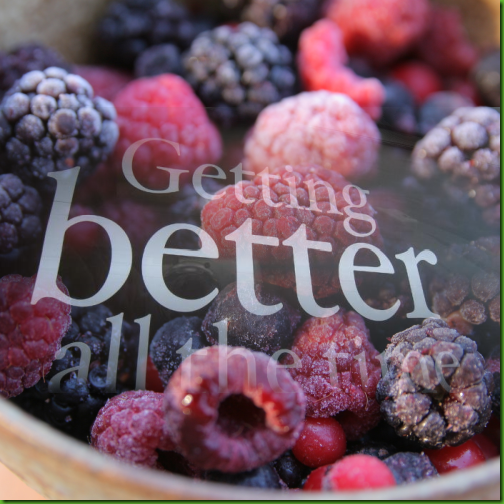
And now, guess what?  FROZEN fruit has come along to solve some of our fruit problems including strawberries, blueberries (impossible to get fresh where we live), and more. 

image

There are even these smoothie-oriented mixes, though they all have “weird” stuff in them like

What’s cheaper??? Three things you’ll love paying less for in Israel

image

We all love to kvetch.  Or maybe I’m just speaking for myself.  I definitely love to kvetch!  But sometimes, it’s worth stepping back and looking around at how much is truly wonderful about this unbelievable place we live.

Here are three that I’m really enjoying this week:

1. Public Transportation

This is my number one.  In fact, this was what caught my eye on Facebook today.  Someone was kvetching about the high cost of buying and renting a car—and they were right.

True, cars are expensive, but public transit is almost laughably cheap.   It’s even cheaper than when we arrived in 2013.  In an era when nothing goes down in price, fares were actually LOWERED around most of the country a couple of years ago!

Here’s what I’m talking about:

I took the kiddies to Jerusalem two days ago.  The three of us went from north of Haifa to Jerusalem and back, taking local buses in both cities, inter-city buses, and trains.  The train was an hour, a one-hour bus ride, then several local trips within Jerusalem.  Then, five hours later, an inter-city bus ride back to Haifa and one local trip to get home.

Total cost?  ₪60 per person. That’s under $20 (US).

Oh, and we could have traveled for another 12+ hours on the same fare, had we been so inclined, because it’s good for 24 hours from purchase.

Where, outside of Israel, can you get around cheaper than that?

(NOTE:  This isn’t what trains look like in Israel nowadays!  This is an authentic 1970s-era train on display in the Railway Museum here in Haifa.  Photo © Deror Avi via Wikimedia)

Two years ago, we were in Ottawa and I wanted to leave my family there and get back to Toronto by bus.  It’s a five-hour train ride, so farther

Have you told your kids about shemittah?

image from the children's book Sharing Shmittah, by Jennifer Tzivia MacLeod

You might know already that here in Israel, this is a shemittah year.

Shemittah is the 7th year of a 7-year cycle found in the Torah, and all year long, Torah-observant farmers aren't working their crops in the usual way.  Yet thanks to a few modern loopholes, many of us, even here, are just buying fruits and vegetables the normal way.

I've been studying shemittah for the last couple of months with a wonderful group of KShmu ladies, using a book called (surprisingly enough!) Shemitah, by Rabbi Yosef Tzvi Rimon.  (There are lots of ways to spell Shemittah!)

If you live in Israel, your kids may find out about shemittah in school if they’re old enough.  But for younger kids, there’s not really any way to find out what it’s all about (at least, not that I could find). 

When I lived outside of Israel, I knew nothing about it… let alone knowing enough to share some of the main ideas with my kids.  We read about it when we read the weekly parsha, and that was that.

The laws of modern shemittah observance can be complicated and daunting for adults, but it really does boil down to a few simple principles.  And my favourite thing to do once I’ve learned something, is to turn around and find a way to transform it into a kids’ book.

So I’ve taken some of what I’ve learned, from Rabbi Rimon’s book and other sources, and turned it into a short, sweet rhyming song. 

(think, "This is the way we wash our hands..." but with a few fun poetic twists and turns)

Here’s the result… a little book called Sharing Shmittah, a “learn-along” song for the whole family.
Cover from the children's book Sharing Shmittah, by Jennifer Tzivia MacLeod

The small, sweet mercy of blueberries (and a medical clinic)


Empty medical clinic in Haifa.
It's not always about me.
Sometimes, the hardest things about aliyah are more about the kids.

But then, sometimes life sends small mercies, and I am grateful, even as my heart breaks at what I used to take for granted.

Like English.

My family is sick of hearing me say it by now.  Every time one of them complains about life's mundane annoyances, like bad service from a phone company, or having to deal with some kind of bureaucratic situation, I just keep telling them, "at least it's in English."

(I sure can be annoying sometimes!)

Maybe someone has told you that "all doctors in Israel speak English"?

Lots of people said it to me, both before and after we came.  Reassuring me that at least in the most dire circumstances, you'd be able to get help in a language you understand.  Turns out that in predominantly Russian areas like ours, that's not quite true.

Doctors may have mastered some key medical terminology in English, but their speaking ability is often very limited.

Last year, when GZ hurt his chin, my heart broke for how overwhelming things must have been for him.  In pain, surrounded by doctors and nurses yelling in a language he didn't understand at all.

"Explain to him!" one nurse kept yelling.  "Tell him if he doesn't co-operate, he'll have to go to the hospital."  Yeah, that didn't help, at all.

Whether you're small or big, medical situations can be overwhelming.  But at least if you're an adult, you have some prior experience.  For kids, it's all new and bewildering, in any language.

Even GZ's routine eye appointment back in June was a trial, albeit a less painful one than the chin.

It’s all about the beauty.

IMG_00004053Israelis love this country sometimes.  They rave about it sometimes, how beautiful it all is, and I always agree, of course, because it would be rude to say anything else.

But seriously – I’m coming from Canada, one of the pristine natural wonders of the world, the Great Lakes, the Rocky Mountains, and you’re telling me some hills, some valleys, and the puddle you call the Kinneret are beautiful??

Sorry, Israel.  On a global scale… not really.

From the air, on a satellite picture, compared to our neighbours here in the middle east, sure.  But close up?  Close up is where you notice the discarded Bamba wrappers, and the preponderance of brown and the tiny scale of things and, I admit, sometimes feel a bit underwhelmed.

But today was not that day.  Today – well, I have a thing about spring; always have, and today was spring.  Spring has become even more ecstatic for me since I took up gardening nearly ten years ago.

Today, I would have to say, was probably the country, and its countryside, at its finest.  Naomi Rivka and I took a trip out to Kibbutz Lavi in the Lower Galil (aka Galilee), and found beauty, beauty everywhere.  Not natural beauty – very much cultivated, in gardens throughout the kibbutz.

Everything that could bloom was blooming!

Rakafot (cyclamen), which look so much sturdier and more robust in nature (or semi-nature) than their potbound cousins in Canada:

 IMG_00004055 

Citrus (not blooming, but bright and colourful nonetheless):

IMG_00004057 

Took this picture of bindweed, my mother’s nemesis.  Even in Israel, it’s taking over wherever it can.

IMG_00004060

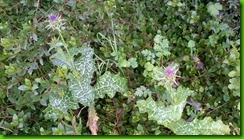
Even thistles – which really are very striking, architectural plants… as long as you don’t stand too close.
IMG_00004061

After I took that first thistle pic, I found this entire freestanding BUSH o’ thistles.  Eeyore would be proud.

 IMG_00004100

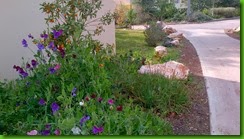
Sweet pea everywhere!  Don’t be tricked by the name.  Lathyrus odoratus may or may not be a pea relative (I forget), but it is easily distinguishable by its flattish twining stems AND is somewhat poisonous.
IMG_00004109IMG_00004105

These things are EVERYWHERE!  A label in the garden labels it as salvia blepharophylla, but I really don’t think so, since those are red.

IMG_00004064

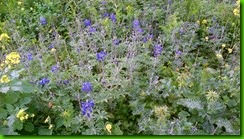
Aha… a quick web search tags it as the wild blue lupin, an Israeli native who blooms from February till May.  Here’s a whole bunch of them, growing together:
IMG_00004062 

I love a garden that is well-organized, with tags… even if the tags are sometimes wrong.  These were in a communal garden on the kibbutz:IMG_00004065IMG_00004066

(ie chives)

IMG_00004068

(lemon geranium)

We even saw some papyrus growing in a fountain in the middle of the garden!  Naomi Rivka was impressed with its height – it looks smaller in books.

IMG_00004067

This one’s an unknown… the plant itself looks like dianthus, or pinks, but the stems are taller and the (5-petalled) flowers lack the distinctive “pinking” around the edges.  Anyone want to help me out?

IMG_00004063      image image

Hate to sound like a travel brochure, but it’s true - Kibbutz Lavi boasts an extraordinary rose garden.  I don’t love roses, but did want to see it in bloom.  We were looking and looking for itn when I suddenly realized I smelled roses and I turned, and there it was, right beside me.

IMG_00004069

In Toronto, my mother planted one of these, a crocosmia plant, a few years ago… and it has done okay.  But it hasn’t truly BLOOMED the way this guy has.

IMG_00004099

Really makes you recognize what a struggle it is to garden with plants that are beautiful but so far removed from their natural climate (in this case, it comes from South Africa, but close enough).

Poppies were everywhere.  I was impressed by this one standing on its own…

IMG_00004070  

… until I noticed this bed full of them (along with some equally beautiful little girls!)…

IMG_00004079 IMG_00004080

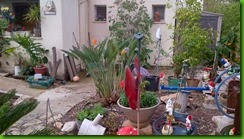
My friend Rachel insisted on showing me around, including a quick stop at this private garden festooned with dwarves and other knick-knacks.  The plants are mainly succulents, which are not my favourites, but a garden that would probably normally strike me as slightly horried actually charmed the socks off me in my happy beauty mood today.

IMG_00004101  IMG_00004103 

No idea what this orange thing is; I was just trying to take a picture of this beautiful blue bird sitting on it.

 IMG_00004106

And speaking of birds… I admit, I naturally just tune out Birds of Paradise.  But Rachel pointed these ones out, and for once, I was actually impressed.  And here’s that blue bird again, too!

IMG_00004107 IMG_00004104

Unknown reddish-pinkish thing.  This one may actually be a salvia; the greyish leaves and flowering pattern makes me think it is, but if anyone wants to help me out, I’d appreciate it!

IMG_00004108 

This was in another private garden – sweet peas and kumquats, all wrapped up in each other. 

 IMG_00004111

I’ve always considered kumquats pretty useless, as citrus go, but they sure are pretty, and the combination of the orange and purple was the last thing we saw as we left the kibbutz.

Oops… forgot to mention:  the kibbutz has a wondeful giant chess set!

IMG_00004072

And that we had a great lunch in the communal dining room (we were allowed to eat there free as guests of a kibbutz member)?

IMG_00004086

(I was sitting innocently eating my lunch when Rachel asked, “Doesn’t this lunch deserve a mention on your blog?”  So I leapt up to take pictures just to appease her.)

If you like some of this flowery nature stuff, it’s worth mentioning that Kibbutz Lavi has a fantastic, beautiful, kosher luxury hotel which is available for Shabbat, chagim or any old time (they have a much better class of dining facility, I’m told – but even so, our “residents’” lunch was delicious!). 

I’d love to be able to stay there… by which I mean, afford it.  But we do hope to go back to the kibbutz for another Shabbos sometime soon; there are more humble guest accomodations available free for friends and relatives of kibbutzniks. 

The kibbutz itself is conveniently close to Teveria (about a 10-minute drive), but due to the weirdnesses of Israeli geography, experiences a breezy Galil climate rather than Teveria’s stifling summer heat.

So I guess it’s not so nice to admit that I’m not blown away by the natural beauty here.  It’s not that I don’t love Israel, but if what I want is pine trees, snow-capped mountains, cool, fresh lakes, and bounding herds of moose, I’d have stayed in Canada. 

I may not be here for the beauty, but today was still a nice chance to discover plenty of man-made beauty, or at least, “man-curated” beauty in one of my favourite parts of the country.

What ever happened to FRUIT???

IMG_00003761

A few days old by now, but I took a picture because I couldn’t believe my eyes when GZ came home with this monstrosity from gan on Tu b’Shvat. 

I mean, sure, they take every opportunity to feed the children candy and sweets… I’d expected that when we came here.  But Tu b’Shvat?  A day to celebrate trees, and all good things that come from them?

I asked him if they made the cupcake in gan, and whether it perhaps had some connection to fruitiness.  Nope.  He shrugged, guessing that the ganenet had made it, and that it was chocolate cake.

Perhaps the brown cake represents soil.  Perhaps the gummy worms represent… well, worms.  And the flower?  That’s just plain cute.

But honestly, I think they could have done better in helping a kid appreciate his first Tu b’Shvat in this incredible land of milk, honey, and sweet dried fruits.

Taking it on the chin

IMG_00003100 (575x1024)

This little person had a not-very-happy run-in with a sidewalk today and ended up with a piece of something embedded in his chin (סַנְטֵר/santeir, which I kept saying over and over to myself on the way to the doctor so I wouldn’t accidentally say פְּסַנְתֵר/p’santeir, which is piano).

(Here’s the spiel I rehearsed silently all the way to the clinic:  בני נפל מה”סקוטר” שלו בדרך הבייתה מגן וקיבל מכה על הסנטר.)

I don’t know if our experience was typical, but this incident happened just before 2:00 pm, and we were home, after having been seen by one doctor and at least three nurses, in two different health care locations, via public transit, by about quarter to 4:00.

Needless to say, though I’m sad he got beat up, I’m happy that this was one of those times when everything works.

Within about a minute of the accident, on a sidewalk on a main street, we were surrounded by a) a woman who gave me a whole package of baby wipes to clean him up with, b) a bunch of teenagers, girls and boys, offering water bottles and asking me if I wanted help to get him to the hospital (or an ambulance), c) a couple of cars pulled over asking if we needed a ride. 

I almost accepted the offer of a ride, and perhaps should have, but as it turned out, the buses were working well and we didn’t have long to wait.  Plus, bus transfers are good here for 90 minutes, regardless of how many stops you make, so we were able to get to both locations quickly on the same fare.

In fact, the only actual delay was when we arrived at the local kupat cholim, health clinic, to find that the nurses were still on “yeshiva” (literally, their “sit break” in the middle of the day).  Fortunately, there were only 10 minutes left of that, and the woman with the number before us let us go first (a screaming kid will do that).

One slightly off-putting thing:  arriving at the trauma area of the “mirpa’at” (local urgent-care centre) and being asked, up-front (after presenting GZ’s health card), to pay ₪23 for our visit.  I assume this is a flat rate, as nobody had examined him.  I don’t know if it’s a “child” rate or if it’s standard for everybody. 

So here’s the thing:  I know that is a very, very, VERY low price for the excellent medical attention he received immediately (we were in and out in under half an hour).  In Canadian dollars, it’s less than $8.  Maybe I’m just spoiled:  this is the first time in my entire life that I have ever had to fork over money to receive care.

Then again, maybe I’m also a little scarred by a lifetime of raising children without ever having enough money to do the job exactly right.  I keep wondering what they’d do if I didn’t have enough, if my bank card was declined, if, if, if… if we were in a situation where that ₪23 was a make-or-break.  Seems unlikely (and as a parent, part of me wants to say “If you don’t have ₪23 to spare, don’t have kids!”), but I wonder.

On the other hand, maybe paying a little has helped me appreciate what we have here even more.  When it was free, I never thought about the value of the services we received.  But having paid ₪23, I cannot help thinking, “wow…”  This is a country where you can barely buy a lightbulb for ₪23, or a big bag of chips (bear with me here – imagine a REALLY big bag of chips, and a huge colourful lightbulb).

For his part, however much I’d paid, GZ did not initially want to cooperate while the doctor stuck a needle in his face.  He thought they’d have to poke right on the bleeding scrape, but even when I explained that it would not be right there, he squirmed and said no.  The doctor walked out and said if he didn’t co-operate, the stitches would have to be done in a hospital under general anaesthesia (or so I gathered from the sign language of a mask-shaped hand the nurse put over her own mouth for illustration). 

They kept saying to explain to him that it wouldn’t hurt after the initial sting, “like a mosquito,” that his chin would go to sleep.  “Hisbarti!  Hisbarti!” (I explained!) I said in my newly-perfected past-tense Hebrew.  Finally, I told him it would be like the dentist, where he has always co-operated nicely.  I also told him that, very often, when mommies took their children for stitches and there was a mall next door that had a kosher smoothie shop, they often felt like buying their child a smoothie with his own choice of fruit flavours.  That worked.

I have no idea what kind of mosquito stings four times with a long injecting needle like the doctor did.  GZ really did scream blue murder, and then the hard bit was done.  Although GZ now claims he felt everything, he was very calm and in fact asked “what’s he doing now?” several times during the scraping and stitching – suggesting to me that he couldn’t feel a thing.

Four stitches later, the only little-bit dumb part was when we had to go into the Dr’s office to “receive the letter.”  I went and sat and handed over the health card again and he gave us the letter and a few words of instruction, then continued typing.  After I sat there for a few moments, awaiting further direction, the doctor said, “we’re done – you can go.”  So we did.

My smoothie was strawberry-banana.  GZ’s was strawberry-melon; his own creation, and he said it was delicious.  The two small-sized smoothies, it has just occurred to me, cost ₪24, exactly ₪1 more than the doctor visit.  I guess I really have very little to complain about.

And so I must end with a request that Hashem help all our life’s problems here in Israel be solved as easily, smoothly, inexpensively… and sweetly as today’s turned out to be.

Fresh & local!

pineapple (1)So you are probably going to get sick of me bragging about the mind-blowingly delicious produce here.  I promise, I’ll keep it to a minimum and not praise every pomegranate we see growing freely in people’s backyards.  (Also, to be honest, the cucumbers are cheap and plentiful but are teeny weeny and don’t taste fantastic.)

But I just have to mention – pineapple!

If you have never had one of these fresh, local teeny-weeny little palm-sized pineapples, you are in for a REAL treat. 

First of all, if you are used to super-sweet imported North American supermarket pineapples, as we are, you will not be disappointed by the sugar level in these sweeties.  They may look pint-sized, but they pack a huge wallop of sugar.  But the first thing that hits you isn’t the sweetness, it’s the fragrance – you can easily smell them across the room, if not farther. 

But beyond sweet, there is another flavour element that’s completely missing in import pineapples.  These ones are almost salty, definitely a savoury layer that explains a lot about why pineapples are so often found in meat dishes (they probably have a marinating/tenderizing effect as well, like papaya does).

And the third important thing about this cutie is that it is SOFT, almost mushy.  Not as mushy as the mango we ate yesterday (well, the kids ate it; I am still a fruit xenophobe and cannot eat any fruit I was not served as a 3-year-old), but definitely not firm enough to stand up to the rigours of being tossed in a crate and shipped across an ocean, then via rail, to Canadian supermarkets.  Which is probably why, if you’re not here, you’ve never tasted a pineapple quite like this before.

Back in Canada, I used to marvel at all the people who’d buy raspberries when we had the most amazing, bursting-ripe berries free in our backyard.  Raspberries simply cannot be shipped and sold when they are ripe – they’re too fragile.  So, by definition, raspberries in stores (and to some extent, at farmers’ markets) are not in prime eating condition.

I always thought pineapples were almost like coconuts:  rock hard and willing to travel anywhere.  Now I realize that they probably shouldn’t go more than a couple of hours if you’re going to experience them at their best.

(Did I mention the produce is often ridiculously cheap?  Two of these little pineapples cost 10 shekels, about $2.75 or $3 Canadian!!!   Almost but not quite makes up for the high prices of everything else…)

Like I said, I promise I won’t write about every bite of Israeli produce I consume (and some produce, like garlic, still is imported, often from China). 

But I’ll probably reserve some future space here for rhapsodizing about my first local grapefruit, in the wintertime.  And I do believe that if we have to live in a tiny besieged little country, a nice side effect is the equation that makes it ridiculous to import – perhaps impossibly or at great expense – produce that will more than happily grow in a field somewhere in the Galil…

Google