Like the MamaLand Empire!

Have you Liked the AliyahLand adventure?
      ...and sign up for weekly aliyah tips by email (it's free).

Showing posts with label tech. Show all posts

5 ways Facebook will save your sanity during the aliyah process

image

If you're not using Facebook, I don't blame you.  I know a lot of people who have quit using it in the last couple of years - with great reason.

But I believe that Facebook, for all its evils, is a Very Good Thing to have in your life while you're making aliyah.

What are the evils?  Maybe you know about them already.

Facebook offers a weird combination of intimacy and distance.  I read a quote recently:  "I hate learning about major life events buried in a timeline between photos of fresh pedicures and pictures of lunch. When someone close to me has a baby or goes through emergency surgery, or suffers a loss, they deserve more than a Like."  (It's from the otherwise-blah memoir I Regret Nothing, by Jen Lancaster.)

Sound familiar?

The bad side of Facebook is that it gives you just enough superficial glimpses of a person's life to make you believe you know them... but not enough actual interaction to actually understand what they're all about.

"Facebook friend," you probably realize now, is something far, far less than a real friend.  It could even be shorthand for “someone I don’t know at all.”  So why keep it around at all?  Good question.

Things that are weird in Israel #16: Book covers

image of popular book covers in Israel

Maybe it’s just me?  Or maybe you’ve wondered about this, too?

Read on and let me know in the comments.

I’ll start by saying I love a great book cover.  It’s almost the most important part of the book. 

Sure, we’d all like to think we don’t judge books by their covers, but really… we do.  Of course, the inside is MOST important, but you’re never going to get to the inside if the outside is lousy.

Am I right?

Which is why book covers in this country continue to perplex me.  Astonish me.  Surprise me with the depths of terribleness to which they are allowed to sink.

To give you a sense of how awful things are, here is a fairly random sampling of some books in translation, so you can compare them to their English equivalents.

How to fix your internet problems in Israel (sort of).

image

The Internet here has a way of stopping shortly after midnight. It should be a lesson of some kind, something like, "it's just too late to be sitting on the computer." That’s what happened last night, as if on cue. It’s only happened a few times, but it’s always at or around 12:17.

Any sensible person might think, “time for bed!” But with my drive to fix things, I usually take it as my cue to put in a call to Bezeq, our internet company.

Maybe you think that makes a little sense? 

Ha.  What you don’t know is that in our nearly year and a half of being their clients, Bezeq has literally NEVER solved a problem for us over the phone.

But they are usually unfailingly polite and speak passable English. It's almost a pleasure to call. So I do.

Last night when I called, just after midnight, the system politely informed me that there was a longer than usual wait time and that my place in line was... 31.

Some places you call, they play radio music for you. Not Bezeq.

Buying a computer in Israel? Don’t shop without this guide! (with Hebrew/English glossary)

image

Do you use a computer?  (If not, how are you reading this???) 

If you do, then sooner or later, you’re going to need a new one. 

I hope I don’t sound unpatriotic when I say that it is better by far to buy a computer in North America.   You’ll get name-brand systems for a lower price with more options and software included in the basic price.  Plus, you’ll be able to read all about those options in a language you understand – a huge plus.

But never fear!  With the information in this guide, you will have at least some of the tools you need to buy a new one here.

My husband’s laptop finally quit the other day.  It’s been showing signs of dying, which is actually great, because he’d gotten nervous and backed everything up.

(It was for exactly this reason, we’re told, that Yitzchak davened for illness before his death.  A midrash says that before this, people – like many computers today – simply dropped dead when their allotted time was up.)

So we had some advance notice of the tragic event.  And we decided to replace it with a desktop which will give him room to spread out while he works and more of the semblance of an office at his little corner desk (me, I’m hooked on writing on my laptop – on trains, buses and anywhere I find myself!).

Decision made:  now, all we had to do was pick one.

Now, I am not a computer newbie.  I used to run a computer centre for seniors.  I sourced and ordered all the computers, a server, outfitted and basically ran the network for an entire office.  I have done server maintenance, network and firewall setup, hardware repairs and more.  I wouldn’t set myself up as a computer professional, but I basically know what I’m doing. 

Did I mention that I have taught workshops on how to buy a computer?  I’ve done this buying-a-computer thing before – hundreds of times.

image

(I bought every single piece of hardware in this picture… and yes, that’s me at the front telling everyone how to use it all.)

So I figured it would be easy.  Maybe even fun.

As always, however, things are different in Israel.  It has not been easy, or fun, so far.  And I thought it would be helpful to share some of what I’ve learned along the way. 

I hope it will help anyone else who’s diving into this kinda-major purchase, along with a few of the pitfalls ion each category.  Since we were buying a desktop computer, that’s what I’ve written about here.  If you’re buying a laptop, some of these points may not always apply.

Basic terminology.

In each section below, I’ll include relevant Hebrew terms.

Basic words that are useful to know: 

  • מַחְשֵׁב / machshev = computer
  • מחשב נייח / machshev nayach = desktop computer
  • מחשב נייד  / machshev nayad = portable computer (people also say לפטופ / laptop)
  • חָמְרָה / chamra = hardware
  • תָּכְנָה / tachna = software
  • כולל / kolel = includes, as in “does this computer include a mouse?”
  • לא כלול / lo kalul = not included
  • ללא / l’lo = not included
  • גִּ'יגָה/ jigga = Giga; in Hebrew, the “G” is bafflingly soft
  • מַאֲרָז/ ma’araz = case, if you’re buying a desktop.  Matters not at all.
  • משלוח / mishloach or משלוחים / mishlochim = delivery
  • שִׁדְרוּג  / shidrug = upgrade.  Many will be on offer.
  • אַחְרָיוּת / achrayut = warranty.  Very, very important!


Computer systems never include a monitor. 

This is true outside of Israel as well.  But there, we were always well-connected enough to score a free monitor of some kind.  For a few years, it seemed we were drowning in them… but here, we had to buy one. 

Cultural disconnect: the Bissli light and an unveiling.

image

Did I mention we don’t have a home phone?

Part of the deal with keeping our Toronto phone number is that we don’t have a landline here.  Between our cellphones and the Toronto phone, I just figured it was enough.  (In a pinch, there’s also Skype, where I have credit to place outgoing phone calls.)

However… there are some good reasons to have a home phone, it turns out.  Like if there’s an Internet outage.

The other night, just as our daughter was getting ready to get on a plane in Toronto, just as I was talking to her on our very stable voice-over-IP phone line – her voice cut out.  There was no click, just silence.  At first, I thought she was miffed; she must have hung up.

But no, there was no phone.  So I checked the plug, made sure everything was working… and sure enough, there was no Internet, either.

We’d broken the Internet.  I unplugged and replugged everything electronic.  No luck.  Rebooted the router.  No luck.

So finally, darn, darn, darn – I called our Internet provider.

My sometimes-wonderful personal translator: Google Translate.

 image

I couldn’t have made aliyah without Google Translate.

If your Hebrew (like mine), isn’t perfect, then you’ll probably come to love it, too.

But you can’t count on Google Translate at all.  If you rely on it 100%, you’ll come out sounding like a moron.

The best way I’ve found to test Google Translate’s abilities is to feed a sentence into it in English, translate it to Hebrew, and then feed the Hebrew back into it, translating it into English again.

Like with the first sentence of this post:

I couldn’t have made aliyah without Google Translate.

And here’s how it comes out when you feed it through this way:

I could not do without immigration Google Translate.

It not only sounds nonsensical, but the meaning is almost the opposite of what I intended.

Partly, that happens because I used a double negative.  Double negatives work a little differently in Hebrew.  Not only are they not a problem – sometimes, they’re the only way to get your point across.

“Nobody” is technically af echad / אף אחד.  But if you want to say “I didn’t see anybody,” you’d say lo ra’iti af echad / לא ראיתי אף אחד, which technically means “I didn’t see nobody.”

So the number-one trick of using Google Translate to get your meaning across is to eliminate double negatives and simplify your language as much as possible.

Keeping our phone: one good decision, one bad one.


Signing off after chatting online with a prospective olah this evening, I added a tip I haven’t mentioned here yet that I decided I really must share right this minute:
You can keep your phone number!
Yes, it’s true:  you can bring your North American landline number with you to Israel by switching it to a Voice-over-IP (VoIP) service before you move.
Why this was a great decision for us
I’m very attached to our number because I’ve had it for over 16 years, longer than any phone number in my life.  More importantly, everybody who’s known me during that time knew that was my number.
A few reasons you might consider keeping your phone number:
  • It’s pretty cheap – between $5-15 per month, depending on your service (you can also buy a device like a MagicJack that includes a certain number of months – but read all reviews carefully!).
  • You get to call North American 800 numbers easily and “free.”
  • You want to retain business contacts and/or keep doing business seamlessly in your old area.  It’s a lot easier to set up an interview and tell the person to “call me back at 416-555-1212” than to tell them “okay, dial 011, then 972, then 54, then 5551212.”  I do entire interviews where I don’t tell the person I’m in Israel… I love it!
  • You have elderly or low-tech and or dumb friends or relatives who might be scared to call a 972 number or still think long-distance is expensive and want to talk for only 30 seconds so they save money.
  • You want your kids to be able to call relatives and friends easily, and vice versa.
  • Extra VoIP services that may be included, like Call Answer that sends your voicemail straight to your email inbox.
  • Extra services, like our local public library’s “Dial-a-Story” line.  (Who in Israel is going to read my kids a story in English over the phone???)
A few reasons you might NOT want to keep your phone number:
  • You’re not moving into your own place right away, and don’t want to pay the full amount every month until you do (we “parked” the number for 6 months while we lived in the Merkaz Klitah, but still had to pay; I did continue to receive voicemail, though)
  • You aren’t leaving a lot of friends / relatives behind in the area code where you were living.
  • You don’t want bill collectors to find you.
  • You don’t want relatives to find you.
  • You’re happy using Skype / facebook / email and so are the people on the other end, so why should you bother paying?
  • You don’t want to bother futzing around with technical stuff (but it’s not all THAT technical!)*
  • You’re getting a great Israeli landline and/or cell plan that includes unlimited North America, and don’t see the need to complicate things with another phone option.
* Don’t be scared by the word “router”!  It’s just the modem box your internet line hooks up to.  If you have internet at home, you have a router, and to use VoIP, you usually just plug a box into the box and you’re good to go.
Does this mean we don’t use Skype, like everybody else?
We do use Skype.  It doesn’t work all the time, with every relative, in every situation.  We like Skype, and still use it when we want a video connection.  We have found that every Skype conversation begins with a lengthy preamble where you talk about Skype, get everything set up and then marvel about Skype some more.
It’s not the same as picking up the phone and just talking.
I also have some dollarses in a Skype-out phone account so I can call actual home telephone numbers on Skype.  This was a great option when we were in the Merkaz Klitah because it didn’t hog a lot of bandwidth or require access to a router, which we didn’t have.  But it’s NOT the same as picking up the phone either.
Young Boy Pretends To Talk On Phone Stock PhotoFunny true story:  last week, the Toronto phone rang and it was a telemarketer, saying, “We’ll be in your neighbourhood next week installing windows and doors.”  It was all I could do to not ask, “What neighbourhood is that, exactly?  Are you going doing Kuwait tomorrow?”
What NOT to do if you move your landline
So if that was the good decision… what was the bad decision?
The outlets here in Israel are different.  You know that already.  They have more electricity in them than the ones in North America – 220V instead of 120V.  That’s a lot of juice!
(It’s the same amount of juice that goes into those jumbo dryer outlets in North America.)
So it goes without saying – you can’t just plug stuff in willy-nilly.
Well, I certainly knew that already!  You don’t have to tell me!  I could teach a class on this stuff!  At least, I could have, until I did something really, really dumb.
adapter!There are two ways to plug stuff in that comes from North America:  an adapter and a transformer.  This deserves a blog post of its own, but basically, an adapter (shown here) changes the plug-holes ONLY; it doesn’t change the electricity.  So you still have super-strong Israel juice going into your appliance.
This will fry most appliances in seconds.
The only thing it works for is chargers, shavers, computer plugs and a few other things, because these usually have a transformer built in, in the form of that black “brick” thing at the end of the wire.  And somewhere on that “brick” in teeny tiny print is written how much juice it can take. 
It’s usually a range – like 100-220V.  The brick will automatically take the electricity you put in and switch it to the amount your device needs.  Nifty!
But it’s not always the SAME range, which means you must always READ the brick!!!
As I discovered, just because it’s a brick doesn’t guarantee that it will give a safe amount of electricity to your appliance.
Like the cordless phone that we shipped all the way here from Toronto… only to fry it like so much cheap bacon the first time I plugged it (with an adapter) into the Israeli powerbar where I plug my laptop (with an adapter).
The bad decision:
  • Adapter + Laptop = many happy computation-hours
  • Adapter + Cordless Phone = “what’s that funny smell?”
It never worked again. 
Happily, I was able to order one online from my favourite Israeli shopping website and it arrived at our door within a week.  So all’s well that ends well, as long as you toss enough money at the problem.  And the new one is better quality, with this ringtone that just makes me want to get up and disco.
One last reason why keeping the phone number was a good decision
I just want to end on a high note (instead of on a “how stupid can you get?” note) with one last reason that I didn’t mention above. 
The fact that my kids can pick up the phone and, with seven quick digits, have my mother, my sister, their friends, the library, on the line… well, it’s more than priceless:  it makes my heart sing.   And the fact that an old friend called my mother last week to get our number, and discovered that it was the SAME number; no dozens of digits to write down.  Again, when the phone rang and it was her, my heart was happy.
(I am careful to unplug the phone at night, with all our tech stuff, because 2 a.m. telemarketers are not quite as charming as 2 p.m. phone calls from an old friend.)
Yeah, your heart can be happy with an Israeli phone as well, and maybe eventually, when life here feels more settled, we’ll wean ourselves off this Toronto landline.  But maybe not… because it feels like such a good decision so far.
Just be careful what you plug in where!
If you’ve made aliyah, did you keep your number?  Was it a good decision?  If you’ve used a VoIP option that you’re happy with, feel free to leave the details in the Comments section!

We <3 (love) United Hatzalah!

IMG_00003911This may be the most important post on my blog.  I hope you read it carefully.

Today was “We <3 [love] United Hatzalah Day” for our family!  We learned so much, but this shouldn’t end with us.  I believe that every oleh, tourist, heck, Jew, must know about this organization, which saves countless lives each year not just in Yerushalayim, but throughout the country.

We took the bus down to Yerushalayim for a dedication ceremony on behalf of a Canadian friend who donated an “ambucycle” – a motorcycle ambulance – and who couldn’t travel to be there for the dedication in person.

I thought we’d go, see the motorcycle, shake a few hands (Akiva) and, as we say in Israel, zehu – finished.  But oh, no.  The five of us (big daughter Elisheva skipped classes to join us, for which I’m very grateful) were given the total red carpet treatment.

Saving a single life?

Later on, after we got home, I did some Googling and discovered that the big news for United Hatzalah this month (though nobody mentioned this while we were there) is that a New York millionaire has donated FIFTY ambucycles, at a cost of about $1.3 million. 

Which is fabulous and all, I mean it, but my heart beat proudly, seeing that, to realize that “our” donation of a single ambucycle (it wasn’t really even ours!) was not treated as any less significant… as if they really do give credence to the Talmudic dictum, “he who saves a single life, it is as if he has saved the entire world.” 

Just one ambucycle can save thousands of lives, and they know it.

And oy, what a setup they have there!  I’ve walked past their building maybe dozens of times while in Yerushalayim, and never, ever had a clue as to everything going on behind those doors.

Our tour began with the ambucycle itself, dedicated by our friend in Toronto.  It was clearly brand-new – it still had the plastic wrap on the seat and its supply box was empty.

IMG_00003909

We then went into the supply depot to see what goes into the kit that all the United Hatzalah volunteers (currently over 2000) take with them everywhere they go.

A lot of stuff to carry around.

So what’s inside the big box in the back of the ambucycle?  A little bit of everything, it turns out.  “It’s got everything an ambulance has, except the bed,” says founder Eli Beer.

There’s a portable bag containing everything from a drug box to bandages to a childbirth kit, all in big, padded red compartments.  There were a few items that our host decided not to pull out, concerned that they might alarm the children.  Good call, I think, especially since GZ is creeped out by all things medical.

Here’s the childbirth kit:

IMG_00003916

(Of course, to my homebirthed kiddoes, the first question was, why do you need supplies to have a baby?  When I looked at the contents list and explained that there was a blanket inside, they remained unconvinced.)

To show us exactly how much equipment is involved, he started loading Elisheva up, starting out by kitting her up with a bulletproof vest and helmet – I suppose for heading into still-active trouble areas.  These aren’t worn every day, but they’re a fun part of the demonstration.  After that, he added a backpack, supplies bag, defibrillator… as she staggered under the weight. 
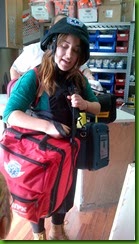
IMG_00003928 

It’s a lot of stuff to carry around, but the mobility and portability are the secret to United Hatzalah’s success.  In years of driving an ambulance, Beer says, he never successfully rescued a patient until he responded on foot to a call he’d overheard on a police scanner in his own neighbourhood… and actually saved a life for the first time.

Motorcycles, scooters and medics on foot are nimble in a city, a country, where being nimble can mean the difference between a response time of ten minutes (dead on arrival) or ninety seconds (good chance of resuscitation).

Command and control:  hand in hand

From the supplies room, we headed into Command Central – the hard-core control room from which United Hatzalah responds to nearly 200,000 calls a year. 

*** YOU CAN REACH UNITED HATZALAH WITH A CALL TO 1221 (no star) FROM ANY PHONE IN ISRAEL.

*** FOR MAGEN DAVID ADOM (regular ambulance), DIAL 101.

“Jews and Arabs don’t always get along,” says Beer.  But today, “hand in hand… Jews and Arabs are getting together for the purpose of saving lives.”  When Beer’s own father collapsed a few years ago, the first responder at his side was an Arab medic from East Jerusalem.

In addition to complex mapping software which can plot the arrival times of the five nearest United Hatzalah responders (which is calculated intelligently based on whether they’re coming on foot, by car or on a motorcycle!), our host pointed out the central computer which is hard-wired to Home Front Command, the central Israeli agency which sends out missile alerts.  If there is anything going on, anywhere in the country, these guys will know about it first.

IMG_00003931

The other cool thing is that if you have donated an ambucycle (and really, you must if you can!), they can find it for you anywhere, anytime.  Just punch in the number and their computers can tell you instantly where it is.

Because the rescue workers with United Hatzalah are all volunteers, the ambucycle essentially becomes their best friend – they take it with them everywhere they go.  The volunteers are essentially on duty 24/7 – yes, that’s 7 as in “seven days a week,” unlike a lot of other things in Israel, which are 24/6. 

Anytime, anywhere, they could get a call.  And no matter what they’re doing – our host told us about a time he was in shul on Simchas Torah and had to leave right before the big aliyah he’d paid a lot for – they drop everything and run.  (He said he also had a newborn baby at the time – but that doesn’t matter when you’re a United Hatzalah volunteer.)

When I mentioned that you’d have to have a pretty understanding employer, he told us about a United Hatzalah volunteer who worked as a delivery guy for a meat store.  The boss apparently started getting sick of not knowing when his employee would have to leave, abandoning his chicken deliveries (“He delivered chickens… he delivered babies.”).  But, since they were both religious people, the meat store owner consulted a rabbi who said that he may be losing a reliable delivery guy but he was gaining a half share in the zechut, the merit, of the lives that the delivery guy was saving.  The delivery guy kept his job.

Ambucycles save lives:  the too-scary-for-kids video

After our visit to Command Central, we went inside to watch a video about United Hatzalah and its activities. 

I’ll warn you now:  this video is too scary for children.  And maybe too creepy for adults. 

A father basically dies during his young daughter’s birthday party because the conventional ambulance can’t get to him on time.  Then, the scene is replayed, except he is saved by an ambucycle that arrives within 90 seconds of the call (based on an actual call to United Hatzalah).

Our host realized after the video started that the kids probably shouldn’t watch the guy (actor, but hey, they’re young kids) die, so he fast-forwarded to the triumphant ambucycle scene.  Nevertheless, they were both quite troubled afterwards. 

As with seemingly every event of this type, there were tasty pastries and soft drinks, and we were even presented with “swag” in the form of magnets, brochures and some nifty-cool United Hatzalah hats.

A country run on donations.

On our way out, we waved to “our” ambucycle, while I silently resolved never to drop in on the Command Centre to find out where it is at any given time.  The work these guys are doing is just too important to interrupt.

But that idea, of pandering to demanding American donors, got me thinking hard about the donor-recipient relationship between Israel and chutz la’aretz, which has gone on since even before the state itself was founded. 

A few weeks ago in my Hebrew film discussion class (what?  you didn’t know I was taking a film discussion class?), we explored this issue as part of the classic 1965 film Sallah Shabati (סאלח שבתי) (excerpt here, captions in French only), in which early pioneers are planting a forest.  When wealthy American donors drive up, their fancy-looking Israeli host hammers in a sign dedicating the forest as the “Birnbaum” forest.    But later, after they’re out of sight, he comes with a new sign proclaiming it to be the “Mrs. Pearl Sonnenschein” forest. 

image

“What can I do?” he asks.  “It’s tourist season.  They all want their own sign.”

Of Yissachar and Zevulun.

Modern Israel is littered with signs, acknowledging all the Birnbaums and Sonnenscheins, generous donors all, over the last century.  Before I came, I admit, I was more cynical about this phenomenon.  If they care so much about Israel, why don’t they move there?  I wondered. 

I still don’t have an answer to this question, but I don’t ask it so much anymore.

Now that I’m here, I’m grateful every time I see an ambulance going past with its dedication, whether from the Canadian Friends of Magen David Adom or from Australia, the U.S., or the United Kingdom.  I’m grateful for every hospital, clinic, and ambucycle bearing the name of somebody outside of Israel who cared deeply about the wellbeing of the people here.

Yeah, it would be incredible if everybody could come live here.  But as in the case of the chicken seller and his ambulance/delivery driver, the Torah speaks of the “Yissachar / Zevulun” relationship, in which one of these tribes (Yissachar / Issachar) worked hard to learn Torah, while the other (Zevulun / Zebulon) became sailors and traders to support them.

I am so, so grateful to our friend in Toronto, and everybody like her who – although they cannot live here – have taken on the role of Zevulun to those of us who are working hard, like Yissachar, to make this a liveable homeland.

Thanks to them, it is a safer home, where lives are saved in a way that respects the land’s holiness, the honour of all its inhabitants… and cashes in on the enterprising high-tech spirit that has made this the “Start-up Nation” we all know it can be at its best.

For more about the spirit behind United Hatzalah, I really recommend watching United Hatzalah founder Eli Beer’s TED Talks video, The Fastest Ambulance?  A Motorcycle.

Did I mention that United Hatzalah emergency responders, thousands of them, are all volunteers?  That they’re on duty 24/7?  That, Muslim or Christian or Jew or whatever, they will save your life for FREE if you ever need them?  Even if you can’t afford a whole ambucycle, do something today to help them out!!!

*** YOU CAN REACH UNITED HATZALAH WITH A CALL TO 1221 (no star) FROM ANY PHONE IN ISRAEL.

*** FOR MAGEN DAVID ADOM (regular ambulance), DIAL 101.

Skyping!

IMG_00002433 (1024x575)Well, our setup here is a little rough… in that our wifi signal comes from the common area of the merkaz klitah, four floors down. 

It wafts up to the window here on the fourth floor (which, like in England, is really the fifth floor), and while we get a stronger signal at night for some reason (maybe because the sun / heat isn’t interfering?), evening is prime-time for everybody else in the building who wants to use the wifi signal. 

So the image started out pretty good but deteriorated pretty quickly.  Still, it was nice to chat with friends.  So far, we have skyped with Ted’s father in Ottawa, these friends in Toronto, and YM (our older son in Toronto), who interrupted this conversation to say hi to the kids.  I told him we’d call him right back and the kids got to say goodnight, then I bentsched him.

IMG_00002430 (1024x575) 

I know it’s not the same as a real playdate, but honestly, this is simply marvellous.  It has never, ever, in the history of anything, been easier to be away from your most beloved people and still feel like you’re right around the corner… (and did I mention, all 3 calls were FREE???)

Everything you wanted to know #5: Appliances and voltages

I asked:

Every site says different things on transformers vs converters and kitchen appliances. I know it's been asked many times before, so I just want personal experiences: what small kitchen appliances did you bring, what did you run them on, and how well did they work (& how long did they last)???

And luckily for you, if you’re looking to this site for answers, smarter people than I am actually responded!!!

  • ask me again on a weekday, please [I posted this question on a Friday morning here – ie late afternoon in Israel!]
  • Personally, I'm not one for transformers. Never owned or used one. If you have an almost new, expected to last a decade or more appliance that's one thing, but otherwise get appliances that will be good for Israel, even if the price seems high. I'm here over 40 years. Transformers aren't free either, and some appliances don't work that well with them. Also, don't overstock on clothes, tablecloths etc. You'll need more closets and more space. They also cost money.
  • I agree…!
  • To be honest I would try to sell your 110 v appliances and buy new top quality 220v ones - go to the 220v store up North and check out prices there and buy from there and put on your lift. WE bought a 220v immersion blender for Pesach more than 6 years ago there and I am still using it!!! It's now chametzdig and dairy
  • I agree… . I didn't come with any appliances at all. Of course, I came marrying into a family here. But even what Rebecca brought over didn't last very long. Nothing more than 5 years. Transformers are great for a once in a while use, like the iron that we use perhaps 5-6 times a year. For things used often, it does shorten the appliance's life span. Better to put 220 stuff on your lift, or buy it here.
  • I agree - buy 220 there and ship it here- because it's being shipped, it doesn't get taxed (in Ontario). We use all the kitchen appliances we used to use- but more often (there is fresh food here so we make more of the stuff that we used to buy over there- we make the baby food, the sauces etc..)
  • For small appliances, you can check the price of 220V appliances in Israel on websites like zap.co.il, bestbuy.co.il, lior-electric.co.il and compare to the cost of bringing a 220V appliance from the US.
    for large appliances, take into consideration that appliances bought in Israel will have local service and warranty, and be appropriate for Israeli conditions - e.g. washers that heat their own water (only a small amount needed) instead of having to heat up the whole water heater so washer can take from it.  [This seems like a good rule of thumb] In general, a transformer might be good for an occasional appliance that you really like, but best to avoid them if you can get a 220V appliance to do the job. also the transformer can convert voltage but not cycles, which can be relevant for some appliances. and they are not supposed to be used for electronic equipment or high-wattage appliances.
  • It might be a bit premature to show up with appliances. They say that the electricity will finally arrive here in 2016.  [What a joker – I hope!]

But seriously… the blender is kind of new, so that hurts a bit.  And the hand blenders, and the mixers, and the Pesach mixer.  But the hardest is my beloved Cuisinart, although… precious as it is, is definitely on its last legs.  I just searched for the post where I blogged about it when it was a brand-new birthday present and discovered that it is older than one of my children (bought for my birthday, I guess eight years ago?).  So I guess they will have to go.

I think the kind of appliances people say to buy and ship are LARGE appliances, which we will definitely need to buy sooner rather than later (even if you’re renting, apartments generally come without any appliances).  But what I was asking about was mainly the small ones, so I guess we will have to buy them when we arrive … or do without. :-(

I suspect that we will be hemorrhaging money for the better part of the first year…

Addendum:  Computers and Power Supplies:

Two late-breaking comments were particularly important so I wanted to add them – actually, this is one issue I researched early on because I just bought a new desktop back in December…

  • However, some electronic equipment, such as a computer or router, might have a power supply that can work on either 110V or 22V input.

  • BTW we brought our computer, monitor and printer as well as our video camera - all of the worked fine with just an adapter (but make sure you switch your CPU to 220 v setting - otherwise you will blow the transformer and lose everything :)

So there you have it – the definitive responses… from actual folks who have been there and done that.

When you can’t pretend…

IMG_00001606

… that everybody is going to fly over to see you in your new home in Israel.

:-(

Ted’s parents (white shirt, red shirt) should live and be well for many more years.  But they are not entirely young and not entirely healthy.

They’re not getting on a plane. 

It was wonderful that they came to visit us in Toronto once (twice?), but even that, 5 hours on a train, was a shlep.  Twelve hours on a plane – a plane which doesn’t fly direct from Ottawa, where they have lived for their entire married life – well, that isn’t happening.

Sometimes, goodbye is goodbye.

I am definitely getting off easier in this department.  My mother is more than a decade younger than Ted’s parents.  She travels.  She went to Europe on her own; she drives around Ontario, hops onto buses with tour groups.  Wonderful!

And I’ve been after my sisters for years that they need to get over to Israel; hopefully, this will be a push in the right direction. 

Actually, Ted’s brother beat them – he and my brother-in-law (taking the picture above!) spent a big chunk of time yesterday sharing pictures and memories of their Israel trip 18 years ago.  They’ve been there, done that, back when I was still not sure whether I ever wanted to go.  Of course, their trip included quite a few Christian sites, as will Ted’s sister’s when she gets over there to see us.  I’ll be happy to show her around if I can.

Despite the bittersweetness, they did pull together a very classy send-off, including a completely surprising (cuz his birthday’s in over 2 months!) 50th birthday party for Ted yesterday.

Hard to muster great big happy smiles – but we sure saw plenty of them this weekend.

IMG_00001594

Very happy that everybody at that end has Skype and is actually figuring out how to use it… hopefully, we’ll keep those beloved faces grinning for many years to come.

Goodbye, Library

Just went online and changed all my public library holds so they expire on July 31st.

I almost cried.  This feels like pre-arranging a death.

Rebirth!  Rebirth!  Must focus on being reborn in a new and better place… though it’s hard to imagine a universe where I will not need a constant supply of shiny, happy library books.

The truth, however, is that more and more of my books have been coming from places other than the shelves of the library.  I still need a few hard-copy books for Shabbos and Yom Tov reading, but my Blackberry Playbook is a great ebook reader (I had a kobo touch before that, but with no backlighting, it was next to useless). image I can still get free ebooks from the library, and there are other ways to obtain reading material that don’t depend on living walking-distance from a great English-language library branch.

So this is a good time to be leaving, technologically – it’s probably never been easier to get English-language reading materials in Israel.

Still.  It’s a bittersweet feeling – mostly bitter.  Some of the books on my list, I know, will not arrive in time. 

For one of them, I’m Patron 260 out of 283.  There’s no way 259 people can read however-many copies of the book they have in the next 4 months.

I wonder which of the many goodbyes in the next four months is going to be the hardest –?

Well, okay, besides the obvious – the Big Goodbye with our family.

Scenes from Rosetta Stone Hebrew

imageA couple of Nefesh b’Nefesh reps have now heavily recommended Rosetta Stone to us, which is great because we’re already using this program, so I thought I’d offer some screenshots, along with my opinions after about a year, off and on, of using the program to learn Hebrew.

One thing I like about the program is that it’s very customizable and moves totally at your own pace.  Everyone else is still on Level 1, but I have taken a number of Hebrew things, so I started myself on Level 2, and so far, I’m on Lesson 4.  If I’d done it more often, I would be farther ahead, because the lessons move along pretty quickly.

There are very few programs, I suspect, that one can use for family members ranging from about 6 years old all the way up.

I don’t have a great screenshot of the very basic way that this program introduces vocabulary, but it’s pretty darn brilliant.  Basically, even if you know NO Hebrew to begin with, without using a word of English, the program will get you comfortable with a basic vocabulary and then work up to some fairly intricate grammatical concepts.

They do this, initially, by showing you a picture and telling you what it is.  For instance, they might show you an egg and say “baytza” ביצה, then a salad and say “salat” סלט.  At that point, your task might be, when shown a picture of an egg, to click the button that says ביצה.  However, the fun begins when it wants to throw in a new word.  It will show you a salad, an egg, and SOUP.  It hasn’t taught you the word soup (which is “marak” מרק), but because you have learned the other two, it’s pretty easy to rule out the other two options and click on the button that says מרק.

Then, on the next screen, you might see a man eating an egg, and a woman eating a salad, and it would say “ish ochel baytza” איש אוכל ביצה.  You have to click on the right picture – the man eating the egg.  In that way, you have not only learned your first noun (egg), but also the words for “man” and the masculine singular present-tense form of “eat.”  In a few more lessons, you might work your way up to a sentence like “the men are cooking at work” or “the women are cooking at home,” just one word/concept at a time.

This is a French-language example of what I think of as the 3-2-1 style of instruction (don’t know what it’s really called).  Even if you know absolutely no French, you can figure out from the top row that chien = dog.  And then, if you’re reasonably bright (Naomi Rivka, at 6 and 7, was and is), you’ll see that chat = cat on the next row.  Finally, there’s the single horse, cheval… and then you have learned 3 brand-words with not very much work!

(not my screenshot)

Here’s another French lesson – you can see the international character of the photos they use – for “men” they invariably use a picture of a gang of Zulu-type African warriors, which never ceases to amaze me.

(not my screenshot)

My own screenshot at the top of this post is from a Level 2 pronunciation lesson where the concepts of “can” and “can’t” are introduced, along with the concept of verb infinitives.  By this point, you already know the words “baby” and “swim,” so it is fairly easy to figure out that you are supposed to use the new words to say that the baby CANNOT swim.  Ditto, when you see a fish, you know “fish” and “walk,” so you can say the fish CANNOT walk.

The oral language practice is good, although I often wonder how well the program does at picking up actual mistakes, because I don’t make many.  When I was testing it out just now, I did notice that a simple mistake, like switching an M for an N, goes unnoticed.  And sometimes, there’s a false negative, where I say something right and it beeps that I’ve gotten it wrong.

In general, the program is infinitely patient, which is a surprising feature because you’d think any program would be patient – it’s a computer, after all; it’s not going anywhere.  But some computer programs for learning stuff make you crazy with timers and lights and flashing and the pace of Rosetta Stone is definitely stress-free.  I am happy about this because it lets me answer the phone and have a life in between questions.

The program uses recordings of native Hebrew speakers, accompanied by photographs of people in real-life settings.  I have been amused by many of the photographs, which depict multi-ethnic individuals in a range of settings, most of which don’t look like Israel at all.  This is by design:  the images are designed to be universal, and used with any language.

That means there’s nothing not only Israeli, but also nothing JEWISH about the program.  It’s hard to explain, but learning Hebrew completely outside of the framework of Judaism is a surreal thing at times.  Saturday, of course, is referred to as Yom Shabbat, but people are doing regular things, like walking dogs on beaches, on that day.  There is no religious content whatsoever.  Strange  (okay, I know that’s not a great example… considering that there isn’t much problem walking a dog, except maybe if there’s no eruv on the beach). 

In any event, you won’t pick up much Jewish or Israeli culture from the program.  And you will learn a LOT about taking subways, although Israel contains only one subway system, in Haifa, which, with 6 stations, is listed by Guinness as the world’s shortest subway line.  (Haifa’s “subway” is technically an underground funicular railway… I wonder how you say that in Hebrew???)

The program offers a lot of variety:  some sections are straight vocabulary and reading (with or without vowels; it’s a simple one-click to turn them off and on), but others include typing and oral pronunciation exercises that at least give you some practice speaking the vocabulary as it’s taught. 

Unfortunately, Naomi Rivka hasn’t able to use the oral portion, I think because her voice is a bit squeaky.  If we were using the “official” microphone / headset that comes with the “official” version of this software, the setup might work a bit better, but as it is, we are using a webcam as a microphone and I just couldn’t make it pick up her responses.  It works fine for Ted and I, though.

Here are a couple more screenshots from the oral practice screens – simply because that’s what exercise I was on when I decided to write it up for this blog. ;-)

In this first one, you are expected to say each part of a dialogue.  I was on the final box, the one with the dot lit up in green.  As you speak the word, it appears “lighted up” in the box to show you have said it correctly.  If you say the word wrong, it appears in kind of a grayish shade.  However, unlike in the rest of the program, the pronunciation screens, you’re not marked as right or wrong; if you pronounce the word ALMOST correctly, the program goes ahead and doesn’t give you the dreaded Red X for that screen.

image

Here’s another screenshot, where I was to ask how much these sunglasses cost.  This irks me because the prices for the items are listed only in Euros, dollars, or Pounds Sterling.  They totally disregard the concept of local currency, which I feel is carrying the program’s universality just a bit too far.

image

If you DO get an answer wrong, two little music notes play a “wah-wah” tune  (hard to describe!) that is not scary or offensive and most importantly, is not too discouraging.  And if you get it right, there’s an angelic-sounding harp trill to keep you on the right track.  The one time I let Gavriel sit down with the program (to see what happened), I didn’t explain at all but he figured out very quickly which were the “happy” and “sad” noises (which didn’t stop him from clicking the wrong picture over and over just to hear the “wah-wah” tune… but when he was ready to move on, he knew which was the right one to click, so he really DID learn; he just thinks he got away with something :-)))).

As for the typing, they have thoughtfully provided an on-screen keyboard in case you don’t have Hebrew-language typing abilities.  I don’t have a screenshot of my own, and this one I’ve stolen is obviously NOT Hebrew, which works a little differently.  They introduce the letters one by one and then the typing practice ramps up to the point where I have actually become quite proficient at touch-typing (no peeking!) in Hebrew – an actual marketable job skill.

(not my screenshot)

In any event, I’ve been most impressed with this program.  However, I haven’t touched at all on the biggest drawback:  price.  Our local public library (and perhaps yours!) offers a program called Mango Languages that is totally free to Toronto Public Library cardholders, and I’ve heard good things about it from other homeschoolers who want to teach a language without being out any money.  There are a number of language-learning programs that fall out anywhere between free and Rosetta Stone, which is pretty much top-of-the-line.

The rock-bottom homeschool Hebrew version begins at $159 (US), and that only includes Level 1.  You can get a set of all 3 levels for $349.  They have also introduced a new, complete online package called TOTALe that I know nothing about yet.  Here’s a more complete review of that package.

Anyway, this has gone on rather long for something that started as NOT a real review.  Feel free to share your own experiences in the comments, below.

Cons:

  • Context-free; nothing about Israeli culture and in some cases, useless vocabulary (subways etc)
  • Context-free = Nothing about Judaism
  • Couldn’t make the oral portion work for a young child
  • Price!!!

Pros:

  • Great for a wide range of ages
  • Universal, no English or Hebrew required to begin
  • Fun pictures engage even kids with minimal reading
  • Difficulty and challenge ramps up at a very appropriate pace

Have you used Rosetta Stone, or another language-learning program for modern Hebrew?  Let me know what you thought!

Google