Like the MamaLand Empire!

Have you Liked the AliyahLand adventure?
      ...and sign up for weekly aliyah tips by email (it's free).

Showing posts with label chagim. Show all posts

Introducing: The unique Israeli holiday celebration you’re not going to want to miss! (with video)

image

Yes, it’s one of my favourite unique Israeli holiday customs: hakafot shniyot! And I can’t believe I haven’t written about it before (or maybe I have?).

Outside of Israel, most people keep 2 days of chag so they're all partied out by the time Simchas Torah ends. But here, it's all one day, so people want to keep right on partying. Not to mention -- if you wait until AFTER the chag, you can have a BETTER party: one with loud music, live or otherwise, stands selling snack foods, bubble blowers, and other kitschy glow-in-the-dark accessories, and much more. PLUS you can record it on your phone. Which I did last night.

Hakafot shniyot - second hakafot - are pretty popular regardless of how religious the community is. They take out the sifrei Torah and announce which hakafa it is, starting each one with a round of "hosha na"s -- very much like the real thing. I don't know if there's any halachic basis to any of it, but basically it's a lot of fun and not a lot of rules.

That said: This year, they WERE enforcing a very strict "tav yarok" (תו ירוק / green tag) which is basically the green passport system. To get into the area in front of the main shul here, you had to show either the COVID passport app or a test from within the past 24 hours (that's how little kids were able to get in). Even with the COVID passport app, they were making you recite your Teudat Zehut by heart while the guards held the tav yarok so you couldn't see it and borrow your friend's. If you passed the test they were giving out wristbands.

Here's what it looked like around here last night...

Shutting Down, Starting Anew (guest post)


Sometimes, someone else says it better than I ever could.  Leonie Lachamish is a 41-year olah from the UK who lives near Jerusalem.

Every Erev Yom Kippur, while we were bringing up young children, I'd make sure the radio was on for the 2pm news so we could all hear the announcement that Israel's National Airport, Ben Gurion Airport (that functions 24/7) was closing down until after Yom Kippur (around 30 hours later) and then that all the radio stations were ceasing their broadcasts until

The horrifying truth about Lag Baomer bonfires


There's so much I love about the period between Pesach and Shavuos here in Israel.  But there's one thing that absolutely disgusts me.  I'll tell you in a minute and see if you feel the same.

When we lived in Canada, this time of year was pretty dull and featureless.  There's Pesach... Yom HaAtzmaut, if we remembered it... Lag Baomer, if we got our act together to get to a bonfire... and then Shavuos.

It was okay, but nothing special.

Here in Israel, it's a VERY special time of year, especially if you measure by how many days the kids have to wear white shirts to school.  In many religious schools, often kids are supposed to wear white shirts for Rosh Chodesh and any other special occasion... and these seven weeks give us PLENTY of those. 

My son's school also has them wear white shirts on Fridays, bringing the white-shirt days up to an uncountably high number:  two days for Rosh Chodesh Iyar, Yom Hashoah, a couple of Fridays, Yom Hazikaron, and more that I'm probably not remembering.  Some chains actually have sales on white t-shirts with school logos just to help parents stock up.

I love all these special days, especially Yom Haatzmaut, which comes smack-dab in the middle of the solemn sefirah period and means we can celebrate Israel's birth with music, which we don't normally listen to during this period (I'm aware that different people observe this different, halachically -- consult your rav for details if you're not sure).

But here's what I don't love. 

What I hate, if you'll allow me to use a strong word.  What disgusts me.

Lag Baomer

Israel: It’s for the birds (and for you)

image

When I met my first husband, I told him about our family's annual camping trips to provincial parks where we'd drive in, park on the site, pitch the tent, and head to the beach or river or forest or whatever to enjoy nature.  Sometimes, those campsites would have running water, other times, you had to walk somewhere else to get water.  My father's strategy was sending the kids to wash dishes in the bathroom -- strictly forbidden according to all provincial campground rules, but you know.  Someone has to be an exception to the rules.

So that was camping.

But my first husband quickly declared, "It doesn't count if you can get to it with a car."

He would have had a hard time with Israel.

Here, camping sometimes means that your tent is just a few feet away from the next person's…

image

(© Tiberias municipality via Wikimedia)

… and hiking usually means taking one of quite a few well-used routes, like the Israel Trail, a 1025 km. (look it up!) route – nothing to sneeze at, really, given that National Geographic has called one of the world's 20 most "epic trails."  But there certainly isn’t the variety, and from what I’ve heard, you’re very likely, in most stretches and hiking-friendly seasons, to bump into a number of fellow travellers.

image

(It’s also perhaps the only one that apparently features a lending library so you can pick up reading material along the way -- People of the Book, indeed.)

image

(photo credit © royisoko via Wikimedia)

Finding a nature getaway definitely isn't hard in Israel.  But as with so many things when you make aliyah, you may have to (slightly) redefine what you mean by the term. 

Since almost every spot is within half an hour's drive of a big city, and there are factories and processing plants of all kinds everywhere from north to south, you're probably not going to get total solitude and silence to commune with nature unless you take to the deep south.

But that has its upside, too, like the fact that you can hop in a bus in Nahariya and within not very long, be standing in the middle of one of the world's most extraordinary bird sanctuaries -- the Hula Valley.  A crucial migration spot between Europe and Africa (and back), the Hula Valley hosts about 500 million migrating birds every single year, and an incredible range of birds as well.

And it happens to be crane season RIGHT NOW.  Well, okay, as our guide explained, these days, it's crane season all winter long, at least until March.

That's because of the Strange History of the Hula Valley, which I'll sum up here very briefly.
Maybe in Hebrew school you learned how

Our bad neighbour–a Yom Kippur story without a happy ending

image

There are a few things that make me sad here in Israel, believe it or not.  I’m about to tell you about THE thing that has made me the most miserable over the last 2-3 years.

EDITED TO ADD:  Before you read on, be aware – I was attacked on Facebook about some of the strongly negative thoughts I’ve expressed in this post.  I know it’s unlike me.  I’ll get back to the happy stuff soon, I promise – I am still in love with this country, don’t worry.  And I’ll share a couple of those negative comments below – just for fun.

I believe it’s important to share not just the good stuff.  Everyone who works in aliyah, whether professionally or just for fun, like I do, has a responsibility to present both the good and bad side of what goes on here, and I hope you know I always try to do that.  I love Israel, love aliyah, love our lives here -- but I'm also realistic and try to present the reality on the ground, not the rose-coloured glasses version some people claim is all they get before they arrive.

I’m saying this because I’ve gotten in trouble for posting negative stuff before.  Even though this site is about 90% gung-ho and positive, there are some people who simply won’t let you share your thoughts if they’re at all down.  If you’re one of those people, I suggest you st0p reading right now even though there’s an exciting bit with firetrucks a little further along.

So.  Still with me?

Good.

What's making me miserable these days is our neighbour.
We live in an almost completely religious neighbourhood, and he wears a kippah and you know, I wouldn't have been surprised if you told me before we moved here that there were evil, horrible people who wear kippahs.  I would have said, "Of course there are."  But meeting one in person is just making me sad, sad, sad.  It's bringing down my whole experience.

He plays music.  Super, super loud music.
We're on the ground floor.  In an apartment which is nearly perfect in terms of almost all

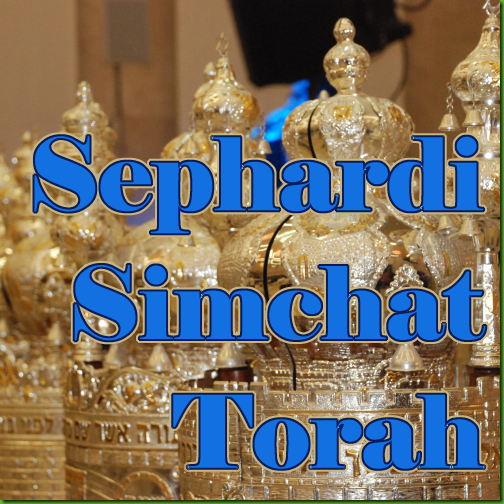
Tin-can dancing – Sefardi Simchat Torah style

image

Some epiphanies come later in life than others, or are only possible in Israel, when you realize that not everybody is Ashkenazi like you are.  One question I heard years ago about Simchas Torah has been echoing in my mind every year, ever since: why is it called “Simchas Torah”? 

(And, yes, in my head it’s still simchas Torah, with a ת/“sav” at the end of the word.  Pronounce it however you like when you read!)

A lot of people lazily refer to the day, when they refer to it in English at all, as “Rejoicing with the Torah,” but you probably suspect this isn’t correct if you know anything about the grammar of possession in HebrewWikipedia translates it as “Rejoicing of/[with the] Torah,” which I like because therein is the answer. 

The name of the holiday is rejoicing not WITH the Torah, but OF the Torah.  Once a year, the Torah rejoices and we, Am Yisrael, are its arms, its legs, its voice in song.

Why have I been thinking about this this year in particular?  Well, if you’re Ashkenazi, like I am, this picture is probably pretty close to what you think of when you think of dancing with a Torah:

image

(Skverer Rebbe photo credit Arit126 via Wikipedia)

This kind of Torah is like a baby, easy to dance with.  Just smoosh it flat against your chest and off you go, bobbling lightly and sedately around the shul.

But it turns out that we Ashkenazim are the only ones

What is Yom Yerushalayim, and why do we need it?

image

What are you up to this week???  Here in Israel, we’re still celebrating.  It’s like one non-stop party at this time of year, which was so bland back when we lived in Canada.  And this time, it’s one of the strangest holidays of all: Yom Yerushalayim (Jerusalem Day). 

This is it – the Big 5-0, and the city is all geared up with so many different kinds of celebration.  Every school in the country, pretty much, is organizing tiyulim to the Holy City, and the place is mobbed with the usual tourists plus some.

I was there, with my son’s school.  We had a great time, but it was a heartbreaking time as well, and here is why:  Jerusalem is so far from being perfect it’s not funny.  Jerusalem is so far from being perfect that I could cry.

imageimage

At the seder each year, we sing, לשנה הבאה בירושלים / leshana haba’ah bi’Yerushalayim – “Next Year in Jerusalem.”  We sing this even if we are lucky enough to be in Jerusalem, because the last word is הבנויה / habnuya – Rebuilt. 

The Jerusalem that we have is a miracle.  It is a beautiful, busy, living, crazy balagan of a city and I love it.   I love the fact that the country just turned 69 years old, and its capital is only 50 – this shows that you can’t take even a capital city for granted here, since we had to do without it for 19 years.

Yes, a miracle indeed. 

image

(photo credit: IDF via Wikimedia)

The Jerusalem we have today is truly many things… but it is not yet rebuilt.

This year, we’re celebrating 50 years since the liberation of Jerusalem from Jordanian hands, putting it in Jewish control for the first time in thousands of years.  But walking the streets of Jerusalem, the city does not yet feel free.

Driving past the Damascus Gate (Shaar Shechem), the Palestinian Bus Station, the police standing guard across from Givat Hatachmoshet, the Dome of the Rock and Al-Aqsa, the scars, mostly invisible, that have been inflicted on this city and its people since it was liberated… well, these things are more than heartbreaking.  They are like a slap in the face when everybody’s coming to celebrate.

But this is the reality.

Did you forget to call us on our special day? (Please call!)

image

It’s not too late, in case you were thinking of picking up the phone.  You’ve still got a few more days.

What?  You weren’t??  Why not???

If you’d normally call someone on their birthday or anniversary, why not call all your Israeli friends and family on Yom HaAtzmaut and/or Yom Yerushalayim?

Go on, pick up the phone.  It’s easy, cheaper than ever; it only takes a few minutes, and means so, so much.

Usually when I speak to family back home in Canada around these special events, which always fall between Pesach and Shavuos, and I mention a holiday, they usually say something like, “Oh, yeah… it’s, um, is it Lag Baomer?”  (Which, to be fair, it sometimes is and sometimes isn’t.)

And they’re absolutely right to be ignorant about what’s going on here.  You really don’t feel Yom HaAtzmaut or Yom Yerushalayim outside of Israel unless you’re immersed in a tremendously Zionist context where people are going to extremes to deck the halls.  That “Oh, yeah,” reaction – well, I don’t blame them.  If you’re just going about your life, it’s a little much to expect you to remember a minor, modern holiday in a country far away.

And yet… every year, I wake up on March 1st knowing it’s my sister’s birthday.  There’s no sign of it in the weather, in the air, posters on the walls, sales in the malls, or fireworks anywhere I go.  (I picked this sister deliberately, and not my mother, who was born on Bastille Day, the French national holiday, or my other sister, who was born on Valentine’s Day…)

And because it’s my sister’s birthday, I think about her, plan a gift (okay, I don’t always get around to sending one – I’m not the BEST sister!), send her some kind of e-greeting, make a phone call.  I sort of think about her all day, and the amazing things she does that I never could.  It’s her special day.

image

(See?  Very special!)

Now, you’ll probably admit that we’re not limited to ONE special day per year per person.  People also phone loved ones on their anniversaries, Mother’s Day, graduations, and other special occasions, so this isn’t limited to birthdays at all.

So why not extend the love to include, oh, an Independence Day (or two)?

Things that are weird in Israel #18:What’s with all the HAMMERS? (Yom HaAtzmaut Edition!)

image

If this is a hammer, it must be… Yom HaAtzmaut!  Yes, it’s time for our country’s national Hammer Day celebration, the day when children young and old head out at night to buy huge inflatable HAMMERS.

Great, big, blow-up hammers in all sizes, shapes, and colours… okay, just kidding.  Not ALL colours.  Just blue and white.  Blue and white hammers to proclaim freedom throughout the land.  Everywhere you go, kids are bopping one another with these things.  Am I missing something???

Now, I have never seen giant inflatable hammers for other occasions, but I figured it couldn’t be a unique Israeli thing, so I went and Googled other holidays.

I started with the obvious:  “Fourth July hammer.”  Let’s see how the Americans do it.

image

Not with hammers, apparently.  Okay, there IS one inflatable in this batch:

image

Getting even more specific, I tried “fourth july hammers inflatable.”  I figured this one couldn’t miss.

image

A little more on the money, but really… this is a disappointingly generic lot.  Is “Bang, Bang, Bang, High Striker” the message you want to ring out loud and clear on YOUR Independence Day??

image

Being a proud and patriotic Canadian – we’re turning 150 this July 1st! - I figured that if independence and hammers were a natural pairing, Googling ““canada day” hammer” would be sure to find something.

5 failproof ways to enjoy chol hamoed in Israel

image

If there's a downside to living in a Jewish country, it may be the fact that everybody celebrates the same holidays.  That means everyone is on vacation at the same time.  Which means, in turn, that every attraction, every highway, every bus route and train line, is going to be jam-packed if you're heading to the most popular destinations - and even some unpopular ones.

This Pesach was our (hmm...) eighth chol hamoed living in Israel (Sukkos / Pesach year 5774, Sukkos / Pesach 5775, Sukkos / Pesach 5776, Sukkos / Pesach 5777 - omg, I can't believe it.)

Our very first chol hamoed (Sukkos 5774), we headed to Yerushalayim, little suspecting that everybody else in the country had the exact same idea.  Public transportation in Yerushalayim isn't entirely reliable at the best of times, and this was NOT the best of times.  We spent a large chunk of the day stuck in traffic.  Very frustrating!

I'm not saying Jerusalem is out of the picture.  But based on our experience and some others over the years (!), I've come up with a few rules for planning chol hamoed activities with the least possible stress.

Here are five tips that will help you sail through chol hamoed with the greatest of ease:

1. Book ahead

Lots of attractions here let you pre-book a specific time slot.  We did that for a few activities this chol hamoed, including the Dialogue in the Dark exhibit at the Israel Children’s Museum in Holon, a jumping / bouncy castle attraction (also in Holon, we made a day of it), a local trampoline place, and the movie theatre.   Last year, I also bought tickets to a play at the Haifa Children’s Theatre Festival.  During previous chol hamoeds, we’ve done various circus things.  There are always choices like this, which allow you to plan ahead.

The movie theatre is a great example.  Sure, they charge something trivial like 5 shekels extra to pre-book, but you get to pick not only your movie time but also your seats.  Yet the throngs at the box office bely the fact that this is 2017 and such a thing as the Internet even exists.  People show up and then act surprised that there are so many other people; they get into the theatre and act surprised that the good seats are already taken.  Plan a good surprise – prebook and you can waltz right in anytime.  We had to kick people out of our seats, but I tell myself they could have booked online, too.

2. Show up on time

Chanukah in Israel: why it’s simply better here

image

"Do they really celebrate Chanukah in chu"l???" (Outside of Israel - see this post!)

This Sunday, I brought English Chanukah songs for the girls I tutor.  One of them was amazed and asked me this outright.  She couldn’t believe that even in Canada, we celebrated Chanukah.

She knew that Jews everywhere celebrate most holidays, but Chanukah is so tied up in the Israeli psyche, our most nationalistic holiday besides Yom HaAtzmaut (Independence Day), that it must have seemed impossible to celebrate anywhere else.

And I have to admit: she’s right. 

Sure, you can celebrate Chanukah in chu”l, but you can’t feel it the way you do here.

I've always been humbug about Chanukah.  It's not that I hated it, but when we lived in Canada,

On Rosh Hashanah, it’s BYOM (bring your own machzor)

image

Rosh Hashanah’s coming, so it’s time for a public service announcement. 

Things here in Israel are NOT the same as they are wherever you come from.  That includes shul on Rosh Hashanah and Yom Kippur.

You probably won’t need tickets, and I don’t know of any shul in Israel that will kick you out if you haven’t signed up ahead of time, but depending on the shul, they might not have a lot of space for you. 

Also, check around your neighbourhood carefully – the davening (prayer services) is very different in different types of shuls.  And I’m not just talking about Ashkenazi and Sefardi (Mizrachi) shuls. 

Yeshivas, for example, may have a longer, more drawn-out davening that’s enjoyable if you like something more spiritual, while “stam” Israeli shuls may have more of a “get in, get out, get home” type of approach.  Most shuls start at 8 am on yom tov, but the ending time really varies, from 10:30ish across the street from me to as late as 1 or 2 in some places.

(So if you’re expected somewhere for either of the lunch meals, it’s extra important to co-ordinate with your hosts so you get there when they want to start.)

If you’re new to your area, ask around to find out which shul is more likely to offer you the best experience.  That depends, of course, on what your criteria are.  Such as whether you like singing or prefer to avoid it at all costs, like at the shul across the street from me, where any necessary musical touches are grudging at best.

Also, if you’re a woman, ask other women – your experience might be very different from what a man would encounter in the same shul.

One thing you won’t get here that you may or may not be used to – calling out page numbers.  Most Orthodox shuls outside of Israel don’t do this either, but our shul in Toronto did because it had a kiruv (outreach) bent. 

Aliyah: the easiest thing in the world

image

Let me tell you a secret about making aliyah:  Pesach.

When we decided to make aliyah, everyone said “Mazel Tov,” and then they’d start to coo.  Ooh and awe in amazement.  “Good for you,” they’d say.  “You’re so brave.  That’s so difficult.  You must be so strong.”

It was embarrassing, really.  But I believed it, too.  I believed that we were doing something incredibly difficult.  I believed that someday, by the sweat of our brow, we would earn the praise.

And then, along came our first Pesach here in Israel.  Which was easy; almost unbelievably so.

Just about any yom tov here is easier.  I guess that shouldn’t be a surprise in the world’s only Jewish country, but there it is; it was a surprise to me.

Like before our first Rosh Hashanah, when, in the post office, the teller was selling holiday greeting cards.  In the grocery store, honey was on sale (regular and silan, the delicious local date honey).  Along the shoreline, we were far from the only family tipping out our pockets come Tashlich time.

Then came Sukkos, Simchas Torah, Chanukah, Purim… they were all so much easier than the same day anywhere else in the world.

Pesach without the monster

But Pesach.  Pesach.  Sweet, sweet, Pesach in Israel…

We have been here for two Pesachs now and each one has been a delicious, delicious surprise. 

Okay, I don’t mean buying foods free from kitniyos (legume products forbidden to us minority Ashkenazim), which was actually harder this year than last, for some reason.  But just… everything about the yom tov itself.

Here in Israel, there’s no Pesach Monster.

What’s the Pesach Monster?

In Toronto, at least, people treat Pesach like it’s a monster, coming to get them. 

Things that are weird in Israel #12: Xmas (that means Christmas)

image

If there’s anywhere the Grinch LOVES at this time of year, it’s got to be the Jewish state… right?

Wrong!

More than 2% of Israelis are Christian, about 161,000 people.  That’s about the same as the proportion of Jews in the United States, although it depends on how you’re counting. 

But it’s not just Israelis.  Beyond that 2%, there are about 300,000 “foreign workers” in Israel, which includes many, many Catholics from the Philippines.  (I also believe that many olim from the former Soviet Union are “secretly” Christian, which would bump the numbers way up beyond the official government tally.)

Anyway, considering this country is the birthplace of Christmas, it’s usually given pretty short shrift.  (A Christian word, by the way, meaning “confession.”)

Would I be a bad Israeli, a bad Jew, if I admit that it feels like there’s something missing here in December?  Don’t worry, I’m not pining for the malls and Santas of years past.  But it’s definitely different.

Which was why I was unexpectedly thrilled when I stumbled upon this colourful display outside a supermarket in the heart of Haifa. 

IMG_00005606

No snow in sight, but at least Frosty is putting in an appearance.

Black crocheted kippah, on judgment.

image
Black crocheted kippah.

The guy across from me on the train, here in the reserved car, is davening.  He holds a big siddur, mouths the words under his breath, with passion.  Expertly, the way Israelis do.

He doesn’t have to daven, of course.  There are dozens of people on the train, all around him, who aren’t davening.  Turning on their laptops, listening to music.  Even with the kippah, they might just assume he davened earlier, at home or at shul. 

Still, no big deal.  He has a ring in his nose, a little silver loop.  A heavy silver-and-onyx ring on the middle finger of his left hand, and an ostentatiously chunky men’s watch on his left hand.  Another fine silvery ring pierces the cartilage of his left ear. 

Two songs you will hear in Israel before Rosh Hashanah.

image

It’s beginning to sound a lot like…

Tishrei!

If you’re the sort of person who feels bombarded by Xmas carols round about December 5th in North America, you have some sense of what goes on here before the Tishrei festivals (ie, Rosh Hashanah, Yom Kippur, Sukkot, Simchat Torah).

Some songs are holier than others.  The “secular” ones deal with the passing of seasons and years, while the holy ones are drawn from the Torah, Tanach, Siddur, Machzor, etc.  Both are heard almost everywhere, regardless of whether it’s a religious or secular setting.

And if you are ever out in public when either of these is sung or performed,

Haveil Havalim, Behar / בְּהַר Post-Party Edition

169854259_ccda36936e_z 

If you weren’t in Israel, you missed Yom HaAtzmaut.  Sure, you may have celebrated even if you don’t live here, as I did for many years before we made aliyah.  But I’m going to take the self-righteous leap and say that you haven’t truly experienced it if you haven’t been here.  It’s not just a party… it is a celebration of national pride, on a spiritual and physical level.  Awesome.

Now the party’s over, but don’t worry – there’s more fun coming, in the form of Lag b’Omer and then Shavuot.

So what are we doing here?  Hosting Haveil Havalim, of course!

imageThis is a weekly roundup of what’s new and great in the Jewish / Israel blogging world.  If you haven’t checked out these great blogs yet, you really should. 

  • Last week’s was hosted by Batya over at Shiloh Musings
  • Next week’s will take place at Esser Agoroth.  Submit your posts to esseragaroth “at” gmail “dot” com.
  • For more details and a complete schedule, please join the HH facebook group.

So while we’re recovering from the party (and waiting for the next one to begin) let’s check in with what’s late & great from around the Jewish World!

Normally, I split the links up into categories… but absolutely everything this week was about Israel, from start to finish.  As is probably fitting this week.  So I made up  my own “categories.”  Enjoy!

Setting off Fireworks

Before we came here, I always assumed there wouldn’t be fireworks in Israel.  I guess I figured there was too much stuff exploding as it is.  But as Batya points out in Yom Ha'Atzma'ut Explosion of Joy 66!, there’s also a spiritual side to the celebration.

Lemon Lime Moon comments on tensions that broke out during Prime Minister Netanyahu’s presence at a Yom HaAtzmaut ceremony over his decision to free prisoners in Netanyahu ' Honors' the Dead, saying “In what far out universe does one honor the dead by freeing their murderers?” 

The Spiritual Side

Yerushalayim wasn’t the only location liberated from Jordanian rule in 1967.  The ancient Biblical site of Shiloh was also reclaimed in the 6-day war, as Batya explains in Women, Join Our Rosh Chodesh Prayers at Shiloh HaKeduma, Tel Shiloh.  Join her each month in the monthly women’s Rosh Chodesh tefillah on Tel Shiloh, the site where the ancient Mishkan (tabernacle) rested for almost 400 years.  (I did!  It was great!)

Fascinating historical fact:  “it is no idle coincidence that the Treaty of London, which would drag Britain into the conflict after 75 years, was signed on Friday the 5th of Iyyar 5599 (19th April 1839), the same date and the same day of the week on which Israel would become independent 109 years later.” writes Devash in Restored-Jewish-Sovereignty-in-the-Land-of-Israel Day.


Getting Your Facts Straight

Still believe that “Israel was brought into existence by the European powers in order to ease their consciences after the horrors of the Holocaust were revealed”?  It’s a myth, says Brian (a fellow Feb 2013 NbN Go North pilot tripper, now living in the north!) in Misconceptions Concerning Zionism and Against Founding of IsraelWhat are the other misconceptions?  Read it and be forearmed against those who would delegitimize Israel.

“The… adversarial statements by United States Secretary of State John Kerry…could be a harbinger of troubling times,” writes Brian, yet in Would Loss of American Unquestioned Support Destroy Israel? he says he’s unafraid.  Whether you agree or disagree, it’s worth a read.

As a victim of a past terror attack, Esser Agoroth also takes issue with the abuse of the rhetoric of terror in the recent death of 20-year-old Shelly Dadon, saying in his post Believe it or Not, Shelly Dadon was Killed by Arabs, not Jews, “To refer to graffiti, even to the slashing of tires and other vandalism as an act of terrorism is more than ludicrous; it is truly offensive.”


Simply Proud

Sure, we’ve all heard of SodaStream (now!), but I had no idea that Fiverr and many other companies are based in or were started in Israel.  Naomi Goldberg shares her favourites in 66 companies that make me proud to be Israeli.

Interested in exploring one of the country’s natural wonders?  The Eilat Coral Reef Reserve is a great place to start, writes tour guide David Ben-Sira.  It’s not overrun with tourists, he says, but there’s a snack bar and on-site gift shop, as well as changerooms with showers, so you’re never too far from civilization.

For me, being Israeli is still a strange, new thing.  Mostly good-strange, but sometimes disconcerting.  Two posts this week deal with different aspects:  one, Learning patriotism, for Canadian beginners., is all about my adventures in discovering patriotism (relatively) late in life, and the second, When chummus comes a-knocking… is a lighter comment on my distaste for this beloved national “dish.”

(Or Not)

“I do not celebrate the birth of the State of Israel, because I despise it,” writes Rafi Farber in Why I do not Celebrate the Birth of the State of Israel.  An unpopular sentiment, perhaps, but it’s seems that it’s more statehood that he opposes than Israel.  I’ll let you get the details from him – you may still disagree, but do read the piece before forming an opinion based solely on its (inflammatory) title.

Ariel ben Yochanan writes, “Let's call a spade a spade and say that these are pogroms!” in reply to some discouraging news in This Is Terrible!

The media here has been abuzz with an incident concerning the trial of David HaNahalawi, mainly because so many soldiers and civilians have reacted in unprecedented numbers through the semi-anonymity of social media.  Esser Agoroth stands with the soldier, saying “There are plenty of additional injustices being executed by the Israeli Government against its own constituents,” in I Stand with David the Nahal Brigade IDF Soldier!

The Israel Prize is the country’s highest honour, handed out once a year on Yom HaAtzmaut to to an Israeli citizen or organization who has “displayed excellence in their field(s), or have contributed strongly to Israeli culture.”  In The State of Israel Awards One of its Loyalists a Prize: Big Deal!, Esser Agoroth takes issue with one of this year’s selections.

The Sting with the Honey

The flipside of happiness is sadness, and there is plenty of it in Israel on Yom HaZikaron.  This country which we celebrate with joy was won with tears.  “All of the pain, all of those wonderful people dead,” says Batya in Understanding Israeli Independence, No Fairy Tale.

Sometimes, celebrating Israel comes down to the small “everyday” moments, touching ones and happy ones, as Mrs. S. asks, “What small yet meaningful moments defined Yom HaZikaron/Yom HaAtzma’ut 5774 for you?” in A Tale of Two Moments.

Hope you check out at least a few of these posts… and tell their authors HH sent you!  Remember to submit your posts for next week to esseragaroth “at” gmail “dot” com.

[photo credit:  Chris Young, via flickr]

Learning patriotism, for Canadian beginners.

image  To say I’ve been surprised by Yom HaAtzmaut isn’t quite true. 

All the chagim have been so much more vivid here that it stands to reason.  And this is THE chag, the Identity Festival that celebrates exactly what this little country stands for and all it’s accomplished in 66 short years.

Back in Canada, I noticed that I only really started taking Canada Day, the July 1st national holiday, seriously after we decided to make aliyah.  With a great big dollar-store flag flapping out front and crafts and activities for the kids (like this Canada Flag activity), we did more than most people I knew. 

imageOkay, we also did the obligatory Big Family BBQ.  Everybody does that, but it’s more about kicking off the summer than celebrating Confederation.

Every time we’d drive south of the border, even when it wasn’t July 4th, I was always struck by the number of flags and the sheer shamelessness of Americans, hooting and hollering about living in the greatest country in the world.

Canadians don’t do that. 

Oh, sure, I think most of us secretly believe it.  It’s a great country:  second-biggest in the world, unspoiled, beautiful, friendly. 

But in general, we will not crassly stick our nationalism in your face – even if your face is marching up and down the streets of our biggest city on our national holiday.  Fireworks and beer, yeah; flags and hoopla, no.

Face it:  Canada just doesn’t do patriotism very well.

We have earned our reputation as the meek among the nations of the world, never offending anybody (except people who don’t like beer or socialized medicine).  Standing in line.  Accommodating.  Apologizing.

I like to tell people here of the time I went shopping, shortly before making aliyah, and in the supermarket, my cart almost made contact with the cart of a woman going in the other direction up the aisle.  Almost; we almost touched carts.  And as we passed each other, like strangers in the night, we whispered to each other that most Canadian of utterances:  “Sorry…”

Yes, we both apologized, instantly and automatically – for NEARLY entering each other’s personal space.

Quebec is like Canada’s crass little brother in this regard.  Even though it’s technically part of Canada (and so, not a nation at all, really), each year on June 24th, they make a big blue and white to-do over their “Fête nationale” (national holiday), St. Jean Baptiste Day (its origin as a saint’s day reflects the province’s Catholic beginnings).

imageOutside of Quebec, the actual national holiday on July 1st gets considerably less attention.  Like I said, there seems to be the prevailing idea that if you like the country, you should keep those feelings tastefully pent-up inside. 

Oh, sure, buy a bunch of made-in-China flags and merch (hats, beer cups, tacky garden ornaments).  But don’t go too far overboard into thinking you or your country are something special.

Israel is a horse of a different colour.  A soos b’tzeva acher (סוס בצבע אחר = “horse of a different colour”), if you will… and that colour is firmly, starkly, proudly KACHOLAVAN.

Flags are everywhere.  Not just on government buildings, although they are all dolled up, of course.  Even the normally pretty dumpy streets of Kiryat Yam are all fancy, with that bunting stuff that flaps and rustles in the breeze.  Here’s Batya at me-ander blogging about setting up the flags at the store where she works.

image (Flags are even on the challahs!  See this post for more.)

Passing through the Herzliya train station the other day, just an ordinary train station, and being literally stopped in my tracks by the beauty of the flags everywhere and what they stood for… goosebumps.

The whole country is covered in flag upon flag
The nation is dancing in wave upon wave
The nation is happy, the nation is glad
It is a festival today in Israel

image כָּל הָאָרֶץ דְּגָלִים דְּגָלִים,
עַם רוֹקֵד גַּלִּים גַּלִים
עַם שָׂמֵחַ, טַף צוֹהֵל –
חַג הַיּוֹם לְיִשְׂרָאֵל.

Read and listen to a scratchy 1956 recording here.

Or watch it as part of a mix of Israeli “chag” songs here (starts at 2:15).

For one day, it seems, for all its flaws and hiccups; for all the bickering and disagreement, for all the pressure from every possible direction to be something else entirely… for one day, Israel is proud of Israel and all it stands for.

It’s nice.

In case you were hoping for something shocking, or controversial or au courant political insight (do you know me???) or at least a mild-mannered kvetch, don’t worry; all that will resume again in a couple of days.

In the meantime, I’m just proud to be Israeli… at last.

(Photo credit:  אורן פלס, Wikimedia)

Yom Aliyah – you didn’t miss it!

image Where were you on April 10th, and what were you doing??  If you were in Israel, you should have been celebrating a national holiday… but you probably didn’t. 

That day, a Thursday four days before Pesach, might have been the first ever “Yom HaAliyah” (or Yom Aliyah), if a Knesset bill introduced several weeks earlier had been able to pass in time before the spring recess of the government. 

They’ll come back from vacation in June, hopefully,  in time to vote the holiday in for next year.  The date will actually be the 10th of Nissan, not April; the two just happened to coincide this year.

So how should we celebrate Yom Aliyah when it finally does come around??? 

  • Sewing a quilt out of all our national flags, stitched together? 
  • Crafting a giant collage of plane and steamship tickets from the past 100 years? 
  • Dressing up in our historic national costume (fun if you’re from the Ukraine; confusing if you’re from Canada and everybody wants you to show up in a Mountie uniform). 
  • Sticking pins on a map to show where we’re all from… then burning the map, to show that we’re all Israelis now?  (we Israelis sure do love to burn stuff!)

image

(this is Banff – I used to live an hour away!)

The cynic in me says we don’t NEED a Yom Aliyah, because we’re almost all olim, if you go back a generation or two or three.  And also, shouldn’t we have a “Yom Vatikim” for all those Israelis who aren’t olim, like the ones who stayed here alongside the Ottomans and British during the hundreds of years when it was difficult and dangerous for Jews to live here?  And maybe four days before Pesach isn’t the best time for a party?

But in this case, I say “tough noogies” to my inner cynic.  I’m an olah, and I need all the celebration I can get.

So how do you think we should party when the 10th of Nissan rolls around next year…?

Things that are weird in Israel #7: Chad pa’ami, a poem about plastic cutlery

chad paami plastic spoon First, some background.  Israelis adore their plastic cutlery, which is mysterious because it is some of the most awful I have experienced in my entire life. 

The spoons are the worst – most are shaped in such a way as to slice the sides of my mouth every time I use them. 

The other cutlery here isn’t much better – the forks snap, leaving tines scattered everywhere in your food, while the knives have wimpy handles that don’t let you accomplish much of anything.

And don’t get me started on the plastic beverage cups, which, where I come from, would be known as “baggies.”  They do have a sort of ring arrangement around the top that prevents them from collapsing utterly when raised to the mouth or lowered to the table – usually.

imageNevertheless, the past week having been Pesach, and our dairy Pesach stuff having apparently been thrown away instead of packed meticulously for our lift (!), we have been dependent on plastic cutlery, also known as “chad pa’ami” (חד פעמי), which means “single use” and is a catchall phrase for anything you can use one time and never again – generally because it has fallen apart along the way.

Until our lift arrived, plastic cutlery was pretty much all we used at the merkaz klitah… so it felt really sad to have to go back to it for this week.

(Yeah, they did community kashering in KShmu, so theoretically, we could have hauled all the regular dairy cutlery to be boiled…)

So now that Pesach is over, I’ve written a poem, in tribute to the plastic cutlery that’s been “plaguing” me all week long (get it?  Pesach – plaguing?).

Chad paami, how I hate thee
All the mouth sores, scrapes and cuts
For Passover, but moreover
All the damage still remains.

All that plastic, trash fantastic
All our money down the drains.
And the mouth sores, scrapes and cuts.
Eating messy, like a klutz,

All those flimsy plastic handles
Stacked beside the yom tov candles
How my mouth bleeds and bemoans,
While around our table groans

The creak and crack of chad paami
Scraping matzah - double whammy
Now the chag is gone and through
So I can say I'm sick of you!!!

And imagelook! 

While googling, I turned up this picture, but I have also seen these in the stores… for people who can’t be bothered buying an actual pot (or cannot afford one):  it’s a chad paami POT – made of TINFOIL. 

If the quality is anything like the rest of the chad paami in this country, I would fear for my life when using this thing…

Please – share your terrible chad paami experiences (Israeli or otherwise) in the Comments section below!

Google