Like the MamaLand Empire!

Have you Liked the AliyahLand adventure?
      ...and sign up for weekly aliyah tips by email (it's free).

Showing posts with label health. Show all posts

Talking to Haredim (badly) about coronavirus

Disgusting... horrifying... sickening...
I’m sure you’ve noticed all the pictures in the media, in Israel and beyond, of haredim ("ultra-orthodox Jews") defying lockdown orders, congregating in public, hanging out in minyans and yeshivas, not wearing masks?

I have.
I've been shocked, horrified, disgusted.

But then I sat down with it for a bit and really thought things through.

One of the things I had to learn during my Master's degree, and for some of my other writing, is seeing the missing pieces of the puzzle.  Who or what aren't you considering in your sweeping generalizations?

This is called academic honesty, and the media could seriously use some of it these days.

Why are we so bad at talking to strangers?

imageAnother thing making me rethink this is Malcolm Gladwell's recent book Talking to Strangers (affiliate link), which is all about how we have trouble communicating with people who are unlike "us" -- however we define "us" at any given moment.  And about how these communication problems lead to bigger problems, possibly even the spread of pandemics.

(My conclusion, not his; his is

To every fruit, there is a season (with helpful seasonal Hebrew vocabulary!)


In Canada, there are seasons. Lots and lots of them. Well, four, but they’re all exciting and distinctly different. You’re probably familiar with them: winter, spring, summer, and fall.

Israel doesn’t have seasons, as such, a fact which has been driven home by this long, warm fall. And been hammered into our skulls with a recent two-week November heatwave חמסין / chamseen (hot wind from the eastern deserts) that’s left us parched and sweating, and left my plants wilting at a time of year when they’re usually starting to soak up the first downpours of the year.

(Interestingly, as this article points out, most Israelis probably call the chamseen by that name because it’s hot, which is חם / cham in Hebrew, in fact it comes from the Arabic word for fifty – meaning fifty days a year of icky sandy hot and dry conditions.)

Spring and fall are often called עונות המעבר / onot hama’avar, the transitional season. Meaning they’re neither here nor there – just seasons that get you from one place to another. (When you sit on the aisle in a movie theatre or airplane, you’re also sitting on the מעבר / ma’avar – exactly the same word.)

The term onot hama’avar usually crops up when we’re talking about health, and other problems, that come up during spring, and especially fall. Colds, allergies, migraines, skin problems – most Israelis are suffering from some combination of all these at the moment, compounded by the current hot, dry wind which has meant I can’t smile or my lips will crack.

Normally, the fall עונת המעבר / onat hama’avar (singular) is also the time to get immunized with this year’s flu vaccine, a fact driven into my head by my ulpan teacher. But this year the vaccines were late (for various international reasons and not due to a conspiracy and/or the fact we have no government!) and we haven’t gotten ours yet.

But however you feel about the weather, that’s actually NOT what a want to talk about. Because there are even more important seasons in Israel: seasons you must be aware of, seasons people argue heatedly about on Facebook, seasons you need to prepare for before you leave the house.

I’m talking about fruit seasons, of course.

I’ve already said many times that we’re huge fans of Israeli fruit. It’s cheap and more delicious than anything I ever

Coming to Israel? You NEED these comprehensive travel tips! (guest post)

Summer tourism and aliyah season is almost here, and whether it’s your first trip to Israel or your eightieth, don’t you wish you could have a list of all the little things everybody else wishes they’d thought of? 

This comprehensive travel guide was written by Debra Nussbaum Stepen.  She’s a Licensed Tour Guide in Israel (no mean feat, as it takes years of study and deep historical and geographical knowledge!) and you can find out more about her and her services at debratours.com.

Comprehensive Travel Tips for Tourists

1. Do not throw out the little slip of paper that they give you at the airport. This is your entry visa and entitles you to exemption of the 17% VAT tax on

What should you bring on aliyah? What should you leave behind?

image

Should you bring Ziploc baggies?  What about furniture and appliances?  One question every single oleh is going to have to face before moving to Israel is – what should I bring with me?

So I thought I’d turn to the real experts – olim who are already here. I asked the following question on two major aliyah groups on Facebook:

What ONE item did you (or should you) have brought with you when you made aliyah? Bonus: what ONE item did you bring that turned out to be utterly useless? (ours was snowsuits!!!)

I’ve divided up the responses into categories to make it easier for you to read. But essentially, there's no one answer that works for everybody. Some people bring several lifts' worth of items, others come with just a backpack.

The advice here is also sometimes contradictory. I’ve met people who say, “Don’t bother bringing anything major, you can get everything here.” And then there are others who tell you to bring everything you possibly can. It really depends on who you are and regardless of what other people’s experiences have been, what you choose to bring is up to you.

That said, hopefully we can all learn something from what people chose to bring (or what they regret bringing...).  Spoiler alert – not one person mentioned ziploc baggies.  Or toilet paper, tuna, chocolate chips, or any one of a huge range of items that they would have been begging for 10, 20, or 30 years ago.  You can get zipper bags of various kinds (though they’re still not very good, in my opinion!), the tuna is excellent, and they even have Godiva chocolate for sale here now.

image

(Mmm… I saw these in a store the exact DAY my husband surprised me by showing up with one as a Rosh Hashanah present!)

Here are the major categories of people’s MUST-BRING items as well as their aliyah REGRETS.

The very biggest regret, hands-down, is a category

Starting a small business in Israel? Learn from my mistakes!

image

Did you come to Israel – or are you planning to come to Israel – hoping hoping to start a small business?  Good for you!  I really mean it.  Israel is the Startup Nation.  It’s a land of opportunity.  It’s the place where you can make many of your dreams come true in amazing ways you never even dreamed of back where you came from.

As long as you’re careful.

For all the opportunities here in Israel, it’s also… (shh) a very bureaucratic place.  And you have to stay on top of the bureaucracy because, unlike in certain larger and more anonymous countries I could name, where you can owe the tax people money for years with absolutely zero consequences, neglecting some of the bureaucracy here in Israel can have serious repercussions.

How do I know?

Um, let’s just say… I’ve learned this the hard way.   Not the extremely hard way, which probably involves jail time.  But the kind of hard way, which involves having your bank accounts frozen and threatening letters from various government agencies.

Setting yourself up as a small business here is actually super-easy.  There are three basic steps, and I’ve found that Rifka Lebowitz’s guide is terrific in terms of explaining these in detail:

  1. Register your business for Ma’am (Value Added Tax = VAT):  There are two kinds of businesses, which mostly depends on how much income they bring in, and for both types, you need to open a “tik” (file) – tax-exempt (osek patur) and tax-paying (osek murshe) with the VAT office.
  2. Register for income tax:  True, they’re both taxes.  But the VAT people don’t talk to the income tax people and vice versa.  So you have to tell the income tax people you’re a business now.  And then they will hound you forever after (see Tip #1) until you close your business tik, which is very easy to do if you’re no longer running your business.
  3. Register with Bituach Leumi:  This is a socialized country You no longer have an employer paying your national insurance, and most importantly, your health insurance to your kupat cholim (HMO, healthcare provider network) – so this is your responsibility now as an independent business person.

In general, skipping one of these steps is a recipe for disaster – so don’t do it.

Here are three mistakes I made along the way through this simple process that I hope you can learn from instead of having to untangle on the other side.  Any tips here are NOT a substitute for a good accountant.  If you think your needs are at all complex, please consult a real tax advisor (not just a blog, for heaven’s sake!) before you take any steps you may regret.

Mistake #1 – Tax ≠ Tax

Sounds like a no-brainer, right?  Except I was lulled into complacency because when you come here, everybody says

Comparing healthcare systems–Israel vs Canada

image

I got a great question from a reader today – I love hearing back from you! – and I thought I’d share it once I was done writing back.  The reader asked, based on my experience with healthcare in Canada and Israel, how I’d compare the two.

It’s actually something I haven’t put a lot of thought into.

As Canadians, socialized health care wasn't such a big transition for us.  American friends have had a variety of reactions, from giddiness that they wouldn’t go bankrupt trying to stay healthy to… well, I don’t think I’ve heard of any who really had a hard time adjusting, so I don’t know what the worst-case scenario is.  I suppose for people coming from the U.S., there may be longer waits and more of a “socialized” feel to things here, if that makes any sense.  But most, as I said, are far too delighted that the safety net exists here to worry about the nitpicky details.

Also, full disclosure:  baruch Hashem (ptoo, ptoo, ptoo!), we haven't had to have a lot of contact with the healthcare system.  However, although we’ve had no major health problems, we have all seen a variety of specialists, done the basic urgent care visit for little-kid stitches, non-emergency hospital visit, and routine health things as well.  Mostly, if it has been harder here, it is because of difficulties with the language, not the system.

A few particulars that I’ve found are different here:

  • Israel is more complicated in terms of choosing a kupat cholim (healthcare plan) and package. 

Who Israel has instead of rock stars and supermodels (and why I’m glad)

image

Sure, supermodel Bar Refaeli captures her share of headlines here.  But you know who's a real celebrity in this country?

I'll tell you.

I was sitting down this afternoon in a little cafe in the mall, revving up my voice recorder, buffing up my pen & notepad, or whatever I do before an interview… when I noticed a woman standing outside the cafe, staring intently. 

After a second, she started waving - at the guy I had come to interview.  She waved timidly at first, shyly, and then a little more crazily when she saw that he'd spotted her there.  "Todah," she mouthed at him.  "Todah."  Thanks.

"He's like a rock star here," said the translator.

I nodded, numb, amazed.

Who was this instantly-recognizable mega-star that I had come to interview?

It was this guy:

image

What’s that you say?

Exactly!  Yeah, this guy.  (The one in the vest.  No idea who the guy in the white kippah could be.)

image

Yup, him.  Desmond Tutu’s buddy.

On a roll (it’s not what you think it’s about)

image

Have you tried Israeli toilet paper lately?

It's actually quite good – as toilet paper.  Definitely better than it was, I'm told.  Which is good, because good old TP has been re-imagined (or perhaps always was) the National Nose-Wipe.

In fact, the toilet paper here is quite good.  Apparently, it used to be simply awful - crunchy and non-absorbent, I assume, since those are the things it would take to make TP simply awful in my book.

I know what I'm talking about.  In England on my honeymoon, years and years ago, I stayed in the World's Worst Hotel, near Paddington Station, which we thought would be cute - but it wasn't. 

There was no bathroom in the room itself, just a little water closet ("loo") up half a flight of stairs.  And the paper in there was absolutely awful.  It was that folding, single-paper dispensing kind that we'd had in my elementary school.  However, unlike anything I had ever seen before, each "sheet" of this paper was treated with some sort of smelly antiseptic chemical and then - mysteriously - waxed so that it was guaranteed to never absorb a single drop of anything.  It was crispy, it was stinky, plus, it simply did not do the job.

Compared to that, anything is better, and as I said, toilet paper in Israel is way more than halfway decent.  It's soft, it's 2-ply, and there are cute puppies on the brand we buy.  There are even premium 3-ply grades you can buy for extra indulgence.

But I still think it’s gross how everybody uses it to wipe their noses.  Maybe this happens elsewhere, too, but I have only ever observed it on a sweeping scale here.

Sure, actual "facial tissues" (aka Kleenex, but they're called "tissue" here in Hebrew) are available, in various colours, small and big packages.

But forget about all that. 

How to choose a health care provider (kupat cholim) in Israel

image

Let's assume you'll never get sick in Israel, shall we?

My teacher in ulpan had a cute habit.  When we were learning about ailments, she refused to use the first or second person - "you're sick; I'm sick."  She would only let us talk about ailments in the third person:  "he's sick; she's sick; they're sick."

So in honour of Morah Sarah, let's do that here, too.  Let’s assume you’re going to pick a kupat cholim (health care provider) and never need to use it.

Because, I'll admit, I've been holding back. 

In all these years of blogging, I haven't really said anything about how to choose a kupat cholim, one of the four healthcare provider networks that exist in Israel.  I feel like I don’t know enough, but the truth is, I’ve been navigating this system long enough to know a thing or two.  So I’ll try to help you straighten things out as far as healthcare is concerned.  If you have questions, ask below and I’ll try to answer.  I’ll also give a list of links for good information at the bottom of this post.

What are those words again?  Practice saying them; you’ll be using them a lot here (but hopefully never in the first person):

  • קֻפַּת חוֹלִים / kupat choleem = sick fund, usually translated into English as “HMO” for people from the U.S. who don’t understand any other approach to healthcare
  • Note, the above is the vowelled spelling.  Without vowels, it’s usually spelled “קופת חולים” for clarity.  Pronunciation is the same:  kupat cholim.
  • It’s sometimes abbreviated as קופ"ח / koopach
  • קֻפָּה / koopah = “fund,” like a supply of money, but sometimes people use this as shorthand to refer to your particular health plan
  • The plural is  קופות חולים/ koopot choleem = sick funds.

How do I choose???

Here are the 4 choices (4 kupot cholim), in English alphabetical order:

  • כללית / Clalit
  • לאומית / Leumit (not to be confused with BANK Leumi!)
  • מכבי / Maccabi (pronounced ma-KAAAAA-bee, not the way English speakers say it in the Chanukah story)
  • מאוחדת / Meuhedet (the "h" is actually a "ch" but this is how they spell it)

All of these 4 have offices all over the country, though one may be more prevalent in a given area, which will probably factor into your decision-making.

These days, most new olim are asked to choose their kupat cholim at the airport when they arrive.  If you don't know your choice, however, you can still do it at the post office like in the old days.  There may be other ways to do it as well. 

Don’t let anybody force you to pick at the airport if you aren’t sure yet!

But the question everyone asks is:  how do I choose???

(Assuming, of course, that you and your family will never get sick!)

Don't forget! Nine things to remember before you fly

image
Even with the best-laid plans, there are some important things that can fall through the cracks.  Here are 9 of the most important reminders – things you’ll want to take care of before you pull on that spiffy new Nefesh b’Nefesh ballcap and hop on the plane to Israel:
 

1.  Medical Check-In

 
Sure, health care in Israel is free.  But you’ll be sitting in front of a doctor who doesn’t know you, doesn’t have your records, and perhaps doesn’t speak English.  (Medical clinic receptionists will insist that “all the doctors speak English,” which means they know the names of medical conditions, but many still can’t carry on a conversation.) 
 
There’s also a different cultural approach and you may not have the confidence as a dripping-wet oleh to be pushy enough with Israeli doctors to make your concerns known.
 
If you have any medical worries, even little niggling things that you’re concerned might get bigger before your Hebrew gets better, get them taken care of ahead of time.
 

2.  Prescriptions

 
This could have been part of #1, except it’s so important I’m giving it its own bullet point.  Get a copy of all prescriptions, and a six-month supply of any medications you take on a regular basis. 
 
Keep these prescriptions in your carry-on baggage along with a few days’ supply, at least.  Checked baggage does get lost, and stuff gets lost inside checked baggage (especially if you’re bringing a dozen or more huge suitcases!). 
 
You don’t want to deal with a medical crisis immediately on landing.

3.  Dentist


Read everything I just said about doctors and multiply it by ten.  Then take out the part about it being free – you will have to pay for dental care in Israel, after you’ve figured out how to find it and how much it’ll be. 
 

Take me with you: How to make aliyah with pets

image

Would you make aliyah and leave your family behind?  If you've got a precious fuzzy (or scaly, or slimy) friend at home, you probably wouldn't consider a big move without them. 

Your dog, cat or reptile may not be exactly Jewish, at least according to the Law of Return, but that doesn't mean they aren't family.

Before we go on, I’ll admit something.  Two things, actually.

One, I have owned almost every kind of pet there is except dogs and birds.  Lizards, guinea pigs, ferrets, cats, frogs, hamsters, turtles, fish.

Two, when I found out I was expecting my son, twenty years ago, I got rid of every single living thing in the house.  I love animals.  But I knew I could either raise animals and plants... or I could raise a kid.  I wasn't responsible enough to do both. 

We've had a couple of near-brushes with cats since then, but so far, nothing has stuck.

So when we made aliyah two years ago, we were petless.  To get some advice on what it's like doing it with a fuzzy (or otherwise) buddy, I turned to some reliable sources on Facebook, as well as personal friends who brought their sweet (ginormous) doggie to Israel from Canada.

Clearing all the hurdles

Most important:  don't assume that just because you've mentioned your pet to your Jewish Agency rep that it's all taken care of.  The Jewish Agency is in charge of HUMAN aliyah. 

Pet aliyah is governed jointly by the Ministry of Agriculture and the Nature Reserves Authority, along with the Director of Veterinary Services.  All of which will require a whole slew of paperwork of their own (some no doubt redundant and - seemingly - unnecessary).

Things that are weird in Israel #15: Tens (and tens of tens)

image

Know why I was so excited last week?

My sister sent me tens of packets of Starbucks Instant Coffee

It’s true!  Tens of them!

Which of course, is also totally bizarre.

Tens? 

I said something about “tens” of something to Akiva the other day and he said “Tens… of what?”

Because in English, we only say “tens” when we’re about to say “of millions.”  And follow it, usually, with “of dollars.”

Despite ostensibly switching to the metric system tens of years ago, Canada has not officially gone over to a metric mentality. 

A truly metric mindset would have no trouble acknowledging the fact that… dozens do NOT make our life easier.  Dozens make things harder and more complicated.

If you think about it, a “dozen” is just about the most counterintuitive number.   Very few of us have a dozen fingers… though I tried harder than most of my parents, one of my kids having been born with eleven.

Dozens just don’t fit inside our brain neatly, the way tens do.

Twelves don’t make any more sense than any of the numbers that follow.  And they make a good deal LESS sense than tens.

Which is why, here in Israel, when multiples of things happen, they happen not in dozens (unless you’re buying eggs), but in TENS – עשרות (asarot).

Seasons (don’t) change: 10 ways you’ll know it’s winter here in Israel.

image

Israelis love to make a big deal of the seasons changing.  Heck, you can even drive up to the northern Galil and Golan to see colourful leaves on trees.

But I’m not buying it.  It’s all just an act.

As far as I’m concerned, there are exactly two seasons here:  good weather and hot weather.

We’re in good weather right now.  I feel like a human being, as opposed to a wrung-out sponja mop.

Nevertheless, Israelis insist on referring to the bit from November to February as winter.  They walk around shivering and kvetching about the cold.  This is disorienting, because if I close my eyes, it could be any season. 

I hope this Top Ten list will help you orient yourself when it comes to figuring out if it’s winter.

Top ten ways you’ll know it’s winter here in Israel:

The dark side of... the sun (like how it can fade your laundry or kill you).

image

You may have heard that Israel is a poor country.
It's true.

But one thing we have plenty of here in Israel is sun.

Almost every day, almost all year 'round (except when my sister decided to come for 2 weeks last December).

This is cool for many reasons:
- Hanging laundry outside, where it can dry in hours
- Saving tons of energy with solar water heaters
- Planning outdoor events 10 months of the year without worrying about rain

As my son said when he was here, the boundaries between indoors and outdoors are just more pourous here.  Our "porch" window opens up and suddenly we are outside.  When air conditioning isn't running, people leave their doors open and come and go as they like.

But there is a dark side to all this sun.

The sun is powerful.

You don’t want to mess with the power of the sun.

The same sun that guarantees that all your whites will come off the line whiter than white also guarantees that your reds, oranges and pinks will fade to pink, in less than 24 hours in some cases.

Oh, and it will kill you, like it kills up to 480 Israelis every year.

The small, sweet mercy of blueberries (and a medical clinic)


Empty medical clinic in Haifa.
It's not always about me.
Sometimes, the hardest things about aliyah are more about the kids.

But then, sometimes life sends small mercies, and I am grateful, even as my heart breaks at what I used to take for granted.

Like English.

My family is sick of hearing me say it by now.  Every time one of them complains about life's mundane annoyances, like bad service from a phone company, or having to deal with some kind of bureaucratic situation, I just keep telling them, "at least it's in English."

(I sure can be annoying sometimes!)

Maybe someone has told you that "all doctors in Israel speak English"?

Lots of people said it to me, both before and after we came.  Reassuring me that at least in the most dire circumstances, you'd be able to get help in a language you understand.  Turns out that in predominantly Russian areas like ours, that's not quite true.

Doctors may have mastered some key medical terminology in English, but their speaking ability is often very limited.

Last year, when GZ hurt his chin, my heart broke for how overwhelming things must have been for him.  In pain, surrounded by doctors and nurses yelling in a language he didn't understand at all.

"Explain to him!" one nurse kept yelling.  "Tell him if he doesn't co-operate, he'll have to go to the hospital."  Yeah, that didn't help, at all.

Whether you're small or big, medical situations can be overwhelming.  But at least if you're an adult, you have some prior experience.  For kids, it's all new and bewildering, in any language.

Even GZ's routine eye appointment back in June was a trial, albeit a less painful one than the chin.

Giving Birth in Shaarei Zedek Hospital of Jerusalem, Israel (a guest post)

image

Thinking of having kids in Israel?

It’s okay if you’re not.  Lots of people make aliyah before they even get married; others come long after their kids have grown up and left home.  (See When is the Right Time to make Aliyah?  Any time is the right time.)

But if you are thinking you may have kids here, read on.

I had all four of my children in Canada, two with conventional hospital births and two with home births assisted by a midwife.   So no sabras for me.

But I’ve always been fascinated by childbirth alternatives, especially those committed to empowering women and helping them make sane choices.  And I’ve always loved and supported the (hard, and often thankless) work of doulas and midwives. 

I’m thrilled to find out that there are some good ones learning and working in all parts of Israel.

This guest post was written by Chana Katzman, a doula currently working in Jerusalem, who offers her perspective on just one of the many possibilities for childbirth in Israel:

More pregnant women choose to give birth in Shaarei Zedek hospital, Jerusalem, than any other hospital in Israel. They must be doing something mothers like.

In 2012, there were more than 15,000 births in Shaarei Zedek. This figure does not include any births related to their taking over the management of Bikur Cholim hospital in late December 2012.

“…the more caesareans a woman has had, the greater the risk of complications in subsequent pregnancies and deliveries…”

In 2013, the combined total of the two locations under their management was over 20,000 births! On average, there were 41 births a day in Shaarei Zedek alone, not including Bikur Cholim.

Shaarei Zedek's magazine reports that the cesarean rate in 2013 was 11%.

Savouring the soil: exploring Kiryat Shmuel with Nefesh b’Nefesh Go North pilot trippers

DSCN0633

Talk about sudden transitions.  A year and a bit ago we were here on a pilot trip.  And yesterday, we stepped into the role of olim vatikim (experienced, or long-time olim) met and spoke with a pilot trip of 20 prospective olim coming to check out northern Israel. 

Our task, along with five other KShmu residents’, was to speak briefly about What We Like About Kiryat Shmuel.

I really should put the word “hosting” in quotes, because the event wasn’t at our tiny place, but in the lovely home of true veteran olim – a couple who have been here for 17 years and raised 5 kids in Kiryat Shmuel. 

Pit stop between Akko and Haifa

As part of a packed Nefesh b’Nefesh Go North pilot trip itinerary, KShmu wound up as one very quick stop on the journey between Akko and Haifa (which, okay, the whole Krayot region kind of is).

The highlight of the event was the 5-minute bus tour of KShmu, which left from our friends’ house and did a nice, leisurely figure-8 around the neighbourhood, ending at the train station – one of the area’s best features (having grown up in a suburb, I don’t count it as a strike against KShmu that one of its nicest attributes is that you can get out of it easily… but some might!).

It was great to get the bus tour… not least because nobody gave us a tour when we first moved in and we’re still trying to figure out where the library is.

On our own pilot trip, beyond the 3-day Nefesh b’Nefesh intensive tour, we got a couple of brief private walking tours (Maaleh Adumim, Ramat Beit Shemesh) and one private car tour (Rechovot), and I think it really made a difference in helping us get a feel for each city.

(Although in the end, we didn’t choose any of those places!)

Questions from the pilot trippers

The pilot trippers asked a variety of questions about life in KShmu:

  1. Does Kiryat Shmuel have its own ulpan?  (No, but the one in Kiryat Yam is very close.)
  2. Is there a Young Israel shul here?  (No, I think the only northern Young Israel is in Karmiel; there are a variety of shuls, but none with davening and/or shiurim in English.)
  3. What kinds of schools does KShmu have?  (A variety, for all ages, including dati le’umi torani, yeshiva-type schools and Chabad, plus a very active Bnei Akiva branch.  Many residents also choose residential schools for high school, either in the north or in the centre of the country.)
  4. What is there for Anglo retirees to do here?  (umm… umm…)
  5. How much do apartments and houses cost?  (It varies; from $250K and up to buy, from $600 and up to rent.)
  6. Where’s the nearest hospital?  (There are 3 in Haifa, including Rambam, a tertiary-care facility; plus, Clalit has the big Zevulun clinic a few minutes away beside the Kiryon mall; plus, there are good clinics of Clalit along with Macabi and others, in the area.)
  7. What are the work opportunities here?  (There are lots of medical-related jobs in Haifa.  For high-tech, jobs, you can either working from home, in Haifa, or in nearby communities like Yokneam… it’s also very easy to commute to other areas – I work one day a week in Herzliya, near Tel Aviv, and know somebody who takes the train every single morning to Nahariya.  I also know lots of olim who have found factory and other employment in the area.  Plus, you can always tutor English!)

All great questions, none of which I thought to ask when we visited communities on our own pilot trip.  Though, to be fair, others did a lot of the asking for me.

Apples to oranges?

I don’t know how KShmu stacked up against the other towns they saw. 

To be fair, a place like Akko, Maalot or Karmiel is a city, while KShmu is just a neighbourhood, and a small one at that (so small that when I talk to people who live in Haifa, I have to explain that yes, I do live in the same city as them, and tell them exactly whereabouts we are…).

I hope a few of them were able to see possibility in the place, in any event… or at least, not come away thinking we’re crazy for choosing to live here.

The pilot trip blur experience

On our own pilot trip, last February, we shlepped around from place to place, gathering information, but also meeting people, seeing the inside of Israelis’ houses for the first time (nicer houses than we’d be able to live in, but that’s mainly because of the logistics of fitting in a big group). 

Picturing ourselves living here every day of our lives.

You don’t have a lot of time for musing on a pilot trip.  You don’t have a lot of time for personal reflection… and if you do the group thing, you’ll spend all your time in an English-speaking Nefesh b’Nefesh bubble, not exactly feeling like you’re in the “real Israel.”

Separating terroir from trivialities

Most of the thinking I did on our pilot trip was influenced by small and insignificant things.  Like if someone had a nice painting in her house when she welcomed our group, or  they served tasty cookies, it counted (subconsciously) as a plus for that city. 

When you only have 20 minutes to decide if you’re going to live in a place, you can’t really pick up a ton of meaningful information, no matter how many questions you ask, so the trivialities take on a disproportionate significance.

But maybe as you walk from house to house, view to view, city hall to city hall, you soak up through your feet a little of the soil of each place, its terroir, as the French say [thanks to an astute French friend for fixing my spelling!].  A little of what makes it and its produce – in this case, the people living, growing and thriving there – special and distinct.

I don’t know if KShmu is right for any of the potential olim who were here yesterday, but I wish them and all pilot trippers a klita ne’ima, a pleasant absorption; sinking and being absorbed gracefully, and peacefully, into the dusty terroir of this eternal land.

[photo credit:  Akiva Teddy MacLeod]

Tummy bugs, sniffles, and other woes of “olim cholim”

healthsupp_olimcholim

From my latest article in the Canadian Jewish News…

It’s so common here in Israel that there’s a name for it: olim cholim – sick immigrants, laid low with the many ailments that are rumoured to plague us for our first couple of years here.

At first I thought it was just a rumour. We arrived in August, and months later, we’d seen no sign of nasty bugs.

Then, winter hit. Winter in Israel changes everything: it’s damp and cold, open season for every virus and bacterium out there. You wouldn’t think cold would be a problem for hardy Torontonians, but without insulation and central heating, even a little cold can set off lung problems and other complaints.

“Olim tend to pick up everything their first year in Israel,” says Tziona, a Torontonian and mother of four who’s lived in Israel for 11 years. “It gets better after they build up some immunity to the new bugs.”

To find out why Technion Medical School professor (and fellow KShmu resident!) believes the “olim cholim” phenomenon is a real thing, click the image to see the full article, or download the entire Canadian Jewish News health supplement (well worth reading!) over here.

If you’re in Israel now, were you an oleh choleh?  Or, if you stayed healthy, what was your trick???

We <3 (love) United Hatzalah!

IMG_00003911This may be the most important post on my blog.  I hope you read it carefully.

Today was “We <3 [love] United Hatzalah Day” for our family!  We learned so much, but this shouldn’t end with us.  I believe that every oleh, tourist, heck, Jew, must know about this organization, which saves countless lives each year not just in Yerushalayim, but throughout the country.

We took the bus down to Yerushalayim for a dedication ceremony on behalf of a Canadian friend who donated an “ambucycle” – a motorcycle ambulance – and who couldn’t travel to be there for the dedication in person.

I thought we’d go, see the motorcycle, shake a few hands (Akiva) and, as we say in Israel, zehu – finished.  But oh, no.  The five of us (big daughter Elisheva skipped classes to join us, for which I’m very grateful) were given the total red carpet treatment.

Saving a single life?

Later on, after we got home, I did some Googling and discovered that the big news for United Hatzalah this month (though nobody mentioned this while we were there) is that a New York millionaire has donated FIFTY ambucycles, at a cost of about $1.3 million. 

Which is fabulous and all, I mean it, but my heart beat proudly, seeing that, to realize that “our” donation of a single ambucycle (it wasn’t really even ours!) was not treated as any less significant… as if they really do give credence to the Talmudic dictum, “he who saves a single life, it is as if he has saved the entire world.” 

Just one ambucycle can save thousands of lives, and they know it.

And oy, what a setup they have there!  I’ve walked past their building maybe dozens of times while in Yerushalayim, and never, ever had a clue as to everything going on behind those doors.

Our tour began with the ambucycle itself, dedicated by our friend in Toronto.  It was clearly brand-new – it still had the plastic wrap on the seat and its supply box was empty.

IMG_00003909

We then went into the supply depot to see what goes into the kit that all the United Hatzalah volunteers (currently over 2000) take with them everywhere they go.

A lot of stuff to carry around.

So what’s inside the big box in the back of the ambucycle?  A little bit of everything, it turns out.  “It’s got everything an ambulance has, except the bed,” says founder Eli Beer.

There’s a portable bag containing everything from a drug box to bandages to a childbirth kit, all in big, padded red compartments.  There were a few items that our host decided not to pull out, concerned that they might alarm the children.  Good call, I think, especially since GZ is creeped out by all things medical.

Here’s the childbirth kit:

IMG_00003916

(Of course, to my homebirthed kiddoes, the first question was, why do you need supplies to have a baby?  When I looked at the contents list and explained that there was a blanket inside, they remained unconvinced.)

To show us exactly how much equipment is involved, he started loading Elisheva up, starting out by kitting her up with a bulletproof vest and helmet – I suppose for heading into still-active trouble areas.  These aren’t worn every day, but they’re a fun part of the demonstration.  After that, he added a backpack, supplies bag, defibrillator… as she staggered under the weight. 
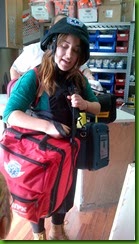
IMG_00003928 

It’s a lot of stuff to carry around, but the mobility and portability are the secret to United Hatzalah’s success.  In years of driving an ambulance, Beer says, he never successfully rescued a patient until he responded on foot to a call he’d overheard on a police scanner in his own neighbourhood… and actually saved a life for the first time.

Motorcycles, scooters and medics on foot are nimble in a city, a country, where being nimble can mean the difference between a response time of ten minutes (dead on arrival) or ninety seconds (good chance of resuscitation).

Command and control:  hand in hand

From the supplies room, we headed into Command Central – the hard-core control room from which United Hatzalah responds to nearly 200,000 calls a year. 

*** YOU CAN REACH UNITED HATZALAH WITH A CALL TO 1221 (no star) FROM ANY PHONE IN ISRAEL.

*** FOR MAGEN DAVID ADOM (regular ambulance), DIAL 101.

“Jews and Arabs don’t always get along,” says Beer.  But today, “hand in hand… Jews and Arabs are getting together for the purpose of saving lives.”  When Beer’s own father collapsed a few years ago, the first responder at his side was an Arab medic from East Jerusalem.

In addition to complex mapping software which can plot the arrival times of the five nearest United Hatzalah responders (which is calculated intelligently based on whether they’re coming on foot, by car or on a motorcycle!), our host pointed out the central computer which is hard-wired to Home Front Command, the central Israeli agency which sends out missile alerts.  If there is anything going on, anywhere in the country, these guys will know about it first.

IMG_00003931

The other cool thing is that if you have donated an ambucycle (and really, you must if you can!), they can find it for you anywhere, anytime.  Just punch in the number and their computers can tell you instantly where it is.

Because the rescue workers with United Hatzalah are all volunteers, the ambucycle essentially becomes their best friend – they take it with them everywhere they go.  The volunteers are essentially on duty 24/7 – yes, that’s 7 as in “seven days a week,” unlike a lot of other things in Israel, which are 24/6. 

Anytime, anywhere, they could get a call.  And no matter what they’re doing – our host told us about a time he was in shul on Simchas Torah and had to leave right before the big aliyah he’d paid a lot for – they drop everything and run.  (He said he also had a newborn baby at the time – but that doesn’t matter when you’re a United Hatzalah volunteer.)

When I mentioned that you’d have to have a pretty understanding employer, he told us about a United Hatzalah volunteer who worked as a delivery guy for a meat store.  The boss apparently started getting sick of not knowing when his employee would have to leave, abandoning his chicken deliveries (“He delivered chickens… he delivered babies.”).  But, since they were both religious people, the meat store owner consulted a rabbi who said that he may be losing a reliable delivery guy but he was gaining a half share in the zechut, the merit, of the lives that the delivery guy was saving.  The delivery guy kept his job.

Ambucycles save lives:  the too-scary-for-kids video

After our visit to Command Central, we went inside to watch a video about United Hatzalah and its activities. 

I’ll warn you now:  this video is too scary for children.  And maybe too creepy for adults. 

A father basically dies during his young daughter’s birthday party because the conventional ambulance can’t get to him on time.  Then, the scene is replayed, except he is saved by an ambucycle that arrives within 90 seconds of the call (based on an actual call to United Hatzalah).

Our host realized after the video started that the kids probably shouldn’t watch the guy (actor, but hey, they’re young kids) die, so he fast-forwarded to the triumphant ambucycle scene.  Nevertheless, they were both quite troubled afterwards. 

As with seemingly every event of this type, there were tasty pastries and soft drinks, and we were even presented with “swag” in the form of magnets, brochures and some nifty-cool United Hatzalah hats.

A country run on donations.

On our way out, we waved to “our” ambucycle, while I silently resolved never to drop in on the Command Centre to find out where it is at any given time.  The work these guys are doing is just too important to interrupt.

But that idea, of pandering to demanding American donors, got me thinking hard about the donor-recipient relationship between Israel and chutz la’aretz, which has gone on since even before the state itself was founded. 

A few weeks ago in my Hebrew film discussion class (what?  you didn’t know I was taking a film discussion class?), we explored this issue as part of the classic 1965 film Sallah Shabati (סאלח שבתי) (excerpt here, captions in French only), in which early pioneers are planting a forest.  When wealthy American donors drive up, their fancy-looking Israeli host hammers in a sign dedicating the forest as the “Birnbaum” forest.    But later, after they’re out of sight, he comes with a new sign proclaiming it to be the “Mrs. Pearl Sonnenschein” forest. 

image

“What can I do?” he asks.  “It’s tourist season.  They all want their own sign.”

Of Yissachar and Zevulun.

Modern Israel is littered with signs, acknowledging all the Birnbaums and Sonnenscheins, generous donors all, over the last century.  Before I came, I admit, I was more cynical about this phenomenon.  If they care so much about Israel, why don’t they move there?  I wondered. 

I still don’t have an answer to this question, but I don’t ask it so much anymore.

Now that I’m here, I’m grateful every time I see an ambulance going past with its dedication, whether from the Canadian Friends of Magen David Adom or from Australia, the U.S., or the United Kingdom.  I’m grateful for every hospital, clinic, and ambucycle bearing the name of somebody outside of Israel who cared deeply about the wellbeing of the people here.

Yeah, it would be incredible if everybody could come live here.  But as in the case of the chicken seller and his ambulance/delivery driver, the Torah speaks of the “Yissachar / Zevulun” relationship, in which one of these tribes (Yissachar / Issachar) worked hard to learn Torah, while the other (Zevulun / Zebulon) became sailors and traders to support them.

I am so, so grateful to our friend in Toronto, and everybody like her who – although they cannot live here – have taken on the role of Zevulun to those of us who are working hard, like Yissachar, to make this a liveable homeland.

Thanks to them, it is a safer home, where lives are saved in a way that respects the land’s holiness, the honour of all its inhabitants… and cashes in on the enterprising high-tech spirit that has made this the “Start-up Nation” we all know it can be at its best.

For more about the spirit behind United Hatzalah, I really recommend watching United Hatzalah founder Eli Beer’s TED Talks video, The Fastest Ambulance?  A Motorcycle.

Did I mention that United Hatzalah emergency responders, thousands of them, are all volunteers?  That they’re on duty 24/7?  That, Muslim or Christian or Jew or whatever, they will save your life for FREE if you ever need them?  Even if you can’t afford a whole ambucycle, do something today to help them out!!!

*** YOU CAN REACH UNITED HATZALAH WITH A CALL TO 1221 (no star) FROM ANY PHONE IN ISRAEL.

*** FOR MAGEN DAVID ADOM (regular ambulance), DIAL 101.

Eyfo HaSherutim? איפה השרותים?

bathroom klalitFeeling like a savvy Israeli doesn’t happen for me very often. 

Today, I took a page out of Batya’s book (okay, blog) when we were out and about in Nahariya.  Strange city, ambling around having a good time with friends from our pilot trip… when Naomi Rivka announced that she needed a bathroom.

(we only took Naomi Rivka – GZ stayed home with Elisheva, yay!)

And I looked up, and like the chorus out of Life of Brian (if you haven’t seen it, you must), there was the local Klalit (they spell it Clalit in English) health clinic.  Using Batya’s rationale, we ARE Clalit members and thus, sort of, “customers” of theirs. 

I also knew that the closest public alternative was the bus-station bathroom, which would almost certainly be sub-par, and also, possibly, be available only for a fee of 1 shekel.  I learned this the hard way in Afula, where you hand over your shekel to an apathetic guy behind a desk who does NOTHING, and then enter the most hideously filthy bathroom which – for ONE shekel! – lacks seats.  It’s like a third-world country, except you’re paying for the privilege.

So… why be a freyer (sucker) if you don’t have to be???  Into the Klalit clinic we went, marched up to the front desk, and asked for the sherutim (literally, services or facilities).  The bathroom wasn’t great (actually required a bit of cleaning before she could use it), but it was free and there was soap, warm water and towels to wash up with afterwards.  (No hand sanitizer!  I have yet to see a health or recreation facility here with hand sanitizer.  Weird, since it’s practically synonymous with these places outside of Israel.)

Anyway, there isn’t much that makes me feel confident these days, but being able to find my kid a bathroom the INSTANT she demands one (it really did just appear there, like a mirage) is one heck of a happiness-booster. 

Oh, yeah, and then we stopped at a sandwich shop and I showed everybody the extensive sandwich menu so they could deliberate before I took a call.  And then… when I turned back a few minutes later, realized I was the only one in the crowd (two were just starting ulpan) who could actually read the menu.  Oops! 

We skipped that joint – too expensive, too complicated – and found a falafel / shawarma place that only had two choices (falafel / shawarma, and half / whole).  Thoroughly yummy!

While wandering around Nahariya, we happened to find delightful store we found in Nahariya called Gan Li / גן לי.  Okay, it’s true, I have a fetish for anything school related, but this is actually the first decent, comprehensive, school-and-art-supplies shop we have seen since we got here.

For months, we’ve been buying binders in one store, a hole punch in another, a filler paper at another, and pencils and pens somewhere else entirely.  Gan Li even had Akiva’s artist ink, and some decent markers he can use for drawing with.  And some cheap (₪9) no-name highlighters for Naomi Rivka and magnet pens for our fridge (₪5 each).  It’s not that the prices were so fantastic, it’s the fact that everything was all in one place that I found so very exciting!

image Oooh!  Ever a sucker for fun new card games, I bought the game Sleeping Queens (note:  links point to the English Gamewright version; the Hebrew one is licensed by FoxMind), for ₪40-something instead of the ₪60-something in the big chain bookstores.  But that’s a subject for another post…

All in all, a nice day spent with nice new friends in Nahariya.  And it was nice travelling home in comfort instead of sitting cross-legged on the bus all the way back (meandering every which way down the coast and through Acco) wondering where I’d find the nearest bathroom.  I’m Israeli; I already know!!!

Google